When outsourcing software development, describing the normal workflow may leave implementation questions unanswered. Can an approved order be changed? If mandatory data is missing, who can provide it? For offshore projects serving Japan, TECHNEST proposes turning these exceptions into concrete scenarios before implementing a feature. The aim is to agree on the behavior and identify who makes the decision.
Start with one workflow that branches
Choose a workflow close to everyday operations, such as order creation, approval or invoicing. Walk through it with the business owner and ask at each step: what would stop the process, send it back or transfer it to someone else? Record work currently done outside the system too. You do not need to expand the entire scope at once. Prioritize points affecting money, approval authority and data status.
Replace broad questions with a scenario table
Each scenario should record the initial state, acting role, triggering condition, expected result and open questions. “An employee changes the quantity on an approved order” is clearer than “allow order editing.” Establish whether the action should be blocked, create a new version or require approval again. These are options for the customer to decide, not requirements that have already been accepted.
Separate agreed rules from assumptions
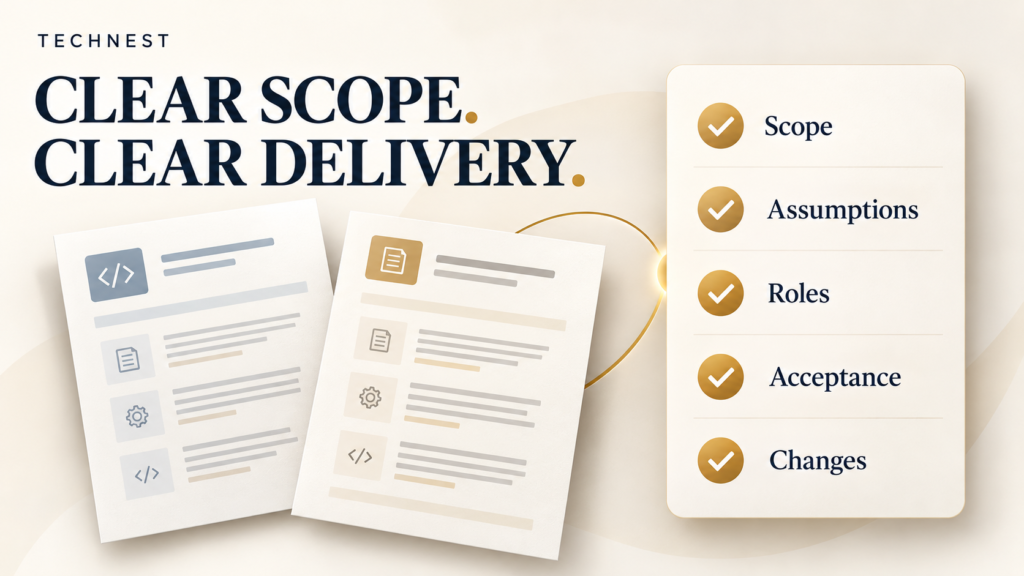
Mark each item as confirmed, assumed or awaiting a decision, with an answer owner and a date when the answer is needed. In Japan–Vietnam collaboration, retain the original business terminology alongside explanations and sample data. After the meeting, share your understanding as a complete scenario. The business owner confirms its meaning; the language contact supports communication rather than making business decisions on their behalf.
Connect decisions to acceptance criteria
Once a rule is agreed, link it to the relevant requirement, screen or process and test scenario. State the conditions, action and observable result: which message appears, whether the status changes and which roles can still act. If a decision arrives after implementation, assess its effect on design, testing, effort and delivery dates before revising the plan with the customer.
Hypothetical example: changing quantity after approval
A Japanese SIer commissions a Vietnamese team to build a purchasing system. The initial document only describes editing before approval. The scenario table reveals that the handling of changes after approval still needs a decision. Suppose the business owner chooses a change request followed by reapproval. The development team then adds the corresponding design and tests. This is an illustrative scenario, not a description of a TECHNEST project or actual results.
Clarify requirements with TECHNEST before development
Drawing on years of collaboration with the Japanese market, business system design and legacy modernization, TECHNEST focuses on clarifying how software supports real work. You can start a discussion with a workflow that still raises questions, a sample screen and a list of decision owners. Explore our DELIVERY service or talk to TECHNEST about a collaboration approach suited to your project.