



Software Maintenance is essential for keeping business systems stable, secure, and efficient in the digital era. As technology evolves, regular maintenance helps prevent errors, improve performance, and ensure compatibility with new platforms. Software Maintenance also supports system optimization, enhances user experience, and ensures continuous business operations.
What is Software Maintenance?
This concept is not merely about fixing bugs when a system encounters issues. It is a comprehensive technical process aimed at modifying, updating, and optimizing the system after delivery. To understand its nature more deeply, we need to examine its standard definition and core objectives.
Standard Industry Definition
Software Maintenance is a set of activities involving the modification of source code, documentation, and system configurations after the product has been released to users. This process ensures the application remains stable, secure, and meets real-world demands.
Core Objectives of the Process
- Maintain Continuity: Ensuring the system operates 24/7 without interruption.
- Correct Errors: Thoroughly fixing logic bugs and emerging security vulnerabilities.
- Upgrade Features: Updating technology to avoid falling behind competitors.
- Optimize Resources: Reducing storage capacity and increasing data processing speeds.
Why Software Maintenance is Necessary
Many businesses mistakenly believe that software is permanently “finished” once programming is complete. In reality, the technological environment and user needs fluctuate constantly. Ignoring this step leads to serious consequences for the system structure.
- Hardware Evolution: Computers, phones, and servers are constantly upgrading to new hardware.
- Operating System Updates: New versions of Windows, iOS, and Android can cause old code to experience system conflicts.
- Changing Legal Policies: Regulations on data security, tax, and accounting require software to update its calculation formulas.
- Market Competitive Pressure: Businesses must add new features to retain existing customers.
Types of Software Maintenance
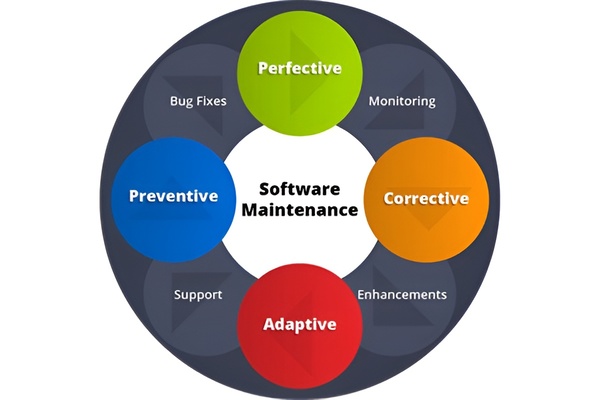
Each type of technical intervention addresses a specific group of issues within the product lifecycle. Classification helps engineers clearly define goals and source code approaches. There are four basic types commonly applied today:
1. Corrective Maintenance
This type focuses on detecting and fixing bugs that arise during actual user operation. These include system logic errors, interface design flaws, or data processing inaccuracies.
2. Adaptive Maintenance
This type helps the software remain compatible with new operating environments. When there are changes in operating systems, cloud platforms, or third-party services (APIs), engineers must modify the source code to ensure the system does not become obsolete.
3. Perfective Maintenance
This type focuses on enhancing performance and user experience even when the software has no errors. Activities include optimizing page load speeds, refactoring source code, and improving the interface to be more intuitive.
4. Preventive Maintenance
This is a proactive inspection activity to prevent potential future incidents. Engineers analyze source code, detect latent security weaknesses, and upgrade the system before hackers have the opportunity to attack.
Pros and Cons of Software Maintenance
Every technical activity brings benefits alongside specific management challenges. Understanding both sides helps businesses balance their resources effectively.
Outstanding Advantages
- Extend Software Lifespan: Helps businesses utilize legacy systems for many more years without the need to build from scratch.
- Enhanced Security: Timely patching of vulnerabilities to strictly protect business data.
- Long-term Cost Savings: Fixing minor bugs is significantly cheaper than recovering from a catastrophic system crash.
- Improved Brand Reputation: Customers consistently experience a smooth and professional application.
Disadvantages and Challenges
- High Personnel Costs: Requires a team of engineers with deep expertise in legacy system architecture.
- Risk of New Bugs: Modifying old code can unintentionally break related features.
- Time-consuming Research: Developers must read through millions of lines of code written by others previously.
Software Maintenance Process
A standardized process helps control code quality and avoids the risk of crashing the current system. This process typically consists of six strictly integrated steps:
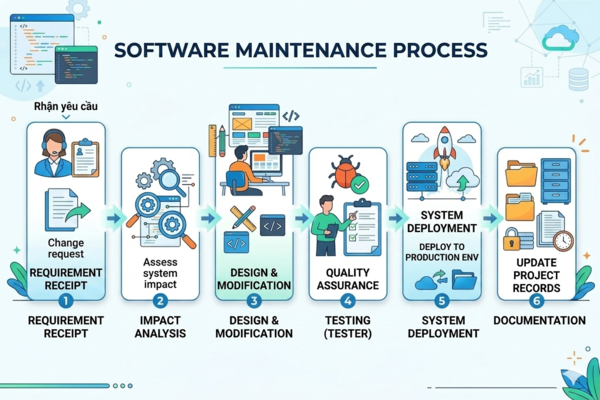
[Requirement Receipt] ➔ [Impact Analysis] ➔ [Design & Modification] ➔ [Testing] ➔ [System Deployment] ➔ [Documentation]
- Requirement Receipt: Collect bug reports or new feature proposals from users.
- Impact Analysis: Evaluate how the modifications will affect other parts of the system.
- Design and Modification: Developers proceed with coding and optimizing the source code according to requirements.
- System Testing: The Testing team runs trials to ensure no new bugs are introduced.
- Deployment and Handover: Update the new version onto the live server (Production).
- Documentation: Update the changelog to track the programming history.
Software Maintenance Support Tools
To optimize time and accuracy, engineers must utilize specialized toolsets. These tools automate many complex inspection stages.
- Source Code Management (Git): GitHub and GitLab help track code revision history and restore data in case of errors.
- Bug Tracking: Jira, Trello, and Redmine help distribute debugging tasks to individual developers.
- Automation Testing: Selenium and JMeter facilitate the rapid execution of thousands of automated error scenarios.
- Static Code Analysis: SonarQube helps detect “dead code” (code smell) and provides early warnings for security vulnerabilities.
Importance of Periodic Software Maintenance
Periodic maintenance is like regular vehicle servicing; it helps detect damages before the vehicle stops running. This is a vital factor determining the success or failure of a digital enterprise.
- Preventing Financial Loss: For banking or e-commerce systems, a single minute of downtime can result in billions of losses.
- Protecting Customer Data: Avoiding the leakage of personal information, identities, and credit card details to the black market.
- Maintaining Processing Speed: Ensuring the system does not slow down or lag during sudden traffic spikes.
- Ensuring Legal Compliance: Timely fulfillment of strict national and international security standards.
Software Maintenance Costs
A surprising reality is that the cost of this phase is often significantly higher than the initial development cost. Businesses need to clearly understand the cost structure for long-term budgeting.
- Budget Allocation: Maintenance costs typically account for 60% to 80% of the total software lifecycle budget.
- Factors Affecting Cost:
- Code Complexity: Poorly written code without documentation will cost twice as much to fix.
- System Lifespan: The older the software and the more obsolete the technology, the more expensive it is to find experts.
- Personnel Skills: Hiring a professional team comes with a high price tag but ensures fast and thorough error resolution.
Frequently Asked Questions (FAQs)
Below is a summary of the most common concerns of business owners when operating technological systems.
How often should maintenance be conducted? Security checks should be performed weekly, performance optimization monthly, and major upgrades quarterly.
Should we perform in-house maintenance or outsource? For small businesses, outsourcing saves on fixed personnel costs. For large corporations holding core data, an in-house team is recommended for absolute security.
Why does software encounter errors even when not in use? Due to external environmental factors such as web browser updates, search algorithm changes, or server configuration shifts, which render the old code incompatible.
Does maintenance disrupt business operations? By applying modern CI/CD (Continuous Integration/Continuous Deployment) processes, engineers can update the system at night or run parallel servers so that users experience zero disruption.
Software maintenance is a strategic activity that helps businesses optimize performance, patch security holes, and adapt to new technologies. Investing in this process ensures continuous operations, minimizes security risks, and saves on the costs of building new systems. This is the solid foundation for maintaining a competitive advantage in the digital era.
