


In the increasingly complex world of DevOps, system monitoring is no longer optional but has become a mandatory requirement. Engineering teams need to know exactly what is happening inside their systems in real time-from CPU load, request volume, and latency, to the status of each microservice. This is the exact problem that Prometheus was born to solve.
What is Prometheus?
Prometheus is an open-source monitoring system and alerting toolkit originally developed by SoundCloud in 2012. In 2016, Prometheus became the second project to be accepted by the Cloud Native Computing Foundation (CNCF), second only to Kubernetes. Today, Prometheus is considered the industry standard for monitoring cloud-native and microservices systems.
The core difference between Prometheus and traditional monitoring tools lies in its data collection model. Instead of having applications “push” metrics to a centralized server, Prometheus actively “pulls” (scrapes) data from predefined endpoints at specific time intervals. The collected data is in the form of time-series-meaning sequences of numerical values marked with timestamps and metadata labels, allowing for flexible querying and multi-dimensional analysis.
Prometheus uses its own query language called PromQL (Prometheus Query Language)-a powerful language that allows users to filter, aggregate, and represent metric data in various ways. Thanks to PromQL, engineering teams can build complex charts, set up intelligent alerting thresholds, and analyze system trends effectively.
How does Prometheus work?
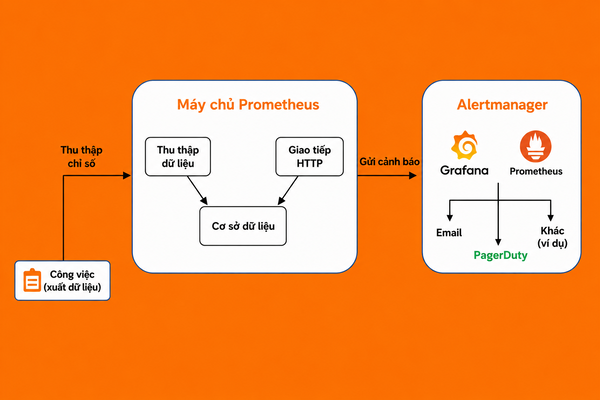
To understand how Prometheus operates, imagine a continuous and systematic loop. Every configured interval (usually 15–30 seconds), the Prometheus server sends an HTTP request to the /metrics endpoints of each registered target. These targets can be web applications, databases, physical servers, or any service that has integrated a Prometheus library or a corresponding exporter.
The received data consists of text lines in a standard format, for example:
http_requests_total{method=”GET”, status=”200″} 1027
http_requests_total{method=”POST”, status=”500″} 3
Each line contains a metric name, a set of labels inside curly braces, and the corresponding numerical value. Prometheus stores all of this data into an internal time-series database with the timestamp of the scrape time. Over time, millions of these data points form rich historical sequences-the foundation for performance analysis, anomaly detection, and resource forecasting.
In parallel with scraping, Prometheus continuously evaluates defined recording rules and alerting rules. When an alert condition is triggered, Prometheus sends a notification to Alertmanager to process and distribute it to the correct receiving channel-email, Slack, PagerDuty, or any other webhook.
Prometheus Architecture
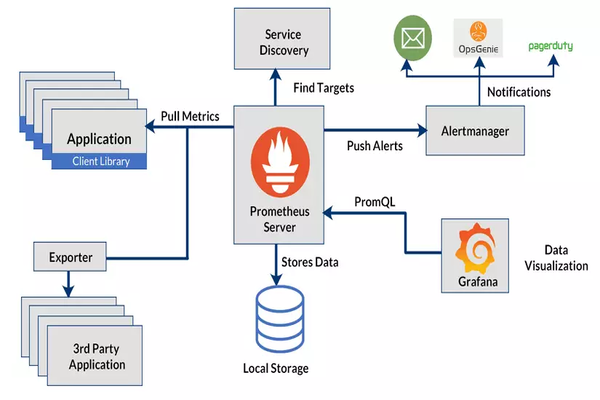
The architecture of Prometheus is designed to be modular and decentralized, where each component handles a distinct role yet collaborates closely with the others. In a properly deployed system, no single component acts as a single point of failure. Let’s dive deep into each component that makes up the Prometheus ecosystem.
Client Libraries
Client Libraries are the starting point of the entire monitoring pipeline. These are libraries embedded directly into the application’s source code, allowing developers to define and expose custom metrics to the /metrics endpoint. Prometheus officially supports libraries for Go, Java, Python, Ruby, and many other languages through the open-source community. With Client Libraries, developers can track any business metric-from the number of processed orders and the response time of each API endpoint, to the number of cache hits/misses in the system.
Exporters
You cannot always modify the source code of the application you want to monitor-especially with third-party software like MySQL, Redis, Nginx, or the Linux operating system. This is where Exporters come into play. Exporters are intermediary programs running alongside the target application; they collect metrics from available interfaces (APIs, system files, system commands…) and then convert them into the standard Prometheus format. Node Exporter is the most common example, providing hundreds of metrics regarding CPU, RAM, disk I/O, and network of a Linux server with just a simple startup command.
Service Discovery
In dynamic environments like Kubernetes or the cloud, the list of instances that need monitoring changes constantly-containers are created and destroyed by the second. Manually configuring each target is virtually impossible. Service Discovery solves this problem by allowing Prometheus to automatically detect new targets through integration with the Kubernetes API, Consul, EC2, Azure, GCP, and many other platforms. When a new Kubernetes pod is created with the appropriate annotation, Prometheus will automatically add it to the scrape list without requiring any manual intervention.
Scraping
Scraping is the heart of Prometheus-the process where the server periodically sends HTTP GET requests to each target and collects the returned metrics. Each successful scrape creates a snapshot of the system state at that specific moment. Prometheus also stores metadata about the scrape process itself, such as up (whether the target is online) and scrape_duration_seconds (how long the scrape took), helping operations teams early detect slow or down targets. The interval between scrapes can be flexibly adjusted from a few seconds to several minutes, depending on accuracy requirements and system load.
Storage
Prometheus utilizes a custom time-series database specifically optimized for monitoring workloads-fast writes, efficient compression, and extremely quick time-range queries. Data is organized into time blocks, where each block contains data from a specific time interval along with an index that allows fast searching by labels. A Write-Ahead Log (WAL) ensures that data is not lost during sudden server restarts. By default, Prometheus stores data locally for 15 days-which is sufficient for most daily operational needs.
Dashboards
Metric data does not hold much value if it is not visualized effectively. Prometheus comes with a simple built-in Expression Browser interface that allows running PromQL queries and viewing results in table or graph formats. However, in practice, most engineering teams combine Prometheus with Grafana-the most powerful dashboard tool in the cloud-native ecosystem. Grafana connects directly to Prometheus as a data source and enables the building of complex dashboards with various types of charts, tables, gauges, and alert panels, all of which can be shared and reused across the entire organization.
Recording Rules & Alerting Rules
Recording Rules allow for the precomputation of complex PromQL expressions and store the results as new time-series. Instead of recalculating a complicated aggregation every time a dashboard loads, the result is periodically calculated in advance, significantly reducing query response times. Alerting Rules operate on a similar principle-defining a PromQL condition and a duration threshold (for duration). An alert is only triggered when the condition is continuously met throughout that entire timeframe, avoiding false alarms caused by temporary spikes.
Alert Management
Alertmanager is a standalone component dedicated to handling alerts sent by Prometheus. It provides sophisticated features that the Prometheus server lacks: grouping (combining multiple related alerts into a single notification), routing (sending the right alert to the right person/team), silencing (temporarily muting alerts during maintenance windows), and inhibition (suppressing secondary alerts when a primary alert has already been triggered). Alertmanager supports built-in integration with Slack, PagerDuty, OpsGenie, email, and many other notification channels via a flexible webhook.
Long-Term Storage
The 15-day local storage limit of Prometheus poses a challenge when it comes to long-term trend analysis or meeting compliance regulations. Prometheus addresses this issue through its Remote Write API-allowing data to be simultaneously written to external storage systems. Common solutions include Thanos (open-source, utilizing object storage like S3), Cortex (distributed, multi-tenant), VictoriaMetrics (high-performance, low-resource), and various other managed services. With this architecture, you can store years of metric data while still maintaining fast querying capabilities.
When to Use Prometheus
Prometheus is not a one-size-fits-all solution, but it is the optimal choice for a wide range of common scenarios in modern DevOps.
Kubernetes and Microservices Environments: This is Prometheus’s “home turf.” When a system consists of dozens to hundreds of services running on Kubernetes, the automatic Service Discovery capabilities and the pull-based model of Prometheus become absolute advantages. Kubernetes even offers the Prometheus Operator-a way to deploy and manage Prometheus entirely declaratively through Custom Resource Definitions (CRDs).
Intelligent and Reliable Alerting: Prometheus and Alertmanager form the perfect pair. With the ability to define alerting thresholds based on historical data, calculate error rates, or detect anomalies via PromQL, operations teams can build an alerting system that is highly responsive yet does not cause “alert fatigue.”
When to Consider Other Solutions: Conversely, you should consider alternative solutions if:
- You need log monitoring (Prometheus only handles numerical metrics, not logs-use Loki or Elasticsearch for logs instead).
- Your applications run in unstable environments where Prometheus cannot guarantee continuous scraping.
Prometheus is the backbone of the modern observability stack. Its simplicity in setup, the power of PromQL, and a rich ecosystem with hundreds of available exporters make it an indispensable tool for any DevOps team serious about understanding and controlling their systems.
