



In the era of digital transformation, cloud computing has become the “backbone” of all business operations, from startups to multinational corporations. Among the giants providing these services, Google Cloud Platform (GCP) emerges as a powerful ecosystem, inheriting the entire elite infrastructure that Google built to run Search, YouTube, and Gmail.
What is Google Cloud Platform (GCP)?
Google Cloud Platform (GCP) is a collection of cloud computing services provided by Google, running on the same infrastructure that Google uses internally for its consumer products. Put simply, instead of having to purchase physical servers and build expensive data rooms yourself, GCP allows you to “rent” computing resources remotely.
The birth of GCP marked a major turning point, helping businesses access leading technologies such as Machine Learning, AI, and Big Data without requiring excessive initial capital investment. With hundreds of diverse services, GCP is not just a storage location but a comprehensive development environment.
How Google Cloud Platform Works
Google Cloud Platform operates based on a massive network of data centers distributed globally. When you use GCP, your resources are virtualized and distributed across Zones and Regions to ensure the highest level of availability.
The operational mechanism of GCP focuses on flexibility: you simply select your desired configuration via the Console interface or Command Line Interface (CLI), and the system automatically allocates resources within seconds. All these resources are connected via Google’s private fiber-optic network, ensuring high speeds and ultra-low latency.
Outstanding Advantages of Google Cloud Platform
Why do businesses prioritize Google Cloud Platform (GCP) over other competitors? The answer lies in the specific advantages that only the Google ecosystem can provide.
- Speed and Performance: Google’s private network is one of the largest in the world, helping data move faster.
- Cost Optimization: GCP applies a “Pay-as-you-go” policy and offers Committed Use Discounts for customers who pledge long-term usage.
- Top-tier Security: With hundreds of security experts working continuously, your data is encrypted in all states: both at rest and in transit.
- Leading Data Analytics: Google leads the way in AI and Big Data (with tools like BigQuery), helping businesses extract value from data with ease.
Limitations of Google Cloud Platform
Despite its power, GCP is not without its drawbacks. Understanding these limitations helps businesses develop appropriate deployment roadmaps and prepare effective backup plans.
The biggest downside often lies in its complexity. With so many specialized services, beginners may feel overwhelmed. Additionally, compared to AWS (Amazon Web Services), GCP has fewer data centers in certain specific geographic regions, and while its support community is large, it is still in the process of catching up with the market’s number one competitor.
Key Tools of Google Cloud Platform
To meet diverse needs, Google Cloud Platform (GCP) categorizes its services into three main models. Each model serves a different purpose, ranging from providing raw resources to finished software.
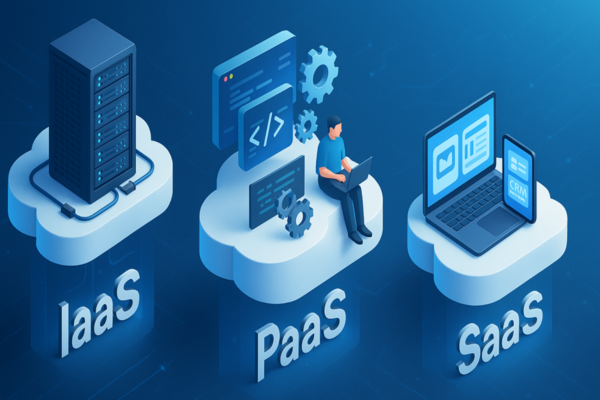
IaaS (Infrastructure as a Service)
This is the most fundamental layer, where GCP provides virtual machines (Compute Engine), storage (Cloud Storage), and networking. Users have full control over the operating system and virtual hardware configuration, making it suitable for migrating legacy systems to the cloud.
PaaS (Platform as a Service)
With App Engine, GCP provides a complete environment for developers to deploy code without worrying about server management. Everything from scaling to system maintenance is automated by Google.
SaaS (Software as a Service)
Google Cloud also integrates closely with software applications like Google Workspace. Here, users simply use the end product via a browser without needing to install or manage any underlying infrastructure.
Google Cloud Platform Certifications
In the IT labor market, possessing GCP certifications serves as a “gold standard” proof of professional competence. Google provides a structured training roadmap ranging from foundational to expert levels.
Popular certifications include the Associate Cloud Engineer for beginners, and Professional certifications such as Cloud Architect, Data Engineer, or Cloud Security Engineer. Obtaining these certifications not only boosts individual career advancement but also helps businesses solidify their credibility with clients when executing Cloud projects.
How to Implement Google Cloud Platform
The GCP implementation process should be carried out through strategic steps to avoid resource wastage and ensure data security.
- Define Objectives: First, businesses need to identify their goals: Data storage, running web applications, or Big Data analytics?
- Setup Hierarchy: The next step involves setting up the “Organization” and “Project” structures on the Google Cloud Console.
- Infrastructure Configuration: Engineers will then establish the network infrastructure (VPC), manage access permissions (IAM), and begin deploying specific services.
- Professional Management: The use of Infrastructure as Code (IaC) tools like Terraform is highly recommended for professional resource management.
Notable Applications of Google Cloud Platform
Thanks to its massive data processing capabilities and AI, GCP has been widely applied across various fields, delivering breakthrough efficiency.
- E-commerce: Utilizing AI for personalized product recommendations and automated inventory management.
- Finance: Detecting fraudulent transactions in real-time through Machine Learning.
- Healthcare: Storing and analyzing human genomes or medical imaging with ultra-large capacities.
- Gaming: Operating multiplayer games with ultra-low latency thanks to its global network infrastructure.
Google Cloud Platform Competitors
In the Cloud Computing market, GCP is part of the “Big Three” alongside two massive rivals. This race drives cloud technology to evolve faster than ever.
- Amazon Web Services (AWS): The market leader with an extensive service portfolio and the largest community.
- Microsoft Azure: The strongest competitor in the enterprise sector due to seamless integration with the Windows and Office ecosystem.
GCP chooses a distinct path by focusing on its strengths in “Open Source” (such as Kubernetes) and “Data Analytics,” creating a unique identity that attracts tech companies and startups.
Frequently Asked Questions about Google Cloud Platform
Finally, let’s address some common questions that users often encounter when exploring this ecosystem.
- Is GCP secure? Yes, GCP complies with the world’s most stringent security standards, such as ISO 27001, SOC 2/3, and HIPAA.
- Do I need to know programming to use GCP? It depends on the service. With Cloud Storage, you don’t need to code, but with App Engine or Cloud Functions, programming knowledge is mandatory.
- How is GCP pricing calculated? GCP charges by the second for most services, meaning you only pay for the actual time the resources are active.
Google Cloud Platform (GCP) is not just a tool, but a technological lever that helps businesses break through. We hope this article has provided you with a comprehensive and insightful overview of this powerful cloud ecosystem.
