



In the era of digital transformation, optimizing infrastructure and minimizing operational costs are top priorities for every business. FaaS (Function as a Service) has emerged as a revolution in how we build and deploy software. By eliminating the worries of complex server management, FaaS allows developers to focus entirely on the core value: the Code.
What is FaaS (Function as a Service)?
FaaS is a type of cloud computing service that allows customers to develop, run, and manage application functionalities without building and maintaining the infrastructure typically associated with developing and launching an app. In essence, FaaS is an event-driven architecture where code snippets (functions) execute only when triggered by a specific event.
FaaS is the core component of the Serverless concept. When using FaaS, you don’t need to worry about the operating system, memory, or CPU of the underlying physical server. Cloud providers (such as AWS, Google Cloud, or Azure) handle all resource management, auto-scaling, and system maintenance. This significantly shortens the Time-to-market from idea to product launch.
How does FaaS work?
The operational mechanism of FaaS is entirely different from traditional models. Instead of running an application continuously on a server, FaaS breaks the application down into independent functions. To better understand the workflow from code deployment to execution, let’s look at the following steps:
- Write and Deploy Source Code: Developers write code for a specific function (e.g., image processing, sending emails) and push it to the FaaS platform.
- Set up Triggers: You define an event that will cause the function to run. This could be an HTTP request, a new file uploaded to storage, or a notification from a message queue.
- On-Demand Execution: When the event occurs, the FaaS provider initializes a temporary container, loads the source code, and executes the function.
- Resource Release: Immediately after the function completes its task, the container is destroyed. Resources are fully released, and you stop paying fees.
Key Characteristics of FaaS
To distinguish FaaS from other cloud services, we need to look at its unique technical properties. FaaS embodies flexibility and ephemerality, making it a powerful tool for modern systems. Below are its most important characteristics:
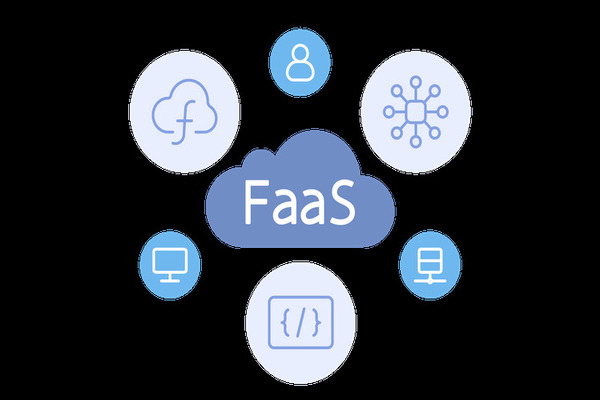
- Server Abstraction: The underlying infrastructure is completely invisible to users, who are not required to manage it.
- Ephemeral Execution: FaaS functions are designed to run quickly and terminate promptly. They are stateless between invocations.
- Auto-scaling: If there are 1,000 concurrent requests, the system automatically creates 1,000 function instances to handle them without manual configuration.
- Pay-per-use: You only pay for the execution time—measured in milliseconds—and the actual volume of resources the function consumes.
Advantages of FaaS
Why has FaaS become a global trend? The answer lies in the economic and technical optimization it provides. For both startups and large corporations, FaaS offers superior benefits that boost engineering productivity.
- Maximum Cost Savings: You don’t have to pay for server “idle time.” If there are no users, the cost is zero.
- Focus on Development: Developers no longer have to perform operations (Ops) tasks like OS patching or network configuration.
- Infinite Scalability: FaaS responds exceptionally well to sudden spikes in load (e.g., massive sales on e-commerce platforms) without the risk of system crashes.
- Rapid Updates and Deployment: You can update individual functions independently without having to restart the entire monolithic application.
Disadvantages of FaaS
Despite its power, FaaS is not a “silver bullet” for every problem. There are technical and administrative hurdles that businesses must carefully consider before deciding to fully migrate to this model.

- “Cold Start” Issues: If a function hasn’t been used for a while, the first invocation will experience latency because the provider needs time to initialize the environment.
- Debugging and Testing Difficulties: Simulating a FaaS environment locally is highly complex, making bug hunting more challenging.
- Vendor Lock-in: Each provider (AWS Lambda, Google Cloud Functions) has its own APIs and configurations, making platform migration labor-intensive.
- Execution Time Limits: Most FaaS functions are only allowed to run for a maximum of a few minutes (typically 15 minutes), making them unsuitable for heavy, long-running processing tasks.
Comparing FaaS with Other Models
To choose the right tool, you need to understand where FaaS sits within the cloud computing ecosystem. Each model offers its own advantages depending on the level of infrastructure control you desire.
| Model | Concept | Key Characteristics | Difference from FaaS |
|---|---|---|---|
| Serverless | The concept of serverless computing | Includes FaaS along with services like serverless storage and databases | FaaS is just one component, specialized in executing code by function |
| PaaS | Platform as a Service | Runs complete applications; instances operate continuously | FaaS runs by individual functions and scales on demand |
| IaaS | Virtual server infrastructure | Full control over the operating system and resources | FaaS completely hides the server; no infrastructure management required |
| Containers | Application packaging environment | Runs long-term processes; requires orchestration | FaaS runs short-term and does not require container management |
Common Applications of FaaS
FaaS is exceptionally effective at handling discrete, event-driven tasks or those requiring rapid scaling. Here are real-world scenarios where FaaS is transforming software system operations:

- Backend for Web and Mobile Apps: Instead of building a bulky backend server, you can use FaaS to handle APIs. Each endpoint (e.g., /login, /get-profile) becomes a separate FaaS function, making the system lightweight and easy to maintain.
- Real-time Data Processing: FaaS excels at processing streaming data. When data flows in from IoT sensors or system logs, a FaaS function automatically triggers to analyze, filter, and store that data in a database instantly.
- Scheduled Tasks: Instead of maintaining a server just to run daily Cron jobs, you can set up FaaS to automatically run tasks like database cleanup, data backups, or sending email reports at a fixed time.
- Chatbots and Virtual Assistants: Every time a user sends a message to a chatbot, it is an event. FaaS receives the message, processes natural language, and responds to the user. You only pay for the exact number of messages the bot processes.
- IT Automation: FaaS acts as the “glue” connecting cloud services. For example, when a new account is created, FaaS can automatically create storage folders, assign access permissions, and send a welcome email without manual intervention.
- Multimedia Processing: A classic FaaS use case is file processing. When a user uploads a video, FaaS is triggered to compress it, generate thumbnails, or convert formats into different resolutions (360p, 720p, 1080p).
- Authentication and Authorization: You can use FaaS as an intermediary security layer to verify tokens or user permissions before granting access to critical system resources.
FaaS is not just a technology; it is a new mindset for building software. While limitations like “Cold Start” or debugging challenges remain, the benefits in terms of cost and development speed are undeniable. FaaS represents the future, bringing us closer to the ultimate goal: focusing solely on source code and business value.
