


In the era of digital transformation, ensuring the stable and continuous operation of information technology systems is a vital requirement for every business. Datadog has emerged as one of the world’s leading monitoring and analytics platforms, trusted by thousands of organizations of all sizes to track system performance in real-time. The article below will provide a comprehensive look at Datadog-from basic concepts, outstanding features, and how it works, to its practical applications in enterprises.
What is Datadog?
Datadog is a cloud-based monitoring and analytics platform founded in 2010 by Olivier Pomel and Alexis Lê-Quôc in New York, USA. Born with the goal of solving the problem of complex system observability in cloud and microservices environments, Datadog quickly became an indispensable tool in the DevOps and SRE (Site Reliability Engineering) toolkits of many global enterprises.
In essence, Datadog is a SaaS (Software as a Service) solution that allows engineering teams to collect, store, visualize, and alert based on metrics, logs, and traces data from across the entire technology infrastructure. Instead of having to use multiple disparate tools for different tasks, Datadog integrates everything into a unified platform, giving engineering teams a 360-degree view of the entire system within a single interface.
The core strength of Datadog lies in its comprehensive observability-also known as “full-stack observability.” Moving beyond just monitoring physical servers or virtual machines, Datadog extends its monitoring scope to containers, Kubernetes, serverless functions, databases, web applications, and even end-user experience. This is why Datadog is chosen by major technology corporations such as Samsung, Airbnb, Peloton, and thousands of other companies as their core monitoring solution.
Outstanding Features of Datadog
Datadog integrates multiple features into a single platform, eliminating the need for engineering teams to use multiple disparate tools. Below are the three most notable main feature groups.
System Monitoring
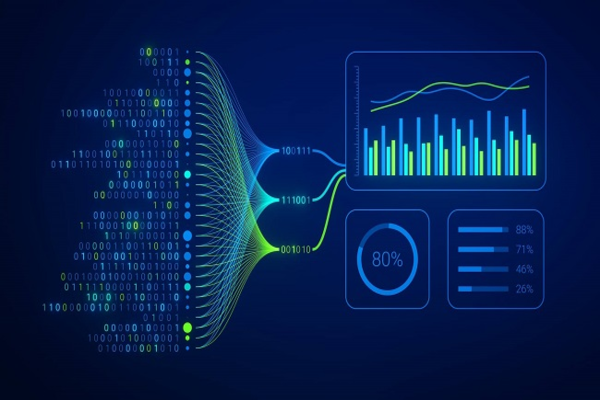
Datadog allows real-time tracking of the entire infrastructure-from CPU, RAM, and network bandwidth to the status of each individual service-all displayed on a single dashboard that is easily customizable to the needs of each team.
Beyond infrastructure, the APM feature helps track application performance at the individual request level. Engineers can trace a request across multiple microservices to pinpoint exactly where the slowdown occurs. Log Management is also built-in, helping to aggregate and analyze logs from all sources into one place.
Automation and Alerting
Instead of just alerting when fixed thresholds are exceeded, Datadog uses machine learning algorithms to detect anomalies and forecast trends. The system can recognize early signs of instability before an actual incident occurs.
The Watchdog feature automatically scans the system to detect potential issues. When an incident happens, Incident Management supports the entire resolution workflow-from assigning responsibilities to remediation-helping to shorten recovery time.
Integration and Expansion
Datadog supports over 700 integrations with popular platforms like AWS, Azure, Google Cloud, along with hundreds of other DevOps tools and databases. Connecting usually takes only a few simple configuration steps.
With diverse APIs and SDKs, engineering teams can also build their own custom integrations. The Datadog Marketplace is a place where the community shares self-created dashboards, monitors, and integrations-making the ecosystem increasingly rich.
Practical Applications of Datadog
Datadog is widely used in both software operations and software development. Below are the two most common practical applications.
System Management
When an incident occurs, instead of having to log into each individual server to check, engineers can view the entire system overview on a single screen and correlate data from multiple sources simultaneously, helping to find the root cause much faster.
With container and Kubernetes environments, Datadog automatically detects new containers, collects metrics and logs from them, and provides specialized dashboards to monitor cluster status without requiring manual configuration.
Application Development
The Continuous Profiler feature helps developers find the exact lines of code consuming the most resources right within the production environment, thereby enabling optimization based on real data instead of guesswork.
Real User Monitoring (RUM) allows for tracking the actual end-user experience-such as page load speeds, occurring errors, and navigation behavior-and connects it directly with backend data. As a result, when there is negative feedback from users, the development team can trace the cause from end to end without having to switch between multiple different tools.
How Does Datadog Work?
Datadog’s architecture revolves around a core component called the Datadog Agent-a lightweight software installed on the servers or containers that need to be monitored. This Agent continuously collects metrics, logs, and traces from the systems, applications, and running services, then encrypts and sends all the data back to the Datadog cloud platform via a secure HTTPS connection.
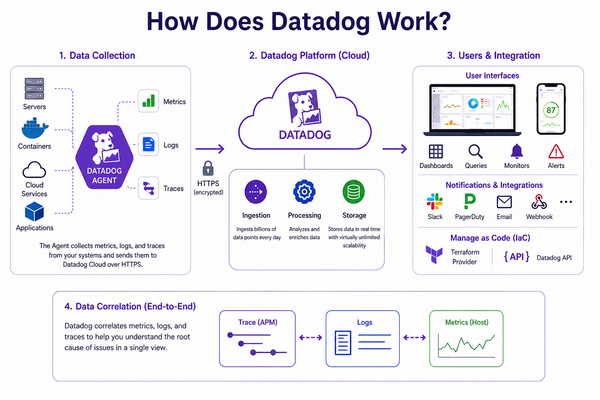
Once the data reaches Datadog’s cloud platform, the system processes, indexes, and stores it in real-time with virtually infinite scalability. Datadog utilizes a distributed architecture with multiple processing layers: the ingestion layer receives billions of data points daily, the processing layer analyzes and enriches the data, and the storage layer retains the data with flexible retention policies ranging from a few days to several years depending on the configuration.
Users interact with Datadog through an intuitive web interface or mobile app. Here, they can build custom dashboards, write queries to explore data, configure monitors, and set up notification channels such as Slack, PagerDuty, email, or webhooks. This entire configuration can be managed as code via the Terraform provider or Datadog API, aligning perfectly with modern Infrastructure as Code (IaC) practices.
A special aspect of Datadog’s design is its continuous data correlation capability-an APM trace can be linked directly to its corresponding logs and the metrics of the host running that service. Thanks to this, when investigating an incident, engineers do not need to switch back and forth between multiple tools; they can start from any symptom and drill down deeply within the exact same interface.
Frequently Asked Questions About Datadog
Is Datadog suitable for small businesses? Datadog offers various pricing plans, including a free tier for small teams with a limited number of hosts. However, costs can escalate quickly as the system scales. Small businesses should carefully evaluate their actual needs before signing up for paid plans.
Does Datadog support on-premise deployment? Datadog is primarily a cloud service (SaaS). Although the Agent can run in on-premise and private cloud environments, the collected data still needs to be sent to Datadog’s cloud infrastructure for processing. Enterprises with strict data residency requirements should thoroughly review Datadog’s data storage policies before deployment.
How does Datadog differ from Prometheus and Grafana? Prometheus and Grafana are open-source tools commonly used together. While Prometheus focuses on metrics and Grafana on visualization, Datadog is an all-in-one platform that natively integrates metrics, logs, traces, APM, and much more into a single product. Choosing between the two approaches depends on your capability to self-manage infrastructure, budget, and system complexity.
How does the Datadog Agent affect system performance? The Datadog Agent is designed to consume minimal resources-typically under 1% CPU and around 100–200MB of RAM. This is an insignificant impact on most modern production systems.
Is data in Datadog secure? Datadog complies with multiple international security standards such as SOC 2 Type II, ISO 27001, PCI DSS, and HIPAA. All data is encrypted in transit (TLS) and at rest (AES-256), while also supporting granular role-based access control (RBAC) features.
Datadog is a comprehensive, powerful, and flexible monitoring solution tailored for enterprises operating complex technology systems in modern cloud environments. With end-to-end observability from infrastructure to user experience, combined with artificial intelligence and a rich integration ecosystem, Datadog helps engineering teams proactively prevent incidents, optimize performance, and make data-driven decisions-the key factors to competing in the digital era.
