



In the digital transformation era, business data and traffic never stand still. An e-commerce website might experience a tenfold surge in traffic on Black Friday, or a startup app could see a user explosion overnight. To handle these fluctuations without system crashes, Cloud Scalability has become the “backbone” of all modern IT infrastructures. So, what exactly is this concept, and why is it so vital? Let’s dive into the details below.
What is Cloud Scalability?
Cloud Scalability is the ability of a cloud computing system to scale resources (such as CPU, RAM, storage capacity, and network bandwidth) up or down to meet the changing demands of a workload. Unlike traditional physical infrastructure-where you must purchase and manually install new servers-scaling in the cloud is fast, flexible, and often highly automated.
In essence, Cloud Scalability allows a system to “expand” when necessary to maintain performance and “contract” when demand drops to optimize costs. This is not just a technical feature; it is a business strategy that helps enterprises maintain a seamless user experience regardless of the load pressure on the system.
The Benefits of Cloud Scalability
Implementing a scalable system delivers value that goes far beyond mere technical infrastructure. It directly impacts a business’s survival and competitiveness in the market. Here are the core benefits that Cloud Scalability provides:
- Cost-Efficiency: With the “pay-as-you-go” model of cloud providers (AWS, Azure, Google Cloud), you only pay for what you actually use. Instead of investing billions in redundant hardware, you can free up your budget for other innovative activities.
- Stable Performance: Scalability ensures that even during traffic spikes, your application remains smooth without lag or downtime.
- Agility: Upgrading resources takes only minutes or seconds via a few clicks or lines of code (Infrastructure as Code), allowing businesses to react instantly to market opportunities.
- Reliability and Fault Tolerance: Scalable systems typically come with high redundancy, minimizing the risk of service interruptions.
How Does Cloud Scalability Work?
To understand how cloud scalability functions, we need to look at the interaction between cloud management software and virtualization infrastructure. When monitoring tools detect that resources are hitting a threshold (for example, CPU usage reaching 80%), the system triggers pre-programmed scaling protocols.
This process is based on virtualization technology. Instead of being limited by a physical machine, Virtual Machines (VMs) or Containers (such as Docker) can be allocated additional resources from the service provider’s shared resource pool. This flexibility is orchestrated by Load Balancers to ensure that all user requests are distributed evenly across the newly added resources.
Common Cloud Scalability Models
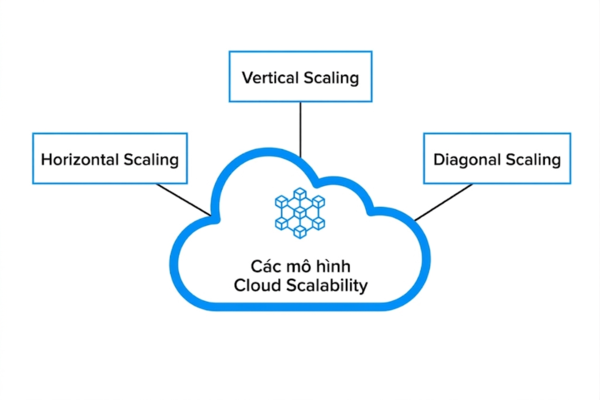
Depending on the application architecture and business goals, we can choose different scaling methods. Each model has its own advantages and disadvantages, suited to specific scenarios.
Vertical Scaling (Scaling Up/Down)
Vertical scaling, also known as “Scaling Up,” is the process of adding more power to an existing entity (node). Imagine upgrading your computer by adding more RAM or replacing it with a more powerful CPU. In the cloud, this means switching from a small server package to a higher-configuration one. Its advantage is simplicity, requiring little to no changes to the application’s source code. However, the downside is that there is always a hardware “ceiling” or limit, and it often requires brief downtime for the upgrade.
Horizontal Scaling (Scaling Out/In)
Horizontal scaling, or “Scaling Out,” involves adding more virtual machines or servers to the existing system. Instead of upgrading one powerful machine, you use tens or hundreds of machines running in parallel. This is the model favored by giants like Netflix or Facebook because it has almost no limit on scalability. When combined with a Load Balancer, horizontal scaling provides absolute reliability: if one machine fails, others continue to operate normally. However, it requires the application to be designed with a Microservices or Stateless architecture.
Diagonal Scaling (Combining Both Models)
Diagonal scaling is a flexible approach that combines both of the above models. In this model, a business will increase the configuration of existing machines to a certain threshold (Vertical), and then start adding new machines (Horizontal) as demand continues to rise. This approach helps optimize operating costs and ensures the system remains in the most balanced state between performance and budget.
Applications of Cloud Scalability in Business
Scalability is not just for tech companies. Every industry, from retail and finance to healthcare, is leveraging Cloud Scalability to solve its specific challenges.

- E-commerce: Handling Flash Sales and holiday seasons when traffic spikes hundreds of times compared to normal days.
- Media & Streaming: Online movie platforms need to expand bandwidth and storage capacity significantly when a “blockbuster” is released.
- Startups and Software Development: Allowing companies to start small (to save capital) and grow gradually alongside their user base without having to rebuild infrastructure from scratch.
- Big Data Processing: When needing to analyze terabytes of data in a short time, businesses can scale up hundreds of computing nodes and shut them down immediately upon completion to save costs.
Comparing Cloud Scalability and Cloud Elasticity
In the world of cloud computing, the concepts of Scalability and Elasticity are often confused. Although closely related, they represent two different aspects of resource management.
| Criteria | Cloud Scalability | Cloud Elasticity |
|---|---|---|
| Primary Goal | Meets long-term growth needs. | Adapts to immediate, short-term fluctuations. |
| Nature | Strategic and planned in advance. | Automatic; expands and contracts based on reality. |
| Mechanism | Increases/decreases resources to keep performance stable as scale grows. | Continuous expansion/contraction like a “rubber band” by the minute or hour. |
| Typical Example | Upgrading the system to serve a user base that doubles next year. | Automatically adding servers during a Flash Sale and removing them once traffic drops. |
| Essence | About the capacity to contain. | About the speed of adaptation. |
Challenges in Implementing Cloud Scalability
While offering immense benefits, achieving perfect Cloud Scalability is no easy feat. Businesses often face technical and management hurdles that require careful calculation.
- Architectural Complexity: To scale horizontally, applications must be designed as “decoupled.” If your application is a “Monolithic” block, scaling will be extremely difficult and expensive.
- Data Synchronization: When running multiple servers in parallel, ensuring data consistency across all nodes is a major challenge, especially for Relational Database Management Systems (RDBMS).
- Out-of-Control Costs: If thresholds for auto-scaling are not set, a DDoS attack or a code loop error could cause the system to automatically rent thousands of servers, leading to a “colossal” cloud bill at the end of the month.
- Security Issues: The more entities created, the wider the attack surface. Managing identity, access rights, and security configurations on a large-scale system requires specialized management tools.
Cloud Scalability is no longer a luxury; it is a mandatory requirement for any business wishing to survive and thrive in a volatile digital environment. Understanding scaling models and knowing how to apply them intelligently will help you optimize performance, save costs, and provide the best experience for your customers.
