


In today’s digital age, software applications increasingly rely on dozens – or even hundreds – of different APIs to operate smoothly. A single API failure can severely impact the entire user experience. That is precisely why API monitoring has become an indispensable part of modern software operations and development strategy.
What Is API Monitoring?
API Monitoring is the process of tracking, measuring, and analyzing the performance of application programming interfaces (APIs) in real time or on a continuous basis. The primary goal is to ensure that APIs remain stable, respond quickly, and return accurate data as expected.
Simply put, API monitoring is like hiring a staff member to continuously check whether every connection door in your system is opening correctly, whether anyone is being blocked at the door, and to immediately alert the team if something goes wrong. The monitoring system periodically sends test requests to API endpoints, then checks the responses – including HTTP status codes, response times, returned data structures, and content accuracy – to detect any issues as soon as they arise.
Why Is API Monitoring Important?
In modern software development environments, the average application uses anywhere from 15 to over 100 different APIs – covering everything from user authentication and online payments to map integrations and email services. This means that any failure in even one of them can trigger a domino effect that disrupts the entire system’s workflow.
API monitoring matters because it enables teams to detect issues before users ever notice them. Rather than waiting for customers to complain that they cannot check out or log in, the engineering team already knows and can act immediately. Beyond that, API monitoring helps businesses gain a deeper understanding of how their systems behave hour by hour and day by day – enabling technical decisions based on real data rather than guesswork. Especially as applications grow increasingly dependent on third-party APIs, monitoring becomes the only way to guarantee service quality even when the root cause of an issue lies outside the internal team’s control.
Benefits of API Monitoring
Investing in an API monitoring system is not just about risk prevention – it is a strategy that delivers a clear competitive advantage. When you have full visibility into how your APIs are performing, you can continuously improve and optimize the user experience.
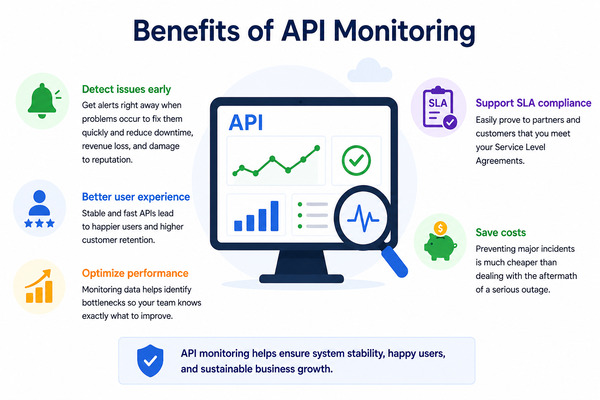
Key benefits include:
- Early incident detection and reduced downtime: Automated alerting systems allow engineering teams to respond within minutes rather than hours, limiting losses in both revenue and reputation.
- Improved user experience: Stable, fast-performing APIs directly affect end-user satisfaction and, in turn, increase customer retention rates.
- Continuous performance optimization: Monitoring data provides deep insight into bottlenecks, helping development teams know exactly where improvements are needed.
- SLA compliance support: It becomes easy to demonstrate to partners and customers that you are meeting your Service Level Agreement commitments.
- Long-term cost savings: Preventing major incidents is always far less expensive than dealing with the aftermath of a serious system failure.
How to Monitor APIs Effectively
Building a truly effective API monitoring process requires a well-thought-out strategy – not simply installing a tool and letting it run on its own. Effective API monitoring demands the right combination of tools, the right metrics, and a clear incident response process.
Some best practices when implementing API monitoring include: clearly identifying the critical endpoints that deserve priority attention; setting appropriate alert thresholds for each type of metric; integrating the monitoring system into your CI/CD pipeline to catch issues as early as the testing phase; and regularly reviewing historical data to spot trends before they become real problems. Additionally, teams should build clear runbooks so everyone knows exactly what to do when an alert fires, avoiding confusion during high-pressure incident response situations.
Key Features of API Monitoring
A comprehensive API monitoring platform goes far beyond simply checking whether an API is up or down. Modern tools provide multiple layers of monitoring, each serving a distinct purpose, giving you a 360-degree view of your entire API ecosystem.
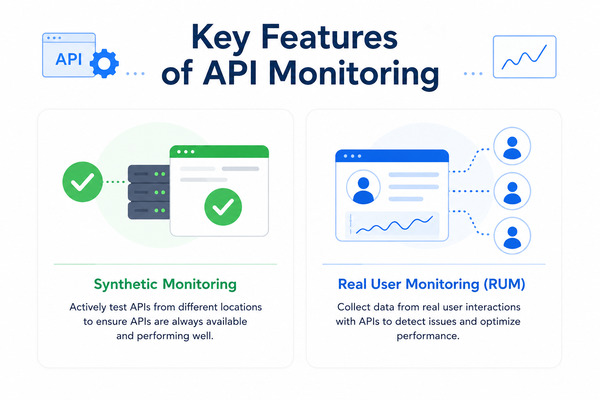
Synthetic Monitoring
Synthetic Monitoring uses automated bots or scripts to simulate user behavior and send scheduled requests to APIs. Rather than waiting for real users to access the system, it proactively checks APIs from multiple geographic locations around the world – from Hanoi to New York to London – ensuring the API performs well for all users regardless of where they are.
The greatest advantage of synthetic monitoring is its ability to detect issues even when no real users are actively using the system – such as in the middle of the night or during off-peak hours. It serves as the first and most critical safety net in any comprehensive API monitoring strategy.
Real User Monitoring (RUM)
Real User Monitoring (RUM) collects data from actual user interaction sessions within the application. Rather than simulating behavior, RUM records every API call that occurs while users are actively using the service – capturing real response times, device types, network conditions, and geographic locations.
RUM provides highly authentic and valuable data because it reflects exactly what real users are experiencing. The combination of synthetic monitoring (for early detection) and RUM (for understanding the real-world experience) creates the most powerful and comprehensive API monitoring system possible.
API Monitoring Use Cases
API monitoring is widely applied across virtually every industry and type of business that uses software. From small tech startups to large multinational corporations, the need to keep APIs running reliably is universal – differing only in scale and complexity.
Typical use cases include: e-commerce platforms monitoring payment and cart APIs to ensure no transaction is ever lost; fintech platforms monitoring banking and money transfer APIs to meet regulatory requirements and ensure financial security; healthcare applications tracking APIs connected to electronic patient record systems; logistics services monitoring map and shipment tracking APIs in real time; and SaaS platforms monitoring internal APIs to consistently deliver a high-quality enterprise customer experience.
Tips for Choosing the Right API Monitoring Tool
The market offers a wide variety of API monitoring tools, from free open-source solutions to full-featured enterprise platforms. Choosing the right tool that fits your organization’s specific needs is a decisive factor in the overall effectiveness of your monitoring strategy.
When evaluating API monitoring tools, consider the following criteria:
- Compatibility with your existing infrastructure and technology stack
- Geographic monitoring coverage (the more global locations, the better)
- Check frequency and alert accuracy
- Dashboard and reporting customization capabilities
- Protocol support (REST, GraphQL, SOAP, gRPC)
- Cost relative to usage scale
Do not choose a tool based on brand name alone – test it in practice with your own API data before making a decision.
Key Metrics to Track
Not every number carries equal weight. For API monitoring to be truly meaningful, you need to focus on metrics that genuinely reflect the health and quality of your system, rather than drowning in unnecessary data.
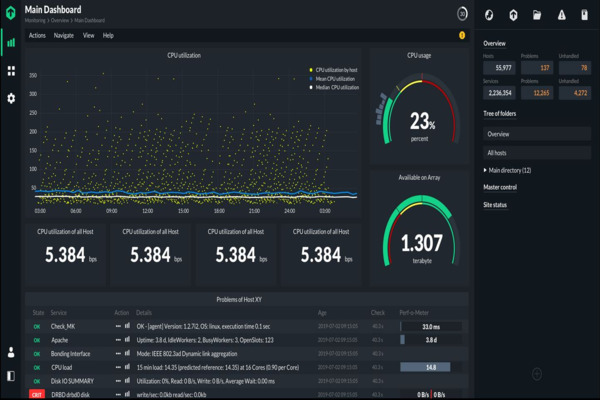
Core metrics you cannot afford to overlook include:
- Response Time / Latency – typically measured at the P95 or P99 percentile to capture the experience of the majority of users.
- Error Rate – the percentage of requests returning HTTP 4xx or 5xx error codes.
- Uptime / Availability – the ratio of time the API operates normally relative to total time.
- Throughput – the number of API requests processed per second or per minute.
- Time to First Byte (TTFB) – a metric reflecting the server’s initial processing speed.
- Authentication success rate – especially critical for APIs that require tokens or OAuth.
Should You Monitor APIs Continuously?
This is a question many engineering teams ask, particularly when weighing the cost and resources required for round-the-clock, 24/7 monitoring. The short answer is: yes – and in most cases, continuous monitoring is the only choice that truly delivers value.
The reason is straightforward: API incidents do not follow business hours. A system can fail at 3 a.m. on a weekend when no one is sitting in front of a screen. Without continuous monitoring, you will only discover the problem once users start complaining – and by then, the damage has already been done. With the decreasing costs of modern monitoring tools, the benefits of continuous API monitoring far outweigh the investment required.
Challenges in API Monitoring
While API monitoring offers clear benefits, implementing and maintaining an effective monitoring system is not always straightforward. Understanding common challenges helps you prepare better and avoid unnecessary mistakes. Common challenges include:
- Managing false positives, which cause teams to lose their sense of urgency when alerts fire
- Handling complex microservices environments with hundreds of interdependent services
- Monitoring third-party APIs over which you have no source code control
- Securing authentication credentials during API checks
- Keeping monitoring data up to date as APIs frequently change versions
Overcoming these challenges requires investment in solid processes, the right tools, and a strong DevOps culture within the organization.
Frequently Asked Questions About API Monitoring
How is API monitoring different from API testing? API testing is performed at a specific point in time – typically during the development phase – to verify that an API behaves according to its specifications. API monitoring is an ongoing process that runs in the production environment to ensure the API continues to perform well over time.
How frequently should APIs be monitored? It depends on the criticality of the API. For high-priority APIs such as payment or authentication endpoints, checks every 1–5 minutes are recommended. Less critical APIs can be checked every 15–30 minutes.
Does API monitoring affect system performance? When configured correctly, the impact is negligible. Modern monitoring tools are designed to send lightweight, optimized requests that do not place significant load on the server.
Do small businesses need API monitoring? Yes. Even if you only use a handful of third-party APIs, knowing when they fail allows you to respond faster and protect the customer experience more effectively.
API monitoring is no longer optional – it has become a fundamental requirement for any organization that wants to build and operate reliable software applications. Investing in API monitoring today is investing in system stability, user trust, and the sustainable long-term growth of your business.
