


In the digital era, raw data is often scattered across various locations and lacks a unified structure. To transform these lifeless numbers into valuable insights, a professional processing workflow is required. This is where ETL (Extract, Transform, Load) emerges as the “backbone” of data management systems.
What is ETL (Extract, Transform, Load)?
ETL is a data integration process consisting of three primary steps: Extract, Transform, and Load. This process allows businesses to retrieve data from multiple sources, process it according to specific business rules, and finally store it in a centralized Data Warehouse.
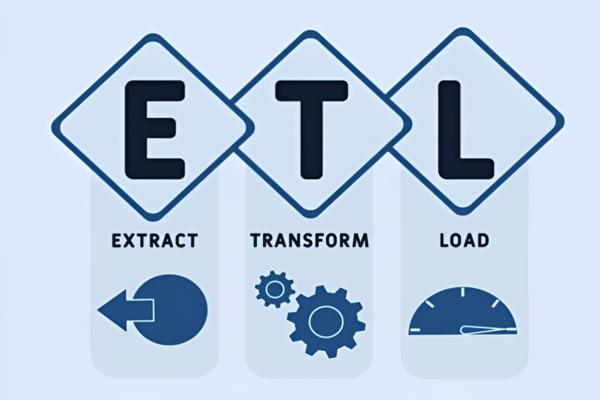
To put it simply, if you want to cook a delicious meal using ingredients from different markets, ETL is the process of shopping for those ingredients (Extract), prepping and seasoning them (Transform), and finally putting them into the pot to cook (Load). The end result is a “data dish” that is clean, consistent, and ready for analysis.
Why is ETL Important?
In the modern business environment, data does not come from a single source. A company may have sales data in a CRM, financial data in an ERP, marketing data from Facebook Ads, and user behavior data on their website. Without ETL, these data sources remain isolated (Data Silos), preventing managers from gaining a comprehensive overview.
ETL acts as the “connector,” helping to merge fragmented pieces into a holistic picture. It ensures that every business decision is based on accurate, timely, and systematic data. Without ETL, analyzing Big Data would be nearly impossible.
Benefits of ETL
Implementing a structured ETL process brings significant advantages to a business, from optimizing operations to enhancing competitiveness:
- Improved Data Quality: ETL helps eliminate duplicate, erroneous, or incomplete data during the transformation phase.
- Time and Resource Savings: Instead of employees manually aggregating data in Excel, ETL automates the entire data pipeline.
- Support for Accurate Decision-Making: Clean and continuously updated data helps leadership grasp market trends quickly.
- Historical Data Storage: ETL allows for tracking data changes over time, supporting future trend forecasting.
- Enhanced Security: The ETL process can encrypt or anonymize sensitive data before it is moved into storage.
The Three Main Stages of ETL
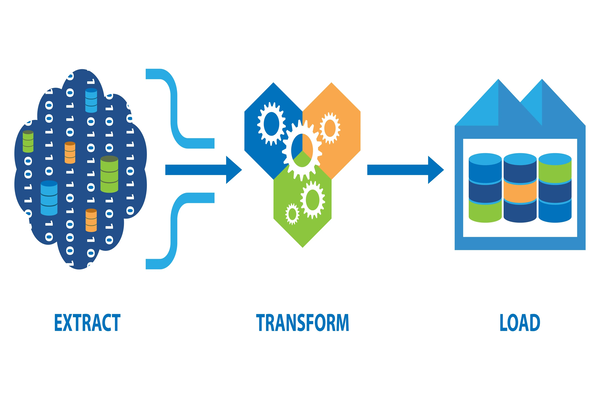
To gain a deeper understanding of how it operates, we need to break down the three constituent stages of the term ETL (Extract, Transform, Load). Each stage plays a pivotal and inseparable role.
Extract – Data Retrieval
This is the first and most critical step. Data is gathered from various sources such as databases (SQL, NoSQL), flat files (CSV, Excel, XML, JSON), application APIs, or even IoT device data. The goal of this stage is to obtain raw data without affecting the performance of the source systems.
Transform – Data Conversion
After extraction, raw data is often “messy.” The Transform stage performs operations such as reformatting dates, data cleansing (removing empty rows), logic validation, joining data tables, and performing necessary calculations. This is the “golden” stage where business rules are applied to make the data meaningful.
Load – Loading Data into the System
Finally, the cleaned and transformed data is pushed into the target system, typically a Data Warehouse or a Data Lake. The loading process can occur as a “Full Load” (completely fresh upload) or an “Incremental Load” (updating only the latest changes). The speed and reliability of this step determine data availability for end-users.
The Role of ETL in BI Systems
A Business Intelligence (BI) system cannot function effectively without “fuel” in the form of clean data. ETL serves as the most solid foundational layer in BI architecture.
It acts as a filter that helps eliminate informational noise. Thanks to ETL, data visualization tools like Power BI or Tableau can generate accurate charts. If BI is compared to an annual summary report, then ETL is the process of recording and auditing invoices and documents throughout that entire year.
Popular ETL Tools
The market currently offers numerous tools to support the ETL process, ranging from high-end enterprise solutions to flexible open-source projects. Here are the top names you should know:
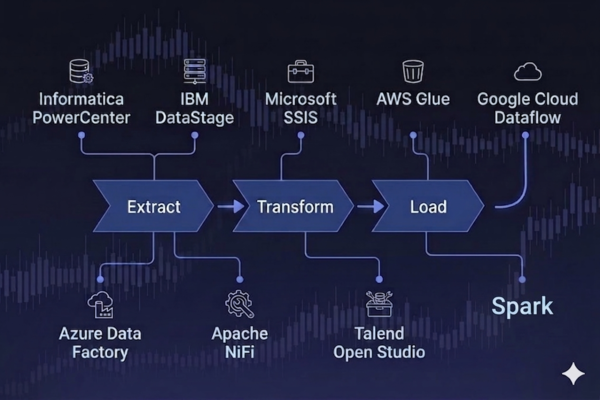
- Informatica PowerCenter: Considered an industry giant tailored for multinational corporations, this tool is renowned for its high security standards and its ability to handle massive, complex data volumes.
- IBM DataStage: A core part of IBM’s InfoSphere suite, DataStage excels in optimizing complex enterprise workflows through robust support for parallel processing.
- Microsoft SSIS (SQL Server Integration Services): The premier choice for organizations within the Microsoft ecosystem, featuring an intuitive drag-and-drop interface that simplifies pipeline development.
- AWS Glue: A fully managed, serverless ETL service from Amazon Web Services that automatically discovers, crawls, and categorizes cloud-based data.
- Google Cloud Dataflow: A fully managed Google service that supports both batch and stream processing; it is built on Apache Beam to provide automated, elastic scalability.
- Azure Data Factory: Microsoft’s cloud-based data integration service designed to create complex ETL pipelines that seamlessly bridge on-premise and cloud data sources.
- Apache NiFi: A powerful, open-source tool that specializes in the automation of data flows, specifically focusing on real-time data processing and distribution.
- Talend Open Studio: A leader in the open-source space, Talend offers a robust platform with hundreds of pre-built connectors to enable rapid data integration design.
- Python (Pandas/Spark): The preferred choice for Data Engineers who favor a “code-first” approach. Using libraries like Pandas for smaller datasets or Apache Spark for Big Data provides maximum flexibility beyond the constraints of a traditional UI.
ETL vs. ELT: Differences and When to Use Each
With the advancement of Cloud technology, a new concept called ELT has emerged and is often confused with ETL. Understanding this distinction helps you choose the right architecture for your system.
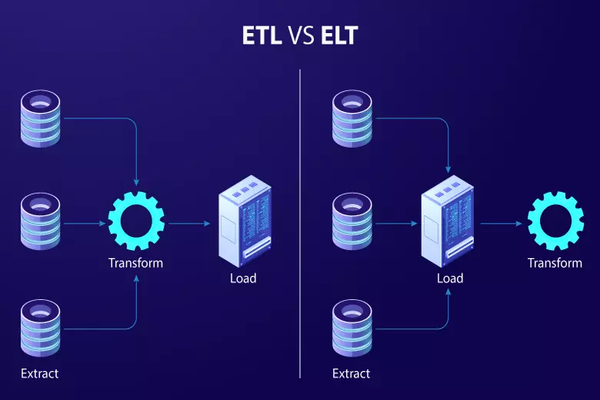
ETL – Extract, Transform, Load
The traditional workflow where data is transformed on an intermediate server before being loaded into the warehouse. This is suitable when high security is required (masking sensitive data before storage) or when the target system has limited computing power.
ELT – Extract, Load, Transform
Raw data is loaded directly into a data warehouse (such as BigQuery or Snowflake), and then the processing power of that warehouse is used to perform transformations. ELT is faster, more flexible, and ideal for modern Cloud systems with powerful parallel processing capabilities.
Challenges and Solutions in ETL Implementation
Despite its great benefits, implementing ETL is not always a walk in the park. Engineers often face the following complex issues:
- Schema Drift: When the data source structure changes (adding/removing columns), the ETL process can easily fail.
- Solution: Use tools capable of auto-detecting changes or design flexible pipelines.
- Poor Performance: When data volume is too large, ETL can take hours to run.
- Solution: Utilize Parallel Processing or switch to an Incremental Load model.
- Low Input Data Quality: “Garbage in, garbage out.”
- Solution: Establish strict Validation Rules right at the Extract step.
Frequently Asked Questions (FAQ) about ETL
To wrap up, let’s review some common questions that beginners often encounter:
- Is ETL only for Big Data? No. Even small businesses with just a few Excel files can use ETL to automate their reporting.
- Do I need to be an expert in programming to learn ETL? If you use drag-and-drop tools like SSIS or Talend, you mainly need strong logical thinking. However, knowing SQL is mandatory.
- What is the future of ETL? ETL is gradually moving toward Real-time processing and integrating AI to automate data cleansing.
Investing in ETL is an investment in the most valuable asset of a business: The truth derived from data.
