



In the era of digital transformation, Public Cloud has become the “backbone” of IT infrastructure for millions of businesses, ranging from startups to multinational corporations. Understanding its nature, operation, and the balance of its advantages and limitations is a prerequisite for optimizing costs and operational performance. This article provides a detailed analysis from core concepts to real-world use cases, giving you the most comprehensive perspective.
What is Public Cloud?
Public Cloud is a cloud computing model in which resources—such as servers, storage, and applications—are owned and operated by a third-party service provider. These resources are delivered over the internet and shared among various organizations (a concept known as “multi-tenancy”).
Unlike purchasing your own hardware to house in an office, with the public cloud, you “rent” space and computing power from tech giants. All costs for maintenance and infrastructure upgrades are the provider’s responsibility, allowing businesses to focus entirely on their core activities.
Benefits of the Public Cloud
The explosion of Public Cloud is no coincidence; it offers superior flexibility that traditional physical server systems (On-premise) simply cannot match in a short timeframe.
Key benefits include:
- Reduced Capital Expenditure (CAPEX): Businesses do not need to invest heavily in purchasing servers, building data centers, or cooling systems. Instead, you transition to an operational expenditure (OPEX) model.
- Infinite Scalability: You can double your storage capacity or processing power with just a few clicks during traffic spikes and scale back down when the demand subsides.
- High Reliability: With a global network of servers, providers ensure near-absolute uptime, minimizing the risk of service disruptions.
Outstanding Advantages of the Public Cloud
When diving deeper into technical and administrative aspects, the advantages of the Public Cloud are clearly demonstrated through its availability and convenience. It is the ideal solution for businesses seeking speed coupled with efficiency.

- Rapid Deployment: It takes only a few minutes to set up a complex working environment, significantly shortening the Time-to-Market.
- No Hardware Maintenance: The service provider is responsible for software updates, physical-level security patching, and replacing faulty components.
- Pay-as-you-go: You only pay for what you use, eliminating resource waste caused by idle servers.
- Cutting-edge Technology: Users gain immediate access to the latest technologies such as AI, Machine Learning, and Big Data without having to build the underlying platforms themselves.
How Public Cloud Works
Fundamentally, the Public Cloud operates based on virtualization technology. Providers build massive data centers and then use software to partition a single physical server into multiple Virtual Machines (VMs).
Each customer is allocated a distinct, isolated space, even though they share the underlying hardware infrastructure with thousands of other clients. All interactions and management are handled through a web interface or API. This ensures data privacy while still leveraging the provider’s massive economies of scale.
Public Cloud Service Models
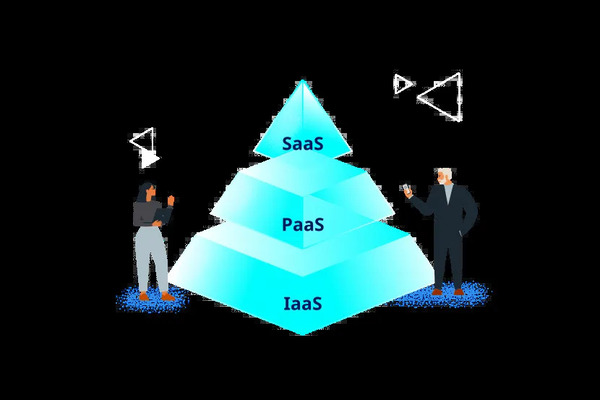
Depending on administrative and technical needs, businesses can choose from different service levels on the Public Cloud. Each model divides responsibilities between the user and the provider, ranging from “all-inclusive rentals” to “platform rentals.”
Software as a Service (SaaS)
This is the most common model for end-users. You simply log in and use the application via a web browser. The provider manages everything from infrastructure and security to feature updates. Typical examples include Google Workspace, Microsoft 365, or Salesforce.
Platform as a Service (PaaS)
PaaS provides a complete environment for developers to build, test, and manage applications without worrying about the underlying operating system or servers. Tools like Google App Engine or Heroku allow dev teams to focus entirely on writing code.
Infrastructure as a Service (IaaS)
IaaS is the most fundamental level, providing raw resources such as virtual servers, networks, and storage. Businesses have full control over the operating system and the applications installed on it. This is the most flexible option, exemplified by AWS EC2 or Microsoft Azure Virtual Machines.
Comparing Public Cloud, Private Cloud, and Hybrid Cloud
To choose the right model, we need to weigh Public Cloud against Private Cloud and Hybrid Cloud. Each type has its own “territory” to shine, depending on security requirements and budget.
| Feature | Public Cloud | Private Cloud | Hybrid Cloud |
|---|---|---|---|
| Ownership | Third-party (Provider) | Owned by the enterprise | A combination of both |
| Security | Good (Standardized) | Very High (Customized) | Flexible by segment |
| Cost | Low, Pay-as-you-go | High, Large initial investment | Medium to High |
| Control | Limited at infrastructure level | Full control | Partial control |
Private Cloud is typically reserved for financial institutions or government agencies requiring absolute isolation. Meanwhile, Hybrid Cloud is the current trend, allowing flexible data movement between both environments to optimize both security and scalability.
Common Use Cases for Public Cloud
Thanks to its versatility, Public Cloud is applied in almost all modern technological scenarios—from simple personal storage to complex data processing systems.

- Backup & Storage: Prevent data loss due to local hardware failure at an extremely low cost.
- Development and Testing (Dev/Test): Quickly create virtual environments to test applications and then delete them immediately upon completion to avoid waste.
- Big Data Analytics: Leverage massive computing power to analyze customer behavior or market forecasts.
- Website Hosting and E-commerce: Keep websites running stably even during major sales events with massive traffic spikes.
Public Cloud is not just a trend but an inevitable leap in technology. While concerns regarding security or provider lock-in remain, the advantages in cost and scalability are undeniable. For most businesses today, adopting the public cloud is the key to maintaining a competitive edge in the digital race.
