



In today’s digital era, owning a mobile application is no longer an option but has become a mandatory requirement for every business. However, the biggest challenge is how to establish a presence on both iOS and Android with the lowest cost but the highest efficiency. That is when the concept of Cross-platform app becomes the center of attention in the tech world.
What is a Cross-platform app?
Before diving deep into the technicalities, we need to clearly understand the nature of this development approach. Instead of having to write two separate source codes for two different operating systems, Cross-platform allows developers to “write once, run anywhere.” To better understand the definition and the core technologies behind it, let’s go through the detailed concepts below.

Definition of multi-platform applications
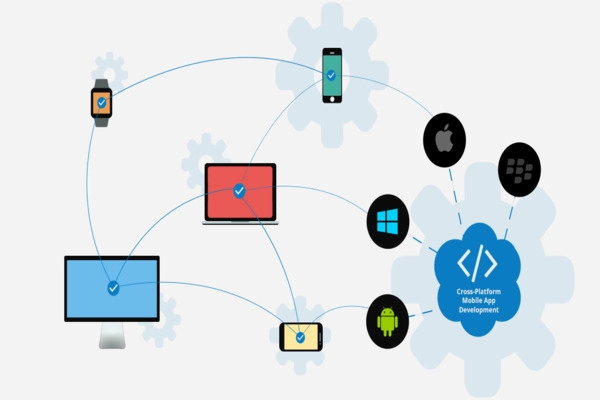
A Cross-platform app (multi-platform application) is a type of software designed to operate on multiple different operating systems (typically iOS and Android) by using a single codebase. Instead of using platform-specific languages like Swift for iOS or Kotlin for Android, developers use intermediate languages.
Operating mechanism of Cross-platform
These applications do not run directly on the hardware like Native apps. Instead, they operate through a “bridge” layer or specialized rendering engines to convert the common source code into an interface and features compatible with each operating system. This helps maintain consistency in the User Interface (UI) and User Experience (UX) across all devices.
Currently popular Frameworks
Nowadays, the Cross-platform app market is dominated by “giants” such as:
- Flutter (by Google): Uses the Dart language, famous for its fast rendering speed.
- React Native (by Meta/Facebook): Uses JavaScript, supported by a massive community.
- Xamarin (by Microsoft): Uses C#, integrating well with the .NET ecosystem.
Benefits of Cross-platform apps
Why do startups and even tech giants like Facebook, Instagram, or Airbnb prioritize using Cross-platform? The answer lies in the superior economic and operational benefits. Below are the core values that this model brings to businesses and technical teams.
Saving Investment Costs
This is the greatest benefit. Instead of hiring two separate development teams (one for iOS and one for Android), you only need one team proficient in a multi-platform framework. Personnel, maintenance, and system operation costs are significantly reduced, potentially up to 40-50% compared to traditional methods.
Shortening Time-to-Market
In business, the first to arrive gains the advantage. With a Cross-platform app, the development process happens simultaneously for both platforms. Once a new feature is written, it appears on both iPhones and Samsung phones almost at the same time, helping businesses quickly reach the market and respond to customer feedback.
Ease of Maintenance and Updates
When bugs arise or features need upgrading, developers only need to make edits to a single codebase. Synchronizing data and updating to new versions becomes much simpler, avoiding the situation where the iOS app has moved to version 2.0 while the Android version remains “stuck” on an older one.
Pros & Cons of Cross-platform apps
Every technology has two sides. Despite its strengths in speed and cost, Cross-platform still has certain technical limitations that businesses must carefully consider. Let’s analyze the details to get the most objective perspective.
Outstanding Advantages
Beyond cost savings, Cross-platform provides brand experience consistency. Customers moving from an Android tablet to an iPhone will not feel disoriented because the interface and operational logic are identical. Additionally, code reusability can reach as high as 80-90%.
Disadvantages to Consider
- Performance: Although much improved, Cross-platform apps still struggle to achieve 100% of the smoothness of Native apps, especially with heavy graphics applications or games.
- Limited Hardware Access: Occasionally, integrating deep features such as specialized sensors, Bluetooth Low Energy, or complex camera processing can be difficult because you must wait for third-party library support.
- File Size: Multi-platform applications usually have larger file sizes because they must include intermediate libraries.
Comparing Cross-platform with Native and Hybrid apps
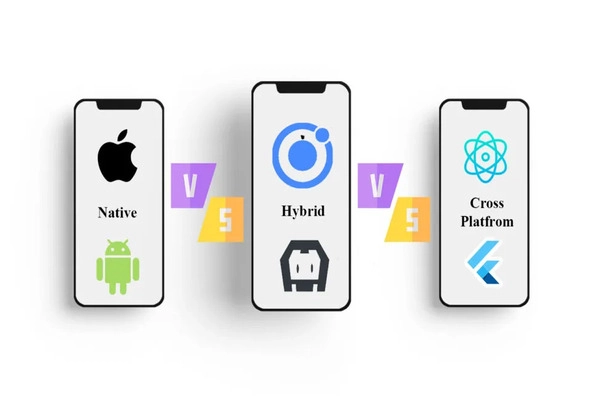
To choose the right “weapon” for your project, you need to clearly distinguish between the three most confusing concepts in mobile programming. Each type has its own structure and specific purpose. The comparison below will help you identify the differences visually.
Native App – Original Power
A Native App is an application written in the original language of the operating system. It takes full advantage of the hardware power, providing the fastest processing speed and the smoothest user experience. However, its development cost is the most expensive.
Hybrid App – The Combination of Web and Mobile
A Hybrid App is essentially a website “packaged” inside a mobile application. It uses Web technologies (HTML, CSS, JS) and runs inside a WebView. This is the cheapest solution but offers the lowest performance among the three types.
Summary Comparison Table
| Criteria | Native App | Cross-platform App | Hybrid App |
|---|---|---|---|
| Performance | Very High | High | Average |
| Cost | Very Expensive | Economical | Cheapest |
| Time | Long | Fast | Very Fast |
| UX Experience | Perfect | Very Good | Fair |
Should you choose Native, Cross-platform, or Hybrid?
There is no “best” choice, only the “most suitable” choice for your business goals and current resources. To make an informed decision, consider the important criteria regarding budget, timeline, and the specific technical requirements of your project below.
When to choose a Cross-platform app?
You should prioritize Cross-platform if:
- You have a moderate budget and want to be present on both stores (App Store & Play Store).
- The application is primarily for data management, e-commerce, or social networking.
- You need to deploy the project quickly (MVP – Minimum Viable Product).
When is a Native App necessary?
A Native App is the mandatory choice for:
- Applications requiring extremely high performance, such as video editing or 3D gaming.
- High-security applications (such as Banking).
- Requirements for absolute smoothness in every transition effect.
Choosing a Hybrid App for simple projects
Hybrid Apps are suitable for businesses that want to test an idea at an extremely low cost, or for content-driven apps like news or simple introductions that do not require complex interaction with phone hardware.
Frequently Asked Questions about Cross-platform apps
During our consulting and implementation process, we have noticed many common concerns from business owners. This section summarizes and briefly answers the most frequent questions to help resolve any final hesitations you may have about this type of application.
Are Cross-platform apps secure? Yes. Modern frameworks like Flutter or React Native have robust security mechanisms. If developers follow standard coding practices, their security is in no way inferior to that of Native apps.
Are Facebook and Instagram Cross-platform? That’s correct. Facebook is the “father” of React Native, and they use this technology for the majority of their applications. This serves as proof that Cross-platform apps can absolutely handle a massive user base of up to billions of people.
Can I switch from Cross-platform to Native later? It is possible, but you will have to rewrite the source code from scratch. Therefore, defining your strategy right from the start is crucial to avoid wasting resources later on.
Cross-platform apps represent the perfect balance between performance and cost in today’s mobile world. With the continuous advancement of technology, performance barriers are gradually being eliminated, making them the number one choice for almost every business.
