


In today’s digital era, building a website from scratch using pure code (Vanilla Code) is no longer the optimal choice for large-scale projects. Instead, developers utilize a more powerful tool to boost speed and ensure security: the Web Framework. So, what exactly is this “framework,” and which names are currently dominating the market? Let’s dive deep into the details in the article below.
1. What is a Web Framework?
Conceptually, a Web Framework is a software framework designed to support the development of web applications, including web resources, web services, and APIs (Application Programming Interfaces). You can imagine it like a house frame that has already been built with a foundation, pillars, and floors; your job is to design the interior and paint it to your liking, rather than having to mold every single brick yourself.
A Web Framework typically comes with pre-written code libraries that help handle common tasks such as:
- Database Management.
- User Authentication.
- Routing between pages.
- Security against common attacks like SQL Injection or XSS.
Using a framework allows developers to focus on the application’s Business Logic instead of wasting time on repetitive structures. This not only saves time but also significantly improves the overall quality of the source code.
2. 5 Popular Frontend Frameworks
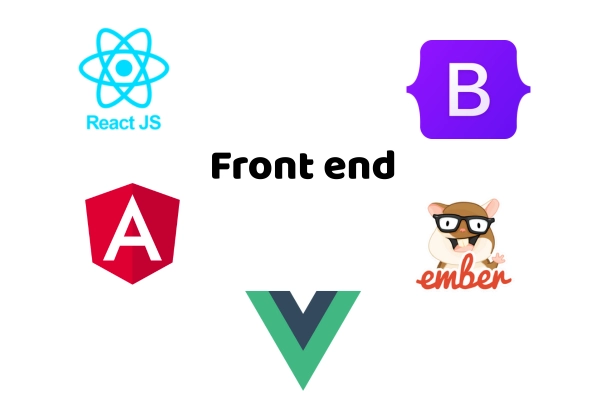
Frontend frameworks are responsible for what users see and interact with directly on their browsers. Over the years, the race between client-side libraries and frameworks has become incredibly intense with the participation of technology “giants.” Below are the five most prominent representatives that help create smooth and vivid interfaces.
React
Although often referred to as a JavaScript library rather than a full framework, React (developed by Meta – Facebook) has completely changed the way we build user interfaces. The greatest strengths of React are the Virtual DOM concept and its Component-based architecture. Breaking the UI into independent pieces makes it easy for developers to manage, reuse code, and optimize rendering performance.
Angular
While React is known for its flexibility, Angular (developed by Google) is an extremely tight and powerful ecosystem. This is a full-featured framework that uses the TypeScript language. Angular provides everything you need—from state management and form handling to routing—without requiring the installation of additional external libraries. It is often the top choice for Enterprise projects that demand stability and strict structure.
Vue.js
Created by Evan You, Vue.js is often dubbed the perfect “hybrid” between React and Angular. It inherits the flexibility of React and the structural nature of Angular, yet possesses an incredibly low learning curve. Vue allows you to start a small project very quickly but is still powerful enough to scale into large-scale applications thanks to its diverse plugin system.
Ember
Ember.js is a framework designed for those who value consistency. With the philosophy of “Convention over Configuration,” Ember provides a clear roadmap for building complex web applications. Although it is not as widely popular as the “Big Three” (React, Angular, Vue), Ember remains a backbone for many major applications like LinkedIn and Apple Music, thanks to its excellent data management capabilities.
Bootstrap
Unlike the four names mentioned above which focus on JavaScript logic, Bootstrap is the world’s leading CSS and UI framework. It provides a Grid system and pre-designed UI components (Buttons, Navbar, Modals, etc.) that help websites automatically adapt to all screen sizes (Responsive). Bootstrap is a “lifesaver” for backend developers who need to build fast, beautiful interfaces without needing deep expertise in design.
3. 5 Popular Backend Frameworks
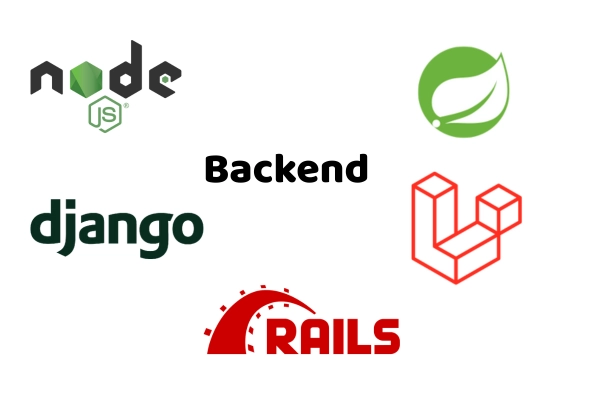
If the Frontend is the “face,” then the Backend is the “brain” that processes logic, stores data, and ensures security for the entire system. Server-side frameworks help simplify interaction with databases and manage complex information flows. Below are five typical representatives to help you build a solid backend foundation.
Node.js (Express)
Although Node.js is a runtime environment, when people mention web frameworks on this platform, they usually think immediately of Express.js. It is a minimalist, flexible, and extremely fast framework. Its special feature is that it allows developers to use a single language—JavaScript—for both Frontend and Backend, helping to synchronize programming logic and optimize human resources in Fullstack projects.
Django
Coming from the Python language, Django is famous for its motto: “The framework for perfectionists with deadlines.” Django comes with most of the necessary features right out of the box (“Batteries included”), from an automatic admin system to high-level security. It is the top choice for applications related to Artificial Intelligence (AI), data analysis, and large-scale news systems like Instagram or Pinterest.
Ruby on Rails
Ruby on Rails (RoR) once took the startup community by storm due to its ability to build prototypes incredibly fast. Utilizing the elegant Ruby language, RoR emphasizes simplicity and developer productivity. Although it faces many competitors today, RoR maintains a strong standing among developers thanks to its enthusiastic support community and powerful “gems” (libraries).
Laravel
In the world of PHP, Laravel is the undisputed “king.” Before Laravel emerged, PHP was often criticized for being cluttered; however, this framework brought an artistic beauty to the language. With its clean syntax, excellent database migration system, and convenient Blade Template engine, Laravel helped revitalize PHP, making it a top choice for e-commerce web applications.
Spring Framework
For the Java ecosystem, Spring (specifically Spring Boot) is an industry standard. It provides a comprehensive programming and configuration model for modern applications. Spring is particularly powerful in handling complex distributed systems, microservices, and the stringent security requirements of the banking and finance sectors.
4. Frequently Asked Questions about Web Frameworks
To give you a broader overview and help you make more accurate decisions, we have compiled the most common questions developers encounter when choosing a tool.
- Which framework should I learn first? If you enjoy building interfaces, start with React. If you prefer data processing, choose Node.js or Django.
- Does using a framework slow down a website? A framework may increase the initial file size; however, with modern optimization techniques, the difference is negligible compared to the benefits of security and manageability.
- Can a website use multiple frameworks? Yes. You can use React for the Frontend and Laravel for the Backend. They communicate with each other via APIs.
- How do I choose the right framework for a project? Base your decision on three factors: Project scale, the language your team is most proficient in, and the framework’s support community.
Choosing the right Web Framework not only affects the project completion speed but also determines its future scalability and maintainability. Whether you choose React for the Frontend or Django for the Backend, the most important thing is still understanding the nature of the underlying programming language. A framework is a tool, and a tool reaches its maximum potential only when it is in the hands of a skilled craftsman.
