


In today’s digital era, technology is no longer just an option but has become the backbone of every business. Behind the seamless operation of banking systems, ride-hailing apps, and social media platforms lies the process of software development. This is a vast field that combines logical thinking, programming techniques, and constant creativity to solve real-world human problems.
What is Software Development?
Software development is a systematic process of creating, designing, deploying, and supporting computer programs. Rather than just simply writing code (programming), this process encompasses a series of activities ranging from understanding user needs and sketching architecture to ensuring the software operates stably across various devices.

To put it simply, if computer hardware is the body, software is the soul and the brain that controls every activity. The growth of this industry has completely transformed the way we work, communicate, and entertain ourselves. To better understand this world, we need to categorize the different types of software currently available on the market.
Main Types of Software
The world of technology is incredibly diverse, and no single type of software can meet every possible need. Categorization helps developers identify the right technologies and processes required. Below are the five most common types you will encounter in the field of software development.

System Software
This is the most fundamental layer, acting as a bridge between computer hardware and user applications. System software manages resources such as the CPU, memory, and hard drives. The most prominent examples are operating systems like Windows, macOS, and Linux, as well as device drivers.
Application Software
This is the most common type of software that end-users interact with daily. They are designed to perform specific tasks. From office suites like Microsoft Office and web browsers like Chrome to photo editing apps like Photoshop or social networks like Facebook, all fall into this category.
Programming Software
These are tools created specifically to serve developers during the software development process. They include compilers, debuggers, and Integrated Development Environments (IDEs) such as Visual Studio Code or IntelliJ. Without programming software, creating other types of software would be extremely difficult.
Embedded Software
Embedded software consists of programs designed to control devices or machinery that are not conventional computers. You can find them in microwave ovens, automotive ABS braking systems, washing machines, or IoT (Internet of Things) devices. Their key characteristics are high specialization and the requirement for absolute reliability.
Software as a Service (SaaS)
SaaS is the most modern model, where software is distributed over the internet as a subscription service rather than being installed directly on a machine. Typical examples such as Google Drive, Slack, or Salesforce have helped businesses save on infrastructure costs and easily access data anytime, anywhere.
Popular Software Development Models
Depending on the project scale and client requirements, development teams will select a specific “methodology” or working model. Each model carries its own set of advantages and limitations, dictating how team members collaborate with one another.
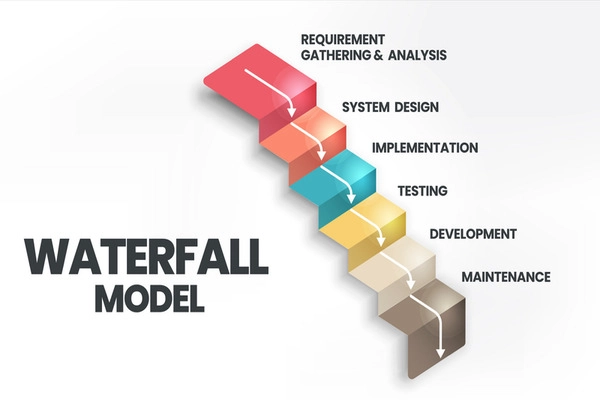
Waterfall
This is the most classic and disciplined model, where every phase occurs sequentially like a one-way flow. You can only proceed to the next step once the previous one has been absolutely completed. Waterfall is extremely effective for projects with fixed, clear requirements from the outset and minimal fluctuations in personnel or budget.
Spiral
A sophisticated combination of system design and an iterative mindset. The highlight of the Spiral model lies in its capacity for in-depth risk analysis during each iteration. This is often the preferred choice for large-scale, highly complex projects where a minor error could lead to significant damage.
Agile
More than just a method, Agile is a flexible mindset. By breaking the project down into short cycles (typically 2-4 weeks), Agile allows teams to react instantly to changes and continuously improve the product based on actual user feedback.

Iterative Approach
Instead of striving to create a masterpiece from the very first attempt, this model opts to start with the simplest version. Through each cycle, the product is built upon with additional features and refined in quality, helping to minimize the risk of design deviations from expectations.
Incremental
The project is broken down into several independent parts. Each part undergoes the full lifecycle—from design to delivery—before being integrated into the overall system. This approach allows businesses to have functional portions of the product for early use, rather than having to wait for the entire system to be completed.
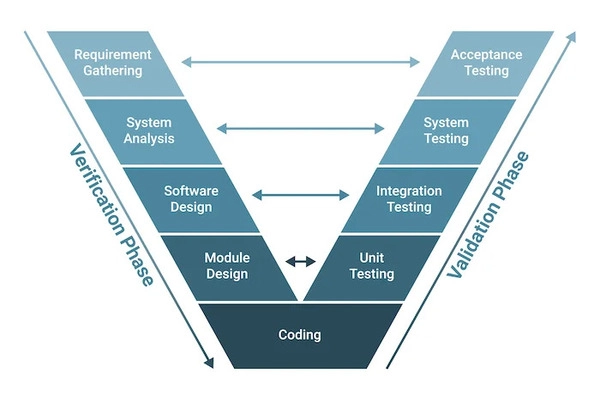
V-Model
Considered a high-safety upgrade of the Waterfall model, the V-Model emphasizes the symmetry between development and testing. Here, every construction phase has a corresponding control scenario, ensuring that even the smallest details are validated for accuracy from the very beginning.
Scrum
Scrum is the most popular framework within the Agile philosophy. It promotes team self-management, transparency through Daily Stand-ups, and the commitment to delivering tangible value after each Sprint.
RAD (Rapid Application Development)
True to its name, RAD prioritizes maximum speed through the continuous creation of prototypes. By reducing administrative hurdles and cumbersome documentation, RAD focuses on gathering direct feedback on the actual product to optimize time-to-market.
Challenges in Software Development
Despite monumental technological advancements, software development has never been an easy path. Software projects often face administrative and technical “black holes” that can lead to failure if not managed effectively.
Complex Requirements Management
One of the greatest challenges is the ambiguity of expectations. Clients sometimes lack a clear vision of the final product or continuously change requirements mid-way (a phenomenon known as scope creep). Finding the balance between user ambition and the practical limits of technology is a daunting task for any project manager.
Shortage of High-Quality Talent
The “thirst” for talent in the IT industry shows no signs of cooling down. However, the challenge lies not just in quantity but in quality. Finding developers who possess both sharp algorithmic thinking and deep domain knowledge, coupled with effective communication skills, is a difficult puzzle for businesses today.
Integration with Legacy Systems
Many organizations still operate on platforms from decades ago. Building modern software capable of “communicating” smoothly and functioning stably on top of aging infrastructure is like fitting a jet engine into a vintage car—it requires immense ingenuity and extremely sophisticated technical handling.
Security and Privacy
In an era where data has become the most valuable asset, cyberattacks are becoming increasingly sophisticated and unpredictable. Modern software development must shift its mindset: security is no longer a final auxiliary check but must be the “backbone” of every design phase (Security by Design) to ensure maximum protection of user privacy.
Software Development Trends 2026
Looking toward the future, the software industry is undergoing a powerful transformation fueled by the explosion of breakthrough technologies. The following trends are not only changing how we write code but also redefining the value that technology brings to our lives in 2026.
Artificial Intelligence (AI) & Machine Learning
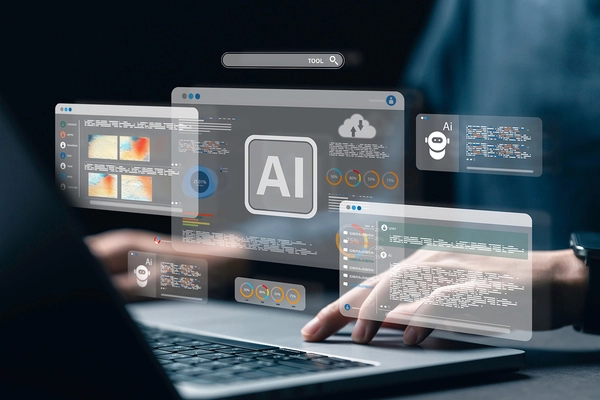
AI has moved beyond its label as a mere “support tool” to become a formidable partner. In 2026, AI is deeply integrated into the core of the software development process—from AI Agents automatically optimizing source code to the creation of applications capable of predicting behavior and personalizing user experiences in real-time with astonishing accuracy.
No-Code/Low-Code
Technical barriers are gradually being dismantled. The No-Code/Low-Code trend allows business managers and domain experts to participate directly in creating solutions through intuitive drag-and-drop interfaces. This not only helps achieve record-breaking time-to-market but also liberates IT teams from repetitive, mundane tasks.
Blockchain for Enterprise Software
Moving far beyond the shadow of cryptocurrency, Blockchain has become the foundation for digital trust in the enterprise. From transparent supply chain management and digital identity verification to self-executing Smart Contracts, this technology ensures that all data remains immutable and tamper-proof.
Green Software
As environmental concerns become urgent, “green software” has emerged as a new ethical standard in the industry. Developers now prioritize optimizing algorithms to minimize server power consumption and extend hardware lifespan, contributing directly to global carbon emission reduction goals.
Security & Cybersecurity
In the face of increasingly sophisticated cyberattacks, the security mindset has shifted to the “Zero Trust” model—trusting no one and no device by default. Modern software is equipped with multi-layered armor, from advanced biometric authentication to post-quantum encryption, ensuring data remains secure even against the most latent threats.
Software development is a continuous journey of innovation and adaptation. Whether you are a business seeking digital transformation solutions or an aspiring developer, understanding the latest processes, models, and trends is the key to success. We hope this article has provided you with a comprehensive and insightful view of the modern software development landscape.
