


In the era of digitalization, Blockchain technology is not only known for Bitcoin or other cryptocurrencies but also introduces a groundbreaking concept: the smart contract. Conceived from the ideas of cryptographer Nick Szabo in the 1990s, smart contracts are now reshaping the way we execute agreements, transactions, and build trust in the digital environment. This article will delve into understanding the nature, operation, benefits, and practical applications of this advanced technology.
What is a Smart Contract?
A smart contract is a computer program that automatically executes, controls, or documents legally relevant events and actions related to agreements and contracts, according to pre-programmed terms. Its core difference from traditional contracts is the absence of a need for an intermediary (such as lawyers, banks, or notaries) to oversee its execution.
Imagine the smart contract as a “digital vending machine.” Instead of buying soda, the user deposits currency (digital data/assets), and if the conditions (sufficient funds, product selection) are met, the machine automatically dispenses the product (executes the transaction). The terms of the contract are encoded into “IF-THEN” statements, stored on a decentralized and immutable Blockchain, ensuring everything proceeds exactly as agreed, automatically and unchangeably.
How Do Smart Contracts Work?
The operation of a smart contract is built upon the Blockchain platform. When a smart contract is deployed, its source code and terms are encrypted and distributed across all computers (nodes) in the Blockchain network.
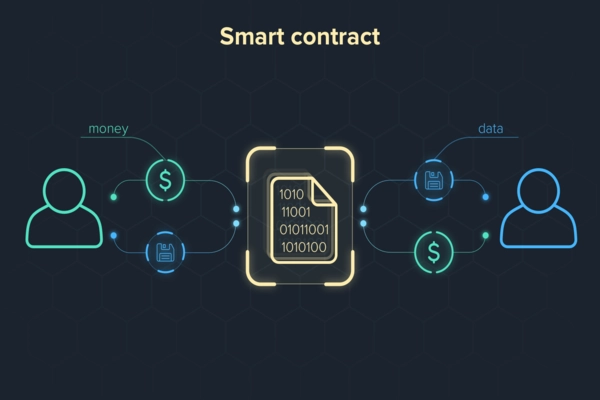
When the two parties involved sign (via digital signature) and submit the contract to the Blockchain, the contract enters a pending state, waiting for activation. Subsequently:
- Data Input (Trigger): The contract awaits input data (also known as an Oracle) or a specific triggering event (e.g., a maturity date, receipt of a payment, or a temperature reaching a certain level).
- Logic Processing: When the event occurs, the smart contract code automatically executes the pre-programmed logic terms (the IF-THEN statements).
- Execution: Depending on the processing result, the contract will automatically perform the specified action, such as transferring funds, issuing digital assets, sending notifications, or changing the status of an asset.
This process takes place automatically, transparently, and without human intervention, ensuring absolute objectivity.
Benefits of Smart Contracts
The elimination of intermediaries and the automation of processes have brought about many significant benefits for smart contracts:

Speed, Efficiency, and Accuracy
In the traditional world, contract processing and execution can take days, even weeks, due to paperwork and the intervention of third parties. Smart contracts significantly increase transaction speed. Furthermore, because they are executed by computer code, human errors are eliminated, ensuring absolute accuracy.
Trust and Transparency
All participating parties have access to the contract’s terms, as they are stored publicly on the Blockchain. Strong cryptographic encryption ensures that the contract is executed exactly as programmed. The decentralized nature of the Blockchain also helps eliminate the risk of manipulation or alteration of data after it has been stored, building solid trust among the parties.
Security
Data on the Blockchain is secured using complex cryptographic mechanisms, making it extremely difficult to hack or forge contract data. Once deployed, a smart contract cannot be modified, ensuring the immutability of the agreement.
Cost Savings
Eliminating intermediaries (banks, lawyers, brokers) from the transaction process significantly cuts down on associated administrative and service fees. This represents a major economic advantage, especially for international transactions.
Pros and Cons of Smart Contracts
Despite offering numerous benefits, smart contracts still have certain advantages and disadvantages that need to be considered.
| Pros | Cons |
|---|---|
| Automation: Executes transactions without the need for intermediaries. |
Coding Errors: If there is a bug in the source code, the contract can be exploited and is very difficult to fix after deployment. |
| Immutability: Once deployed, the contract cannot be changed. |
Legal Ambiguity: The legal framework for smart contracts remains incomplete in many countries. |
| High Transparency and Security: Data is encrypted and publicly accessible on the Blockchain. |
Oracle Problem: The contract is only reliable if the input data (from the Oracle) is reliable. |
| Saves Cost and Time: Eliminates intermediary costs and increases processing speed. |
Deployment Cost: Designing and testing smart contracts requires high specialized skills and can be expensive. |
Applications of Smart Contracts in Practice
The capabilities of the smart contract have extended far beyond the realm of cryptocurrencies and are being widely applied across numerous industries, creating new business and transaction models.

Finance and Banking
In Decentralized Finance (DeFi), smart contracts are the backbone of lending, trading, and insurance applications that operate without the need for traditional banks. They automate the issuance of loans, interest payments, and the liquidation of collateral.
NFTs and Blockchain Games
Smart contracts govern the creation, transfer, and verification of ownership of Non-Fungible Tokens (NFTs). They contain the metadata (descriptive data) of the digital asset and define the rules for royalties each time an NFT is resold. In Blockchain games, they manage game rules, in-game assets, and monetization mechanisms.
Legal Sector
Smart contracts can be used to automate simple legal agreements such as power of attorney agreements or the management of digital inheritance assets after a person passes away. They can also be used to securely store and manage important evidence and documentation.
Real Estate
They can automate the transfer of asset ownership when payment terms are met, making property transactions faster and more transparent without needing multiple layers of brokers and notaries. The tokenization of real estate, thanks to smart contracts, also opens up opportunities for fractional ownership investment.
Building DAOs – Smart Contracts in Business
Smart contracts are the foundation for Decentralized Autonomous Organizations (DAOs), allowing organizations to operate without centralized management. Voting rules, fund distribution, and decision-making are all encoded and executed automatically, enhancing community participation.
Other Emerging Technologies
From supply chains (tracking and automated payment upon goods arrival) to healthcare (secure management of patient records), smart contracts are opening the door to innovation across numerous fields. They are also applied in the energy sector (smart grid management) and IoT (automating communication between devices).
Challenges in Building Smart Contracts
Although the potential is vast, the development and deployment of smart contracts still face several key challenges that developers and businesses need to be mindful of before putting them into practical application.

- Source Code Errors: A minor flaw in the code can lead to serious and irreversible consequences (a typical example being the DAO hack). Code auditing is absolutely crucial before deployment.
- Gas Costs: Deploying and executing contracts on some Blockchains (like Ethereum) can be costly due to high gas fees, especially during periods of network congestion.
- The Oracle Problem: The ability to securely and reliably connect smart contracts with real-world data remains a major technical challenge. Oracle providers need to ensure honesty and freedom from manipulation.
- Difficulty in Upgrading: Immutability is an advantage, but also a significant challenge. Fixing bugs or upgrading the functionality of an already deployed smart contract is extremely difficult, often requiring the deployment of a new contract.
Fields of Smart Contract Application
In summary, smart contracts are being actively explored and applied across every industry that demands high levels of trust, automation, and transparency.
- Decentralized Finance (DeFi): Lending, borrowing, decentralized exchanges (DEXs), and derivative asset management.
- Governance: DAOs and decentralized voting systems.
- Supply Chain: Goods tracking, origin verification, and automated payments.
- Insurance: Automated compensation payouts based on specific conditions (e.g., flight delays, natural disasters).
- Asset Management: Tokenization of physical and digital assets, and ownership transfer.
- Intellectual Property: Automated distribution of royalties and licenses management.
- Identity Management: Self-Sovereign Identity (SSI) systems.
Frequently Asked Questions (FAQs) about Smart Contracts
1. Are smart contracts truly legal contracts?
This depends on the jurisdiction. In many places, although smart contracts can enforce technical terms, they still need to be supplemented by a traditional legal framework to have full legal effect in the event of a dispute. However, the trend is that governments are gradually recognizing their legal validity.
2. Can smart contracts be hacked?
The Blockchain itself is extremely secure, but the source code of the smart contract may contain security vulnerabilities if it is poorly programmed (a bug). Once exploited, fraudulent transactions can occur.
3. What programming languages are used to write smart contracts?
The most common language is Solidity (for Ethereum and EVM-compatible chains). Other languages include Rust (for Solana) and Vyper.
Smart contracts are not just a technological tool but also a new model for establishing trust in the digital environment. As this technology continues to evolve, we will see it increasingly play a central role in building a more transparent, efficient, and automated economic and social system.
