


In the context of the powerful boom of Industry 4.0, the terms Robotics and Automation are no longer sci-fi concepts but have become the “backbone” of the global economy. Shifting from manual labor to intelligent machinery is not just an option—it is an urgent requirement for businesses to survive and thrive in the digital age. This article will delve into the roles, applications, and future trends of this technology in the modern manufacturing industry.
Industrial Robots
The emergence of industrial robots marked a monumental turning point in manufacturing history. From primitive robotic arms in 1960s automotive plants, they have evolved into sophisticated machines possessing extreme precision and tireless durability. Before diving into technical aspects, we need to understand the nature and diversity of the robot lineages operating in factories today.
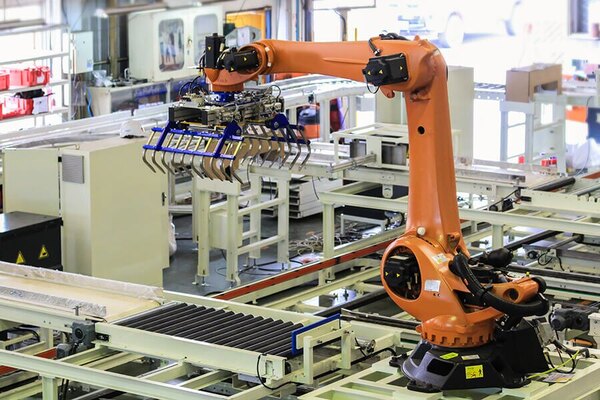
What is a Robot?
An industrial robot is a mechanical system designed to perform manufacturing tasks automatically, featuring reprogrammable and multi-functional capabilities. Unlike fixed machinery, robots possess flexible joints (often called degrees of freedom) and intelligent sensor systems, allowing them to interact with their environment and perform complex human-like maneuvers but with superior speed and stability.
Types of Industrial Robots
Based on structure and purpose, industrial robots are divided into several popular types:
- Articulated Robots: The most common type with rotary joints, typically used for welding, painting, and assembly.
- Collaborative Robots (Cobots): A new generation of robots designed to work safely alongside humans without safety fences.
- Delta Robots (Parallel Robots): Featuring ultra-high speeds, these are specialized for packaging and sorting lightweight products.
- SCARA Robots: Ideal for “pick-and-place” tasks thanks to a flexible arm structure on a horizontal plane.
Benefits of Industrial Robots
The deployment of robots brings undeniable surplus value:
- Increased Productivity: Robots work continuously 24/7 without rest, unaffected by psychological factors or health issues.
- Consistent Quality Assurance: Production errors are minimized to nearly zero (ranging from 0.01mm 〜 0.1mm).
- Occupational Safety: Robots take over heavy, toxic, or hazardous jobs (such as arc welding, chemical handling, or high-temperature environments).
Industrial Automation
If robots are the “arms,” then automation is the “nervous system” that controls the entire operational process. Robotics and Automation go beyond simply replacing humans with machinery; it is about optimizing the entire supply chain through control algorithms and management software. Below is an overview of how automation is reshaping the face of manufacturing.
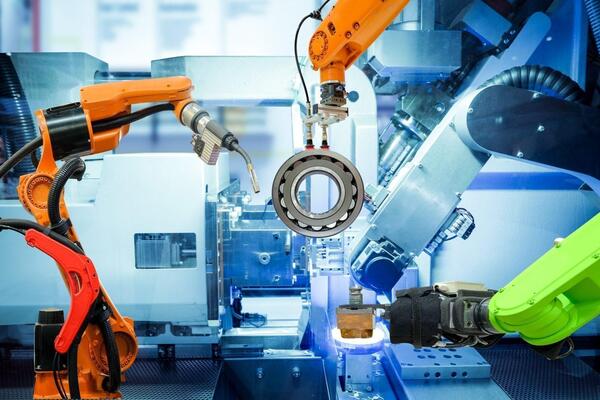
What is Automation?
Industrial automation is the use of control systems (such as PLC, SCADA, and AI) to operate equipment and production processes without direct human intervention. The core objective is to create a closed-loop process where data is collected, processed, and responded to immediately to maintain optimal performance.
Benefits of Automation
Automation helps businesses solve difficult economic equations:
- Optimizing Operating Costs: Significantly minimizing raw material waste and saving energy.
- Production Flexibility: Easily changing production processes by simply updating software instead of replacing entire production lines.
- Real-time Monitoring Capabilities: Business leaders can track factory performance from anywhere through intelligent dashboards.
Applications of Automation in Industry
Today, automation is present in every corner of the factory:
- Automated Assembly Lines: Predominant in the electronics and automotive industries.
- Automated Storage and Retrieval Systems (AS/RS): Utilizing Autonomous Mobile Robots (AMR) and Automated Guided Vehicles (AGV) to transport goods automatically.
- Machine Vision Quality Inspection: Using AI-powered cameras to detect product defects with absolute precision.
Should You Invest in Robotics and Automation?
This is a question that every business owner ponders. Although the initial investment cost for Robotics and Automation can be substantial, looking at the long-term equation reveals a highly favorable Return on Investment (ROI).
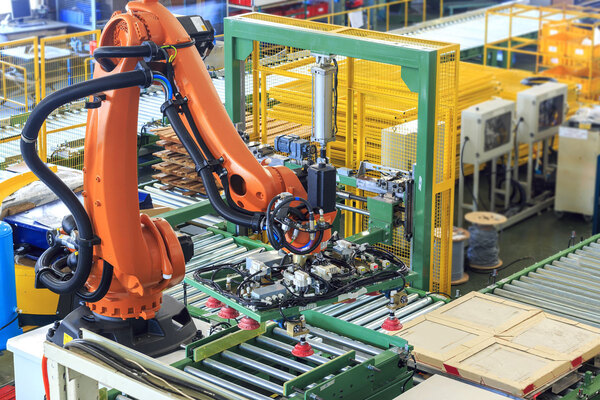
In a landscape of rising labor costs and a shortage of high-skilled workers, automation helps businesses reduce their dependency on human labor. However, enterprises need a specific roadmap: start with the smallest, most error-prone stages for testing before scaling up to the entire factory. Investing in technology is not merely about purchasing machinery; it is an investment in core competitive capabilities to ensure you do not fall behind global competitors.
Future Trends of Robotics and Automation
The future of the manufacturing industry will be defined by the intersection of Artificial Intelligence (AI) and physical machinery. We are steadily moving toward the era of “Lights-out Manufacturing“-where systems operate entirely autonomously in the dark without the need for human presence.
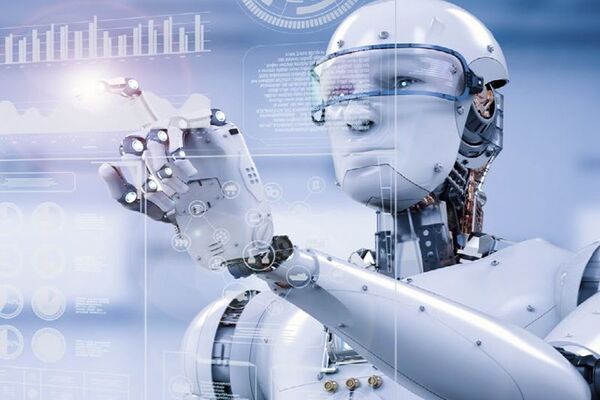
Some prominent trends include:
- AI-driven Robots: Robots will no longer just follow fixed programming but will possess the ability to self-learn and adapt to changing situations in the work environment.
- Industrial Internet of Things (IIoT): Every robot and machine will be interconnected via the cloud, enabling Predictive Maintenance—repairing machines before they even have a chance to fail.
- The Rise of Cobots: Robots will no longer be confined to steel cages; they will become friendly “colleagues,” supporting humans in tasks that require dexterity and creativity.
- Green Manufacturing: Automation will focus on minimizing carbon footprints, utilizing renewable energy, and recycling materials more efficiently.
In conclusion, Robotics and Automation are the keys to unlocking new doors of productivity. Businesses that master this technology early will possess an absolute advantage in conquering the global market.
