


In the era of Industry 4.0, competition between businesses is no longer just about price; the key factor is product quality. A single minor error on the production line can lead to billions in losses and shake customer confidence. Therefore, Quality Control has become the “backbone” of all manufacturing and service activities. This article will help you understand everything from basic concepts to the most effective implementation methods today.
What is Quality Control?
Quality Control (QC) is a component of quality management focused on fulfilling quality requirements. It is a systematic process designed to inspect, evaluate, and adjust various factors within the production process to ensure the final product meets established standards.
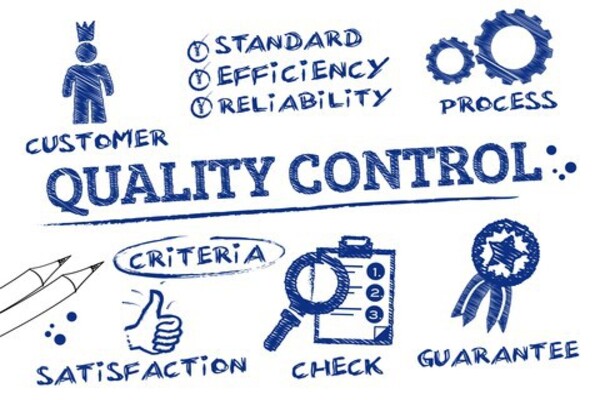
Simply put, if quality management is the overall strategy, then Quality Control represents the actual actions taken on the ground. It involves measuring, comparing against standards, and implementing corrective measures when deviations occur. The ultimate goal is to eliminate defective products before they reach consumers, ensuring the consistency and reliability of goods.
The Role of Quality Control
Implementing a strict control system is not just a task for the technical department; it is a survival strategy for the business. Below are the core values this process brings, helping businesses optimize resources and assert their market position through these specific aspects:
Improving Product Quality
The primary goal is to ensure every product leaving the factory is up to standard. Through continuous inspection, businesses can detect technical flaws early, thereby refining the process to make products increasingly perfect in both functionality and aesthetics.
Enhancing Brand Reputation
Modern customers are extremely demanding. A defective product can lead to negative reviews spreading rapidly on social media. Effective Quality Control helps build trust and creates an image of a reputable, responsible, and sustainable brand.
Reducing Production Costs
It may sound counterintuitive, but investing in Quality Control is actually the most effective way to save costs. By detecting errors right at the input stage or mid-process, businesses avoid wasting raw materials on faulty products and reduce costs related to recalls, warranties, and complaint handling.
Regulatory Compliance
Every industry has its own safety and technical standards (such as ISO, HACCP, or GMP). Quality Control ensures all processes operate within the legal framework, avoiding legal troubles and penalties from authorities.
Factors to Control for Quality Assurance
To achieve perfection, businesses must focus on the 4M1E model—the five core pillars that determine output quality. Effective Quality Control must not overlook any of the following elements:
- Manpower: The skill levels, sense of responsibility, and formal training of the employees.
- Machines: Equipment precision, regular maintenance schedules, and the technology in use.
- Materials: Input quality from suppliers must be strictly scrutinized and audited.
- Methods: Standard Operating Procedures (SOPs) and clear, concise work instructions.
- Environment: Factors such as temperature, humidity, lighting, and workspace conditions that directly impact the process.
Popular Quality Control Methods
Currently, numerous methods and tools assist businesses in optimizing their control processes. Depending on the scale and specific nature of the industry, enterprises can flexibly apply the following modern methods to achieve maximum efficiency:
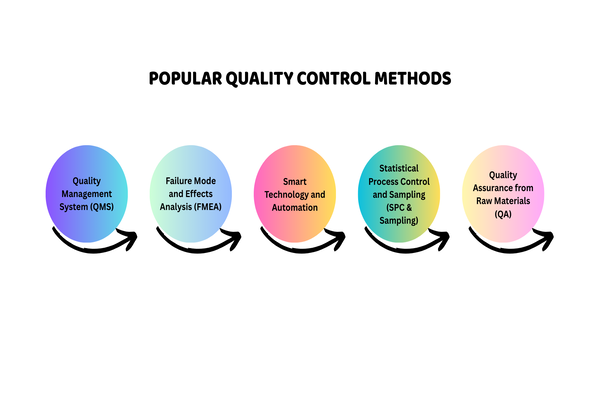
Quality Management System (QMS)
A QMS acts as the administrative “framework,” helping to document all processes, procedures, and personnel responsibilities. A prime example is the ISO 9001 standard, which enables businesses to move away from intuitive management toward scientific, consistent, and systematic operations across the entire organization.
Failure Mode and Effects Analysis (FMEA)
Instead of passively waiting for errors to occur, FMEA allows businesses to stay one step ahead. By forecasting potential risks during the design stage, evaluating their severity, and establishing preventive measures, FMEA helps eliminate issues in their infancy.
Smart Technology and Automation
In the digital age, the integration of AI, IoT sensors, and Machine Vision has sparked a revolution. This technology eliminates human sensory errors, allowing for the detection of microscopic defects with absolute precision and processing speeds of thousands of products per minute.
Statistical Process Control and Sampling (SPC & Sampling)
To balance efficiency and cost, the SPC method utilizes statistical charts to monitor the “health” of the production line in real-time. Instead of wasting resources on 100% inspection, scientific probability sampling ensures an accurate assessment of the entire batch’s quality.
Quality Assurance from Raw Materials (QA)
Unlike final-stage inspections, Quality Assurance (QA) focuses on a systematic prevention mindset. By tightening supplier standards and strictly auditing input materials, businesses ensure a simple yet sustainable philosophy: “Only with pure raw materials can the final product be perfect.”
Effective Quality Control Implementation Process
Building a Quality Control process is not something that happens overnight. It requires seamless coordination between departments and a well-structured roadmap. A standard process typically encompasses comprehensive steps, from initial preparation to final improvement:
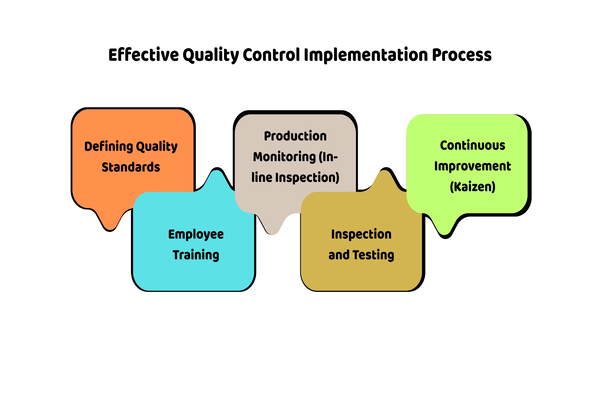
Defining Quality Standards
All control efforts are meaningless without a precise “yardstick.” Businesses must concretize standards for dimensions, weight, color, durability, and other factors into specific quantitative data. Eliminating ambiguity in criteria ensures that the evaluation process remains objective and consistent.
Employee Training
Humans are the core of the operational system. Beyond training on how to use measurement tools, businesses need to foster a sense of responsibility in every employee. When individuals understand that “quality is the survival of the company,” they become the most reliable “safeguards.”
Production Monitoring (In-line Inspection)
This is the “live” control phase directly on the production floor. Tight supervision allows management to immediately detect process deviations, enabling timely adjustments and preventing systemic errors before they cause significant damage.
Inspection and Testing
At this stage, samples undergo rigorous laboratory testing for physical and chemical properties. This serves as the “final exam” to confirm that the product is not only aesthetically pleasing but also safe and functions perfectly according to design commitments.
Continuous Improvement (Kaizen)
In the world of quality, there is no such thing as “good enough.” Based on the actual data collected, businesses apply the PDCA cycle (Plan – Do – Check – Act) to deep-dive into existing weaknesses. Continuously listening to feedback and relentlessly improving is the key to maintaining a leading market position.
Quality Control is not merely a technical stage but a fundamental business philosophy. Investing appropriately in QC is the key to sustainable development, profit optimization, and winning total customer trust. Start standardizing your process today to ensure you don’t fall behind in the global quality race.
