


In the digital era, relying on a single cloud provider poses significant risks. Therefore, a Multi Cloud strategy has become an essential solution, helping businesses optimize the strengths of platforms like AWS, Azure, or Google Cloud. While offering great flexibility, this model also presents challenges in governance and security. This article will provide a detailed analysis of the mechanisms, benefits, and risks of implementing Multi Cloud.
What is Multi-Cloud?
Multi-Cloud is a computing model that uses a combination of at least two Public Cloud services from different providers. A key distinction between Multi-Cloud and Hybrid Cloud is its focus on distributing workloads across multiple public cloud infrastructures, rather than simply combining cloud with on-premise infrastructure.
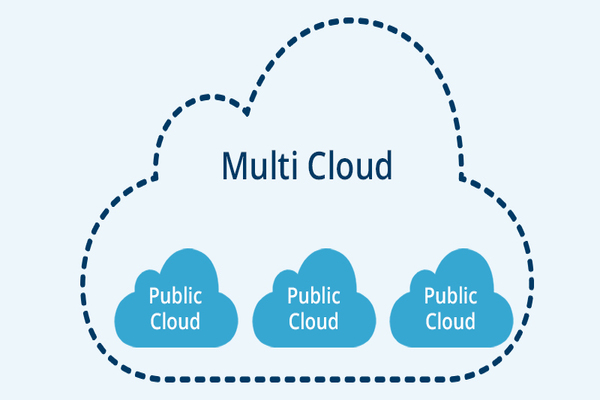
The primary goal of Multi-Cloud is not just data storage, but performance optimization by selecting the “best-of-breed” services from each provider. For example, a business might use Google Cloud for data analytics and Machine Learning (AI/ML) tasks, while utilizing Microsoft Azure for office applications and internal management systems. This creates a flexible ecosystem that prevents the business from being tied to a single provider (Vendor Lock-in).
How Multi-Cloud Works
The operational mechanism of Multi-Cloud is based on the principles of fragmentation and connectivity. Instead of putting all resources into one basket, businesses break down their software architecture into independent components. These components communicate with each other via the internet or specialized connections (such as AWS Direct Connect or Azure ExpressRoute).
To ensure the system operates smoothly, businesses often implement Abstraction layers. These layers help standardize application deployment processes, making it easier to transition between different clouds. The seamless orchestration of storage, computing, and security services from various sources is the key to maintaining high availability and superior fault tolerance within a Multi-Cloud setup.
Pros and Cons of Multi-Cloud
Adopting a Multi-Cloud strategy is a double-edged sword. On one hand, it liberates businesses from technological constraints; on the other, it demands a significantly higher level of technical management compared to traditional models. Below is an overview of both sides of this strategy:

Advantages:
- Cost Optimization: Businesses can take advantage of competitive pricing and discount programs from various providers.
- Minimized Downtime Risks: If one provider experiences an outage, the system can reroute to another provider to maintain operations.
- Regulatory Compliance: It facilitates storing data in specific geographic regions to meet data protection laws (such as GDPR).
Disadvantages:
- Management Complexity: It requires an IT team proficient in multiple different platforms.
- Hidden Costs: Data transfer fees between clouds (Egress fees) can be exceptionally high.
- Security Risks: The more integration points there are, the broader the attack surface becomes.
Real-World Applications of Multi-Cloud
In practice, Multi-Cloud is no longer a foreign concept but is present in almost all large corporations. The most common applications include:
- Disaster Recovery (DR): Businesses store primary data on one cloud and maintain a backup copy on another cloud to ensure absolute safety.
- Latency Optimization: Utilizing providers with data centers closest to end-users in specific geographic areas.
- Big Data Analytics: Leveraging specialized Big Data tools from one provider (such as Google’s BigQuery) while the main application continues to run on a different platform.
- Development and Testing (Dev/Test): Running development environments on lower-cost clouds while deploying the actual Production environment on clouds with the highest security and performance.
Core Technologies in Multi-Cloud
To realize a Multi-Cloud strategy, businesses require a robust technological toolkit to blur the boundaries between providers. These technologies act as the “glue” that connects disparate infrastructures into a unified whole.

Containerization
Containers (such as Docker) allow applications to be packaged along with all necessary libraries and configurations. This ensures that the application performs consistently regardless of the cloud platform it runs on, eliminating concerns over differences between operating systems or server environments.
Container Orchestration
When the number of containers reaches the thousands, manual management becomes impossible. Kubernetes (K8s) has become the gold standard for automating the deployment, scaling, and management of containerized applications in Multi-Cloud environments, helping to efficiently coordinate resources across different server clusters.
Infrastructure as Code (IaC)
Tools like Terraform or Ansible allow developers to define infrastructure using source code. Thanks to IaC, you can provision a wide array of servers, networks, and databases across multiple clouds with just a few lines of code, ensuring accuracy and repeatability.
Cloud Management Platforms (CMPs)
Centralized management platforms provide a “single pane of glass” to monitor performance, resource consumption, and costs across all providers. This gives managers a holistic view without the need to log into each separate dashboard.
Application Programming Interfaces (APIs)
APIs serve as the communication bridge between services. In a Multi-Cloud strategy, using standardized APIs allows applications on Cloud A to retrieve data or trigger functions from Cloud B seamlessly and securely.
Advanced Networking Technology SD-WAN
(Software-Defined Wide Area Network) and multi-point VPN solutions help optimize data flows, ensuring that connections between clouds remain stable, low-latency, and securely encrypted.
Advantages of Multi-Cloud
The greatest advantage offered by Multi-Cloud is autonomy. Businesses no longer need to worry about being “price-gouged” by a single provider or being heavily impacted when a vendor changes its service policies. Infrastructure diversification bolsters innovation because technical teams always have access to the latest technologies from across the entire cloud market, rather than being restricted to a narrow service catalog.

Furthermore, Multi-Cloud significantly optimizes network performance. By distributing workloads, businesses can minimize bottlenecks and ensure the user experience remains at its peak, regardless of sudden spikes in traffic volume.
Limitations and Challenges of Multi-Cloud
Despite its many advantages, a Multi-Cloud strategy poses substantial governance challenges. The most daunting issue is the shortage of high-quality personnel; finding experts with certifications and hands-on experience across AWS, Azure, and Google Cloud is a hurdle for any HR department.
Additionally, security becomes more complex as each provider operates under its own Shared Responsibility Model and unique security tools. Without a consistent security policy and end-to-end monitoring tools, businesses are prone to exposing critical vulnerabilities during data transit. Finally, operational costs can skyrocket if a business fails to strictly control Cloud Sprawl (resource wastage) across different platforms.
The Multi-Cloud strategy is a promising yet challenging journey. To succeed, businesses need a clear roadmap, investment in modern orchestration technologies, and continuous upskilling of their workforce. When implemented correctly, Multi-Cloud serves as a powerful launchpad for growth and agility for any enterprise in the digital future.
