


In the era of digitalization, Blockchain technology has emerged as a revolution, not only in the financial sector but also expanding into many other industries. However, the core strength that gives Blockchain its value is its exceptional security capability. Understanding Blockchain Security is not merely grasping a technical aspect; it is also the key to unlocking the full potential of this technology. This article will delve into the layers of security, the potential challenges, and the future of security in the Blockchain world.
What is Blockchain Security?
The concept of Blockchain Security encompasses all mechanisms, protocols, and layers of defense designed to protect the distributed ledger from malicious activities, fraud, and other forms of attack. The ultimate goal is to ensure the integrity, immutability, and availability of the data stored on the Blockchain.

To better understand, imagine the Blockchain as a chain of blocks linked together using cryptography. Blockchain Security is the summation of many factors: the use of hash functions to create a unique fingerprint for each block; the consensus mechanism to verify and approve transactions; and public/private key encryption to determine asset ownership. The tight integration of these elements creates a robust decentralized self-defense system.
How Secure is Blockchain?
Blockchain is considered one of the safest technologies available today, thanks to its unique design structure and core operating principles. This security does not come from a central authority but from decentralization and cryptographic principles.

Blockchain’s security is built upon three main pillars.
- The first is Cryptography: each block contains a cryptographic hash of the previous block, forming a continuous chain. If an attacker changes the data within one block, the hash of that block changes, invalidating all subsequent blocks, and this alteration will be immediately detected by the network.
- The second is Decentralization: the data is not housed on a single server but is replicated and distributed across thousands or millions of nodes in the network. To alter the data, an attacker would have to control and change the information on at least 51% of the nodes, which is an almost impossible task.
- The third is the Consensus Mechanism: algorithms like Proof-of-Work (PoW) or Proof-of-Stake (PoS) require nodes to agree on the validity of transactions and the order of blocks before a new block is added to the chain.
Security by Blockchain Type
Not all Blockchains possess the same level of security; it depends on the type and structure of the network. The difference in managing access control and authentication creates distinct requirements and challenges for Blockchain Security.
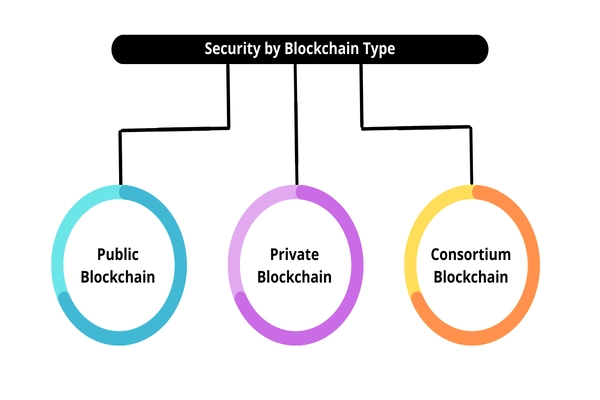
- Public Blockchain: This is a completely decentralized type (e.g., Bitcoin, Ethereum). The security level is very high due to the large scale of the network and rigorous consensus mechanisms.
- Private Blockchain: The network is managed by a single organization. Decentralization is lower. Security focuses on managing access control and the identity of authorized members.
- Consortium Blockchain: Managed by a predefined group of organizations. Security relies on mutual trust among alliance members and established network layer security protocols.
Major Threats to Blockchain Security
Although Blockchain is a secure technology, it is not completely immune to all threats. Most attacks do not target the core cryptographic technology itself but often exploit vulnerabilities in the consensus mechanism or the application layer. This requires developers and users to always remain vigilant to reinforce Blockchain Security.
51% Attack
A 51% attack is a serious threat, especially to smaller Blockchains that use the Proof-of-Work (PoW) or Proof-of-Stake (PoS) mechanism.
If an entity can control more than 50% of the total computing power (hash rate) of a PoW network (or more than 50% of the total staked tokens in a PoS network), they have the potential to carry out malicious acts such as preventing new transactions from being confirmed, or reversing executed transactions (leading to the double spending problem). Controlling such a large amount of resources represents a very significant economic and technical barrier for large networks.
Double Spending
Double spending is the act of using the same digital asset (token/coin) to execute two or more different transactions.
In the Blockchain environment, security against double spending is an essential principle. It is resolved by ensuring that all transactions are ordered chronologically and agreed upon by all nodes in the network through consensus. If an attacker possesses enough power (as in a 51% attack) to create a separate Blockchain branch and confirm a duplicate transaction before the main network confirms the original one, they might be able to execute double spending.
Sybil Attack
A Sybil attack occurs when an attacker creates a large number of fake identities (fake nodes) to gain control of the network and disrupt the consensus mechanism.

The goal is to overload the network or seize a large proportion of voting or transaction validation processes. Large, public Blockchains counteract Sybil attacks through resource expenditure (such as PoW requiring computational power, and PoS requiring collateral assets) to create nodes. Private or newly established networks may be more vulnerable if they lack strong identity management mechanisms.
Smart Contract Vulnerabilities
Smart Contracts are self-executing code snippets stored on the Blockchain. They are the backbone of decentralized applications (DApps) and decentralized finance (DeFi).
Vulnerabilities usually do not reside in the Blockchain itself but rather in programming errors within the smart contract’s source code. A small bug can allow an attacker to withdraw funds or exploit functions illegitimately. Due to the immutable nature of the Blockchain, once a vulnerable smart contract is deployed, fixing it is extremely difficult, making code auditing a critically important security step.
Blockchain Security Applications in Business
The capabilities of Blockchain Security have extended beyond digital currency and are being utilized by businesses to address issues of data security and trust.
- Supply Chain Management: Blockchain provides an immutable record of a product’s origin, movement, and ownership, preventing counterfeiting.
- Healthcare Data Security: Patient data is encrypted and stored, allowing patients to control access via their private keys.
- Decentralized Digital Identity (DID): Users can own and control their digital identity, mitigating the risk of identity theft.
Future Trends in Blockchain Security
The field of Blockchain Security is constantly evolving to counter new threats and meet scalability needs. These innovations will further solidify Blockchain’s position as a leading security technology.

- Zero-Knowledge Proofs (ZKP): Allows one party to prove a statement is true without revealing any information beyond the statement itself, thereby improving privacy.
- Advanced Smart Contract Security: Applying AI-powered automated auditing tools and upgradeable contract models to mitigate the risk of source code errors.
- Post-Quantum Cryptography: Research into transitioning to quantum-resistant algorithms to address the threat from quantum computers in the future.
Frequently Asked Questions about Blockchain Security
Can data on the Blockchain be altered?
Theoretically, data on the Blockchain is immutable. Changing data after a block has been added to the chain is extremely difficult-almost impossible for large public Blockchains-due to the requirement of controlling a majority of the network and recalculating the entire chain.
Is my cryptocurrency wallet safe on the Blockchain?
The cryptocurrency wallet itself is not stored on the Blockchain. Wallet security depends on how you protect your Private Key. If your private key is leaked, your assets will be at risk, not due to a flaw in the Blockchain but due to a personal security failure.
Does Blockchain require traditional security measures?
Yes, while the Blockchain’s protocol layer protects itself using cryptography, the application layers and infrastructure layers (servers, wallets, exchanges) still require traditional security measures such as firewalls and Intrusion Detection Systems (IDS) to guard against external attacks.
Blockchain Security technology is not just a feature but a core foundation-a promise of a more secure and decentralized digital future. As this technology continues to evolve, upholding security principles and constant innovation will be the decisive factors in its success and widespread adoption across all sectors.
zzz
