


In today’s digital era, Blockchain technology has become one of the most prominent and revolutionary trends. A Blockchain platform not only enables transparent data storage and management but also opens up numerous application opportunities in finance, logistics, healthcare, and many other fields. This article provides a detailed overview of Blockchain platforms, including their features, classifications, applications, and ecosystems.
What is a Blockchain platform?
A Blockchain platform is a technology platform built on Blockchain that allows the development, deployment, and management of decentralized applications (dApps) as well as smart contracts. Essentially, a Blockchain platform is more than a distributed digital ledger; it also provides tools and protocols for businesses or individuals to develop applications that are secure, transparent, and scalable.

A Blockchain platform can be envisioned as an “operating system” for Blockchain. It manages transaction validation, data storage, and information security, while enabling developers to create customized solutions. These platforms typically have large developer communities and provide a wide range of tools and libraries, making application deployment much easier.
Key Features of a Blockchain Platform
A modern Blockchain platform possesses several notable features that distinguish it from traditional data storage systems. The following are key aspects that any business or developer should understand.

Scalability
Scalability is one of the biggest challenges in Blockchain technology. A high-quality Blockchain platform must be able to handle a large volume of transactions without compromising system performance. For example, platforms like Ethereum 2.0 and Solana have implemented sharding and proof-of-stake mechanisms to enhance scalability, enabling them to process thousands to millions of transactions per second.
Flexibility and Functionality
A flexible Blockchain platform allows customization of features to meet specific business needs. This includes deploying smart contracts, issuing proprietary tokens, or building complex dApps. The more flexible the platform, the easier it can integrate with existing systems, from ERP and CRM to IoT or AI solutions.
Security
Security is always a top priority for any Blockchain platform. These platforms use advanced encryption algorithms and decentralized consensus mechanisms to prevent data tampering and cyberattacks. Additionally, many platforms support automated auditing and end-to-end data verification, ensuring the integrity of information.
Public or Private
Blockchain platforms can be broadly classified based on access permissions: public or private. Public platforms, like Ethereum, allow anyone to join the network and fully transparent transactions. In contrast, private platforms, such as Hyperledger Fabric, restrict access to authorized members only, making them suitable for organizations that require strict data privacy.
Classification of Blockchain Platforms
Based on architecture, consensus mechanisms, and access permissions, Blockchain platforms can be categorized into several types:
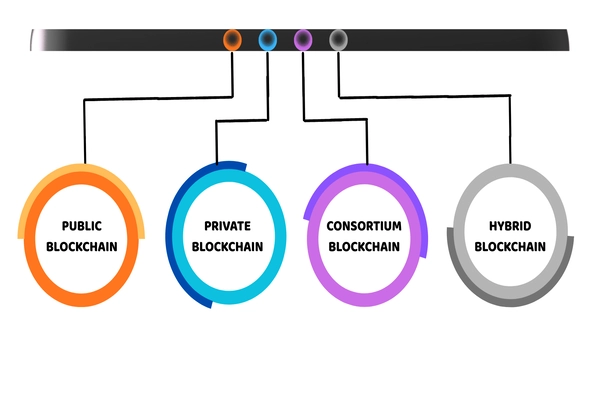
- Public Blockchain: A Public Blockchain allows anyone to join the network and validate transactions. Examples include Bitcoin and Ethereum. Its advantages are high transparency and decentralization, although scalability can sometimes be limited.
- Private Blockchain: A Private Blockchain restricts participation to authorized individuals only. Examples include Hyperledger and R3 Corda. Its advantages include strong data control, but it offers lower decentralization compared to public blockchains.
- Consortium Blockchain: A Consortium Blockchain is controlled by a group of organizations, combining features of both public and private blockchains. It is often applied in industries such as banking or logistics.
- Hybrid Blockchain: A Hybrid Blockchain combines the benefits of both public and private blockchains, allowing sensitive data to be secured while maintaining the necessary transparency.
Choosing the right type of Blockchain platform depends on the goals, security requirements, and scale of the business or project.
Real-World Applications of Blockchain Platforms
Blockchain platforms are not just theoretical concepts—they have been widely applied across various industries:

- Finance and Banking: Banks use Blockchain platforms to process cross-border payments, manage securities transactions, and reduce the risk of fraud.
- Supply Chain and Logistics: Blockchain platforms help track goods, ensuring transparency from production to the end consumer.
- Healthcare: They are used to securely store medical records and share data among hospitals while protecting patient privacy.
- Real Estate: Smart contracts on Blockchain platforms automate the buying and selling process, reduce paperwork, and accelerate transactions.
- Media and Entertainment: Blockchain platforms enable copyright management, digital content licensing, and royalty payments through blockchain tokens.
These applications demonstrate that Blockchain platforms not only enhance security but also improve operational efficiency and reduce costs.
Ecosystem of a Blockchain Platform
A robust Blockchain platform is always supported by a complete ecosystem, including:
- Developer Community: Contributes to the platform’s development, testing, and upgrades.
- Development Tools: SDKs, APIs, and smart contract libraries facilitate easier application deployment.
- Integration Partners and Businesses: Companies can integrate the platform into existing systems to increase business value.
- Governance Mechanisms: Ensure the platform operates sustainably, transparently, and stays regularly updated.
This ecosystem enables a Blockchain platform not only to survive but to thrive, opening up numerous opportunities for future applications.
Blockchain platforms are no longer a technology of the future—they have become practical solutions applied across multiple industries to enhance transparency, security, and efficiency. Understanding their features, classifications, applications, and ecosystem helps businesses and developers fully leverage the potential of Blockchain technology. With the continuous evolution of Blockchain platforms, the future of decentralized applications and new business models is closer than ever.
