


Over the past decade, the world has witnessed the powerful rise of distributed ledger technology. From the birth of Bitcoin (Blockchain 1.0) to Ethereum’s smart contracts (2.0) and the scalability of Cardano or Polkadot (3.0), this technology has evolved continuously. Now, we are entering the era of Blockchain 4.0—where technology is no longer reserved solely for the financial sector but has become the “backbone” of the entire Industry 4.0 infrastructure.
1. What is Blockchain 4.0?
To understand Blockchain 4.0, we must first look back at the evolutionary journey of previous generations. While its predecessors focused on solving the problems of transactions and basic decentralization, version 4.0 aims for a higher goal: Practical applicability in enterprises (Blockchain for Business).
Blockchain 4.0 is the generation of blockchain technology focused on deep integration with real-world business processes, Artificial Intelligence (AI), the Internet of Things (IoT), and Big Data. Its primary objective is to fundamentally resolve the “blockchain trilemma” (Scalability, Security, Decentralization) to meet the demand for processing millions of transactions per second for multinational corporations. It is not merely a data storage network, but an intelligent, automated operating system capable of seamless cross-chain interoperability.
2. How Blockchain 4.0 Works
The operational mechanism of Blockchain 4.0 differs significantly from older generations due to the optimization of data structures and consensus algorithms. Instead of relying on energy-intensive Proof of Work (PoW) mining, this generation utilizes more advanced methods to maintain the network.
The core operating principle of Blockchain 4.0 is based on a combination of Sidechains, Sharding, and Interoperability protocols. Specifically:
- Parallel Processing: Instead of validating blocks sequentially, Blockchain 4.0 allows for multiple transactions to be processed simultaneously across different branches.
- Next-Generation Smart Contracts: Smart contracts can now self-trigger based on real-world data from IoT sensors via Oracles. This enables supply chain automation without the need for human intervention.
3. Decentralized Blockchain 4.0
Decentralization has always been the “soul” of blockchain, but in version 4.0, this concept is elevated to suit industrial scales. Decentralization no longer implies being slow or difficult to manage.
In the Blockchain 4.0 ecosystem, decentralization is maintained through globally distributed networks of nodes, supported by intelligent consensus algorithms such as Delegated Proof of Stake (DPoS) or Proof of Authority (PoA). This ensures that:
- No Single Point of Failure: The network continues to function even if a large portion of nodes encounter issues.
- Community Governance: Users have the right to participate in voting on system changes (Governance), creating a true digital democratic environment.
4. Advantages of Blockchain 4.0
Why are businesses so eager to transition to Blockchain 4.0? The answer lies in the breakthrough improvements that previous generations simply could not provide. Here are the prominent advantages that make Blockchain 4.0 a “game changer”:
- Ultra-fast Transaction Speeds: Processing capacity can reach hundreds of thousands of transactions per second (TPS), equaling or even surpassing Visa’s systems.
- Low Costs: Thanks to optimized consensus algorithms, gas fees or transaction costs are reduced to a minimum, making it suitable even for micropayments.
- User-Friendliness: With easier Application Programming Interfaces (APIs) and Software Development Kits (SDKs), traditional programmers can now build applications on the blockchain with ease.
- Sustainability: Extremely low energy consumption, fundamentally solving the environmental concerns currently faced by Bitcoin.
5. Types of Blockchain 4.0
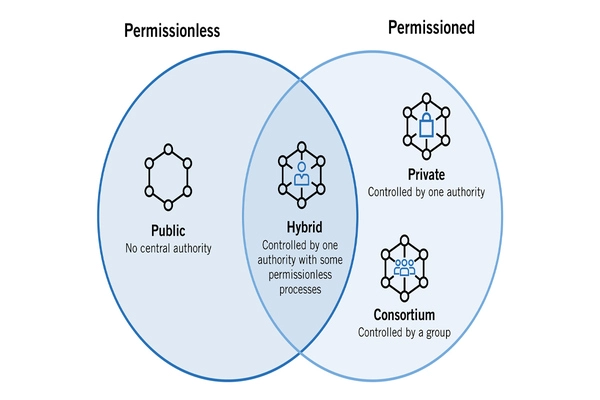
Depending on the needs of an organization or individual, Blockchain 4.0 is divided into different models. Each type has its own characteristics regarding access rights and security. We can classify Blockchain 4.0 into three main groups:
5.1. Public Blockchain
This is a type where anyone can join, read data, and send transactions. In the 4.0 era, Public networks focus on infinite scalability and connecting large user communities globally.
5.2. Private Blockchain
Exclusively for a specific organization or business. Here, control is centralized within a single entity, ensuring absolute internal security and the fastest possible processing speeds for accounting or human resource management processes.
5.3. Permissioned Blockchain
This is a hybrid between Public and Private. In this network, anyone can view data (if permitted), but only designated nodes have the right to validate transactions. This model is extremely popular among banking alliances or international food supply chains.
6. Security of Blockchain 4.0
Cybersecurity is the top priority when putting technology into practical operation. Blockchain 4.0 utilizes the most advanced encryption technologies to protect user assets and data. The security system of Blockchain 4.0 is built upon multiple layers of defense:
- Quantum-Resistant Cryptography: Preparing for a future where quantum computers could potentially break current encryption algorithms.
- Zero-Knowledge Proofs (ZKP): Allowing for transaction validation without revealing the specific details of that transaction, ensuring maximum privacy protection.
- Self-Healing Mechanisms: Nodes have the ability to automatically detect and eject malicious components attempting to infiltrate the network.
7. Applications of Blockchain 4.0
The true power of Blockchain 4.0 lies in its ability to permeate every corner of daily life and industrial production. It is no longer just “virtual currency” but a solution to today’s most pressing challenges. Typical applications include:

- Smart Manufacturing: Tracking the product lifecycle from raw materials to the consumer, guaranteeing 100% authentic goods.
- Healthcare: Securing electronic medical records, allowing doctors instant access while maintaining strict patient privacy.
- Logistics: Optimizing shipping routes and automating customs payments through smart contracts.
- E-Government: Bringing transparency to voting activities, managing citizen identities, and distributing social welfare benefits.
8. The Role of Blockchain 4.0 in Modern Technology
In the Fourth Industrial Revolution, Blockchain 4.0 serves as the “glue” that connects other breakthrough technologies, creating a comprehensive digital ecosystem. Blockchain 4.0 does not operate in isolation; rather, it serves as the foundational platform for:
- The Data Economy: Providing a secure environment for buying and selling AI data without the fear of theft.
- Metaverse and Web3: Creating a foundation for true digital asset ownership, where users have full control over their identities in cyberspace.
- Global Automation: Enabling IoT devices to transact with one another (Machine-to-Machine payments) without the need for human intermediaries.
Blockchain 4.0 is not merely a technical upgrade; it is a revolution in the mindset of technological application. By combining speed, security, and diverse integration capabilities, it is laying the first bricks for a digital future that is more transparent, efficient, and equitable.
