


In the era of digital transformation, data is often compared to a business’s “oil.” However, oil only holds value when it is transported and refined. API Integration acts as the most modern pipeline system, helping information flow smoothly between different software platforms. This article will provide a detailed analysis, from the core concepts to the practical applications of this critical technological solution.
What is API Integration?
To understand API integration, we first need to imagine a world where software programs do not speak the same language. Without connectivity, employees must manually enter data from one system to another, leading to errors and a waste of time.
Definition of API
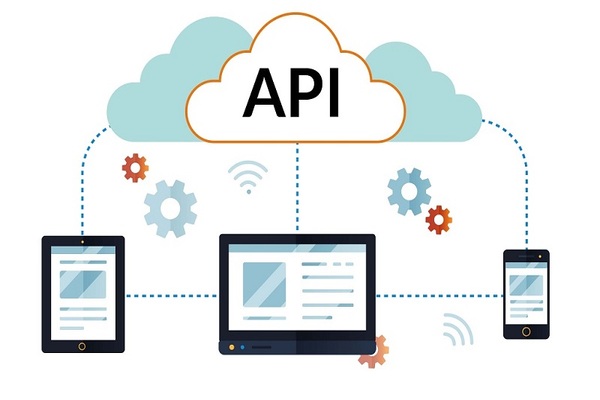
API (Application Programming Interface) is a bridge between applications. Imagine an API like a waiter in a restaurant: you (the user) place an order, the waiter takes that request to the kitchen (the software system), and brings the food (the result) back to you.
The Concept of API Integration
API Integration is the process of connecting two or more applications through their APIs to allow them to exchange data and perform functions without manual intervention. This creates a unified ecosystem where software components complement each other to optimize performance.
Types of API Integration
Depending on the needs for speed, security, and data structure, businesses can choose from various connection methods. Each type of integration has its own strengths and weaknesses, making it suitable for specific objectives.
REST API (Representational State Transfer)
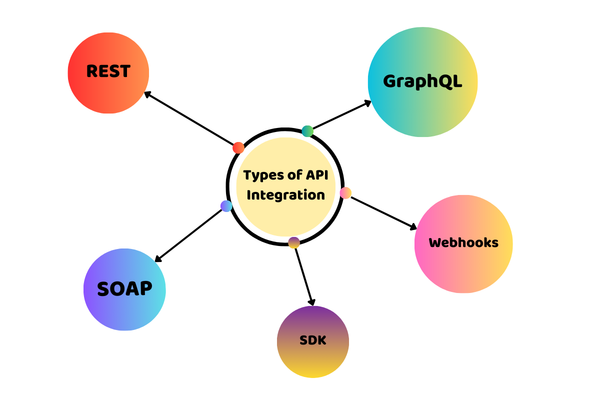
REST is currently the most popular architecture due to its simplicity, flexibility, and high compatibility with the Web. It utilizes standard HTTP methods (GET, POST, PUT, DELETE) and typically returns data in JSON format, making data transmission lightweight and fast.
SOAP (Simple Object Access Protocol)
Unlike REST, SOAP is a more rigid protocol that uses XML for information exchange. SOAP is preferred in banking systems or large enterprises thanks to its exceptionally high security and its ability to handle complex transactions safely.
GraphQL API
GraphQL is a query language for APIs developed by Facebook. Instead of receiving a fixed set of data like REST, GraphQL allows users to request exactly what they need. This helps reduce bandwidth load and increases processing speeds for mobile applications.
Webhooks
Webhooks are often referred to as “Reverse APIs.” Instead of your application having to constantly ask another system if there is new data (Polling), a Webhook will proactively “push” data to your application as soon as a specific event occurs (for example, when a customer successfully completes a payment).
Software Development Kit (SDK)
An SDK is a collection of tools, libraries, and sample code pre-packaged by providers (such as Google or Facebook). Using an SDK helps developers integrate complex features into applications much faster without having to write the code from scratch.
The Importance of API Integration in Business
In a fiercely competitive environment, the ability to react quickly to the market is a vital factor. API integration is no longer just a “nice-to-have” option but has become the core foundation of every modern business.
- Breaking Down Data Silos: Many businesses face a situation where the Sales department uses one software and Accounting uses another, leading to inconsistent information. API integration helps interconnect data, creating a “Single Source of Truth” for the entire organization.
- Enhancing Decision-Making Capabilities: When data from various departments is aggregated in real-time via APIs, management can monitor Key Performance Indicators (KPIs) with the highest accuracy. This enables strategic decisions based on actual figures rather than emotional guesswork.
How API Integration Works
The API integration process takes the form of a continuous information exchange cycle. To implement it successfully, managers need to understand the basic operating mechanisms behind the complex lines of code.
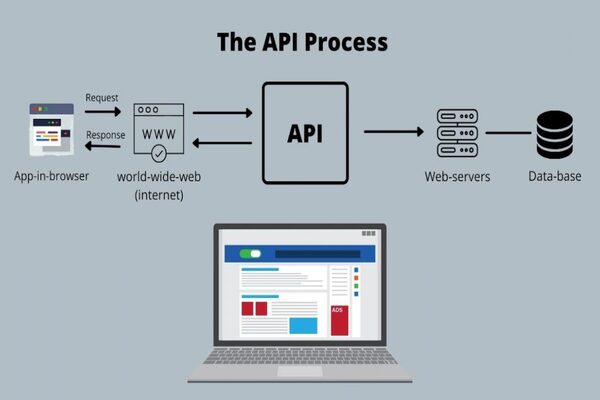
- Request and Response Mechanism: The process begins when an application (Client) sends a “request” to another system (Server) via an Endpoint. After authenticating the identity, the Server processes the request and sends back a “response” containing data or a status notification of success or failure.
- Security and Authentication Layers: To ensure that information does not leak, APIs use authentication methods such as API Keys, OAuth 2.0, or JWT (JSON Web Tokens). This protective layer ensures that only authorized parties can access the business’s data repository.
Benefits of API Integration
The power of API integration brings dual benefits: optimizing internal operations while enhancing the external customer experience. Below are the tangible values that businesses will receive.
- Workflow Automation: API integration helps eliminate repetitive tasks. For example: When a customer registers on a website, their information is automatically pushed into the CRM and Email Marketing system to send a welcome letter immediately without any manual intervention.
- Minimizing Human Error: Manual data entry always carries the risk of data discrepancies. With APIs, data is transmitted in its original form with 100% accuracy, helping accounting and logistics departments control goods and cash flow precisely.
Criteria for API Connection
Not all APIs are created equal. When choosing software for connection, businesses need to rely on a clear set of technical standards to ensure long-term system stability.
- Clear Documentation: A good API must have detailed, easy-to-understand documentation for developers. This includes code samples, error code lists, and configuration guides, which can help reduce actual implementation time by 50%.
- Scalability: The API system must be capable of handling sudden spikes in traffic (for example, on Black Friday). Businesses should prioritize APIs with robust infrastructure to ensure the system doesn’t “hang” when the number of API calls increases.
Costs of API Integration
The budget for API integration can fluctuate significantly depending on the scale and complexity of the project. Businesses need to carefully analyze expenses to calculate an effective ROI (Return on Investment).
- Initial Development Costs: These are the fees for hiring a programming team or purchasing integration platform-as-a-service (iPaaS) solutions. This cost covers architectural design, writing connection code, and conducting rigorous testing before going live.
- Maintenance and Upgrade Costs: Many API services charge based on the volume of data transmitted or the number of monthly API calls. Additionally, when partner software updates to new versions, businesses must allocate a budget for maintenance and adjusting the source code for compatibility.
API Integration Applications for Business
In reality, we utilize the results of API integration every hour without even realizing it. From booking a ride-hailing service to online shopping, APIs are everywhere.
- E-commerce and Payments: Retail websites integrate payment gateway APIs (such as VNPay, MoMo, PayPal) to process transactions instantly. Simultaneously, shipping APIs (such as Giao Hàng Nhanh, Viettel Post) help calculate shipping fees and automatically generate orders for the carrier.
- Customer Relationship Management (CRM): API integration between a CRM and social media platforms helps businesses collect customer feedback from Facebook or Zalo into a single dashboard. This allows customer service teams to respond faster and increases satisfaction rates.
Future Challenges of API Integration
Alongside the immense benefits, the era of connectivity also brings new risks. Businesses need to be prepared to face both technological and legal challenges.
- Security and Data Privacy: As data moves between multiple systems, the risk of hackers attacking these “connection points” is significant. Complying with standards like GDPR or implementing multi-layer security will become a heavy pressure for IT teams.
- Third-Party Dependency: If you integrate too deeply with a partner’s API, you face risks if that partner stops operating or suddenly changes their pricing policy. Therefore, “multi-platform” strategies and data backups will be inevitable trends in the future.
API Integration is not merely a technical task, but a smart business strategy. It helps enterprises become more flexible, agile, and professional in the eyes of their customers. To begin this journey, identify the manual processes that are slowing you down and search for the right connectivity solutions today!
