


In today’s fast-moving technological landscape, user experience can make or break a software product. A slow, unstable, or crash-prone application doesn’t just drive away customers – it causes serious, lasting damage to a company’s reputation. That’s why Application Performance Monitoring (APM) has become an indispensable part of the technology operations strategy for modern organizations.
What is Application Performance Monitoring (APM)?
Application Performance Monitoring (APM) is the collection of tools, processes, and methodologies used to track, measure, and manage the performance of software applications in real-world environments. The core objective of APM is to ensure that applications consistently run smoothly, meet user expectations, and achieve established performance benchmarks.
APM is far more than simply checking whether a server is running. It encompasses detailed data collection on response times, error rates, system resource consumption, user behavior, and transaction flows across the entire application architecture. From this data, engineering teams can detect bottlenecks early, predict incidents before they occur, and proactively optimize the end-user experience.
Why Does Application Performance Monitoring Matter?
In today’s digital business environment, every second of delay has a price. Research from Google shows that if a webpage takes more than 3 seconds to load, over 50% of users will abandon it. This raises a critical question: how can a business know how well its application is performing without the right monitoring tools?
This is precisely why APM has become essential. Without APM, operations teams typically only learn about an incident after users have already complained – meaning the damage is done. APM enables a shift from a reactive mindset to a proactive one: detecting problems before users ever feel them, maintaining consistent service quality, and making decisions based on real data rather than guesswork. For e-commerce platforms, online banking systems, or SaaS products, every minute of downtime equals lost revenue and eroded customer trust.
How Are APM Monitoring and APM Management Different?
Many people confuse Application Performance Monitoring (APM) with Application Performance Management (APM). Though they share the same abbreviation, the two concepts differ significantly in scope.
- Application Performance Monitoring focuses on collecting real-time data and tracking technical metrics such as response time, error rates, and CPU/memory usage. It forms the foundational layer, providing raw information about application health.
- Application Performance Management, in the broader sense, goes beyond monitoring to encompass root cause analysis, optimization planning, SLA (Service Level Agreement) goal-setting, and coordinating remediation actions. In short, if monitoring is about seeing the problem, management is about solving it systematically. Modern APM platforms typically integrate both dimensions into a unified solution.
Core Features of APM
An effective APM platform doesn’t just collect numbers – it needs to offer a comprehensive set of features that help engineering teams see the full picture of application health.
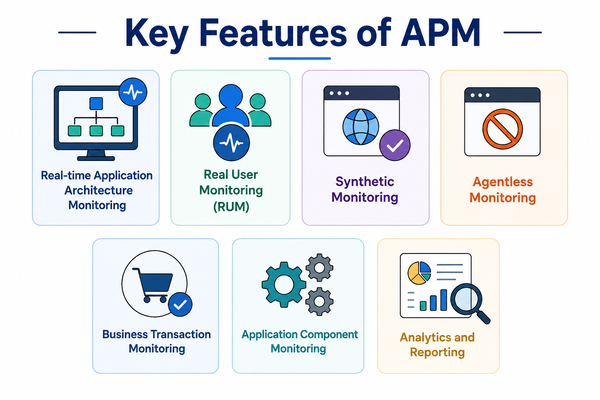
Real-Time Application Architecture Monitoring
This feature gives engineering teams a live overview of the entire application stack – from frontend and backend to databases and third-party services. When a component in the dependency chain begins to degrade, APM immediately identifies the location and impact, dramatically reducing Mean Time to Resolve (MTTR).
Real User Monitoring (RUM)
RUM collects data directly from the browsers or devices of actual users as they interact with the application. Rather than simulating behavior, RUM accurately reflects what users are genuinely experiencing – including page load times, interaction speed, error rates by geography, and device type. It’s an invaluable source of ground-truth data.
Synthetic Monitoring
Synthetic Monitoring complements RUM by using pre-scripted scenarios to simulate user behavior on a scheduled basis, even when there’s no real traffic. This is especially useful for detecting issues before real users encounter them, testing availability from multiple geographic locations, and verifying that critical flows like login, payment, or checkout always work correctly.
Agentless Monitoring
Agentless Monitoring allows teams to monitor applications and infrastructure without installing agent software on each server or container. This reduces performance overhead, simplifies deployment, and is particularly well-suited for cloud and microservices environments where the number of components fluctuates constantly.
Business Transaction Monitoring
This enables tracking of critical transaction flows from a business perspective, not just a technical one. Rather than knowing only that an API is slow, teams can see exactly how the “Order Checkout” transaction is impacted – how many customers failed to complete their purchase during peak hours, and which part of the processing chain is the bottleneck.
Deep Component Monitoring
Deep Component Monitoring provides visibility into each individual component of the application: databases, message queues, caches, external APIs, and more. Distributed tracing is the core technology here, enabling end-to-end tracking of a request as it travels through multiple microservices to pinpoint exactly where latency originates.
Analytics and Reporting
Analytics and Reporting transforms raw data into actionable insight. Modern APM platforms offer intuitive dashboards, automated reports, intelligent alerting, and long-term trend analysis. Some advanced solutions integrate AI/ML to automatically detect anomalies and forecast potential incidents before they occur, keeping operations teams one step ahead.
Why Organizations Need APM
As digital transformation accelerates, user expectations keep rising while application systems grow ever more complex. A modern enterprise application may span hundreds of microservices, run across multiple cloud providers, and serve millions of simultaneous users – all of which is far beyond the capacity of manual monitoring.
Organizations need APM for several specific reasons. First, competitive pressure demands the shortest possible incident recovery times – every minute of downtime has a measurable cost. Second, SLA requirements are increasingly strict, and APM is the essential tool for demonstrating compliance. Third, in microservices and multi-cloud environments, identifying the root cause of an incident without APM can take hours or even days. Fourth, APM provides the foundational data DevOps and SRE teams need to make optimization decisions based on evidence, not assumptions.
How Does APM Work?
Technically, APM operates through multiple coordinated data collection layers. Agents or SDKs are integrated into the application to gather metrics, logs, and traces – collectively known as the Observability Triad. This collected data is sent to a centralized platform where it is processed, indexed, and correlated. When an incident occurs, the system can trace from the external symptom (e.g., rising response times) back to the root cause (e.g., an unoptimized SQL query). Automated alerts are triggered when metrics exceed predefined thresholds, notifying the right people through channels like email, Slack, or PagerDuty to ensure a timely response.
The Benefits of Application Performance Monitoring
Investing in APM delivers concrete, measurable benefits for both engineering teams and the business.
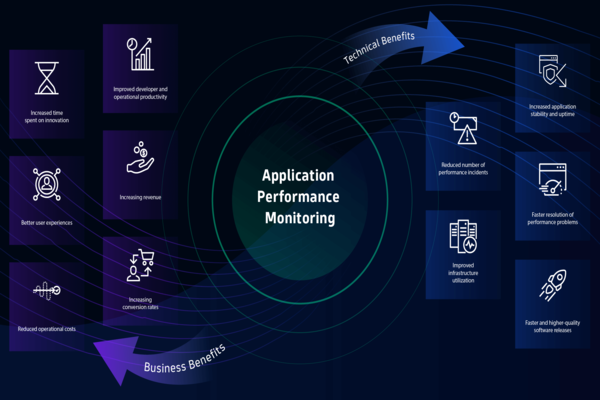
- On the technical side, APM shortens Mean Time to Detect (MTTD) and Mean Time to Recover (MTTR), improves overall system stability, and enables targeted performance optimization rather than blind tuning.
- On the business side, better-performing applications translate directly into higher customer retention, increased revenue, and lower operational costs due to fewer incidents. Engineering teams are also freed from constant firefighting to focus on building higher-value new features.
- Equally important, APM fosters a data-driven culture within the organization – one where every architectural, deployment, and optimization decision is supported by clear, quantitative evidence rather than intuition or individual experience.
In the digital age, where software sits at the center of every business operation, Application Performance Monitoring is no longer an optional add-on. It has become a fundamental requirement for any organization that wants to maintain a competitive edge and deliver outstanding user experiences.
