


In asset management and equipment operations, corrective maintenance is one of the most frequently mentioned terms – especially in manufacturing, industrial, and building management sectors. However, not everyone fully understands its nature, classifications, and the right time to apply it. This article provides a comprehensive and detailed look to help you master the concept and practical applications of corrective maintenance.
What Is Corrective Maintenance?
Corrective Maintenance is the form of maintenance carried out after a piece of equipment, machinery, or system has experienced a failure, malfunction, or deviation from its intended operation. Its primary goal is to restore the asset to its normal working condition, ensuring that production or operations are not disrupted for an extended period.
Unlike Preventive Maintenance – which is performed periodically before any failure occurs – corrective maintenance is only triggered when there are clear signs or evidence of an actual fault. It is the most common form of maintenance among many small and medium-sized enterprises, as it does not require complex maintenance planning or large upfront investment. However, if applied incorrectly or relied upon too heavily, corrective maintenance can lead to significant losses in time and operating costs.
Why Is Corrective Maintenance Important?
While it may not be the ideal maintenance strategy in every situation, corrective maintenance remains an indispensable part of any organization’s asset management system. The reason is straightforward: no preventive maintenance plan can predict 100% of real-world failures.
When equipment suddenly stops working, the operations team needs a clear and rapid process to handle the incident, minimize downtime, and restore production. That is precisely when corrective maintenance proves its value. Furthermore, for low-cost equipment with short lifespans or assets that do not affect the main production line, maintaining a corrective rather than preventive approach can sometimes be more cost-effective in the long run. The importance of corrective maintenance lies in its flexibility and ability to respond quickly to unexpected situations.
Types of Corrective Maintenance
Not all failures are the same, and corrective maintenance is not a one-size-fits-all solution. Depending on the severity, urgency, and plannability of the issue, corrective maintenance is divided into four main types, each with distinct characteristics and handling approaches.
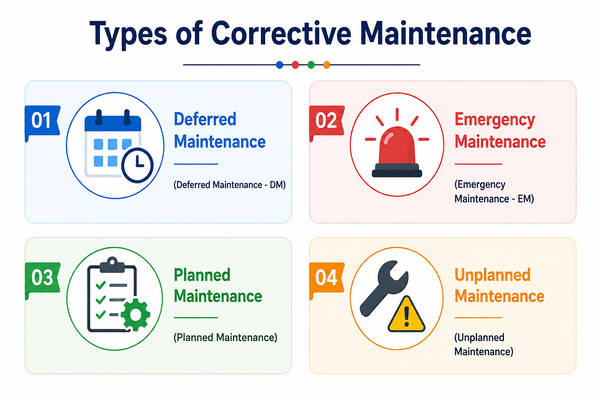
Deferred Maintenance (DM)
This type applies when a fault has been detected but does not immediately pose a serious threat to system operation, and can therefore be scheduled for repair at a more convenient time. For example, a minor leak in a secondary pump that does not affect the main water supply system can be added to next week’s repair list rather than addressed immediately. Deferred Maintenance helps the maintenance team optimize resources and plan work more efficiently, avoiding rushed responses that lead to waste.
Emergency Maintenance (EM)
In contrast to Deferred Maintenance, emergency maintenance requires an immediate response because the failure is causing – or has a high risk of causing – serious damage, such as a complete production halt, occupational safety hazards, or significant asset loss. Typical examples include electrical leaks in a factory, a broken main conveyor belt on a production line, or a failed refrigeration system in a pharmaceutical warehouse. Emergency Maintenance tends to incur the highest costs and causes the most operational disruption, which is why businesses always strive to reduce its frequency through proactive preventive measures.
Planned Corrective Maintenance
Planned Maintenance within corrective maintenance refers to repairs that are scheduled in advance after a fault or sign of deterioration has been detected through monitoring systems, routine inspections, or operator feedback. Although it is labeled “corrective,” this type still carries a proactive element, as the team has enough time to prepare spare parts, assign personnel, and choose a timing that minimizes impact on production. This is the most optimal form within the corrective maintenance group, as it balances incident response with cost control.
Unplanned Maintenance
Unplanned Maintenance is the most common and most problematic type. These are failures that occur suddenly without warning, forcing the maintenance team to drop all current work and respond immediately. The cost of Unplanned Maintenance is typically 3 to 9 times higher than planned maintenance, due to the need to mobilize overtime labor, procure spare parts urgently at premium prices, and accept extended downtime. Reducing Unplanned Maintenance is one of the top priorities of any effective maintenance management strategy.
The Corrective Maintenance Process
A well-structured corrective maintenance process typically follows a sequential series of steps, from fault detection to post-resolution review.
- Step 1 – Fault Detection and Reporting: The operator or sensor system detects abnormal equipment behavior and records the relevant information.
- Step 2 – Priority Assessment: Determine whether the fault is an emergency, can be deferred, or should be planned, in order to allocate resources appropriately.
- Step 3 – Resource Preparation: Coordinate technicians, prepare replacement parts, and gather the necessary tools.
- Step 4 – Repair Execution: Carry out the corrective work according to proper technical procedures, ensuring occupational safety throughout.
- Step 5 – Testing and Acceptance: Run the equipment after repair to confirm it is operating normally.
- Step 6 – Documentation and Analysis: Record the incident, root cause, and resolution method to support trend analysis and improve the maintenance strategy going forward.
Benefits of Corrective Maintenance
Although often viewed as a “reactive” approach, corrective maintenance offers several practical benefits that cannot be ignored. For non-critical or low-cost equipment, a “run-to-failure” strategy can save significant periodic maintenance costs. Businesses do not need to invest manpower and spare parts in maintaining equipment with a low probability of failure and negligible replacement costs.
In addition, corrective maintenance allows the technical team to focus resources on actual incidents rather than spreading them across preventive activities that are sometimes unnecessary. In resource-constrained environments, this is a meaningful advantage. Corrective maintenance also serves as an irreplaceable safety net – regardless of a company’s primary maintenance strategy, there will always be unexpected failures that require timely corrective action.
When Should Corrective Maintenance Be Applied?
Corrective maintenance is not always the right choice, nor can it always be avoided. Understanding when to apply it helps businesses optimize their overall maintenance strategy.
Corrective maintenance is appropriate in the following cases: equipment is low-cost and easy to replace; equipment is not part of a critical production line; the failure rate is low and unpredictable; and the cost of preventive maintenance far exceeds the cost of repairing the failure when it occurs.
Conversely, reliance on corrective maintenance should be limited when equipment plays a key role in production, when failures could pose occupational safety risks, or when downtime causes significant revenue loss. In these cases, it should be combined with Preventive Maintenance or Predictive Maintenance to minimize risk.
Advantages and Disadvantages of Corrective Maintenance
To make well-informed decisions, businesses need to evaluate corrective maintenance objectively, considering both sides.

- Advantages include: low upfront costs since no investment in monitoring systems or periodic maintenance schedules is required; full utilization of equipment’s actual lifespan before intervention; simple management since action is only taken when a fault occurs; and suitability for low-cost equipment or assets with multiple redundant backups.
- Disadvantages are equally noteworthy: unpredictable downtime that affects production schedules; emergency repair costs that are typically higher than planned repairs; cascading failures that can cause widespread damage if not addressed promptly; pressure on the maintenance team during emergencies that can lead to errors; and difficulty in accurately budgeting for maintenance due to its unpredictable nature.
How to Perform Corrective Maintenance Effectively
To maximize the effectiveness of corrective maintenance and minimize its negative impacts, businesses need to build a systematic management framework rather than reacting on an ad hoc basis.
- Establish a clear fault reporting system: Every incident must be recorded immediately upon detection, including detailed information about symptoms, time of occurrence, and extent of impact. A Computerized Maintenance Management System (CMMS) is the ideal tool for this step.
- Classify and prioritize incidents: Not every fault requires immediate action. Businesses need a clear priority matrix based on the impact on production, occupational safety, and cost of damage.
- Strategically stock spare parts: Identify the most frequently failing parts and keep them in inventory to reduce wait times when a failure occurs. This is a key factor in significantly shortening downtime.
- Regularly train technicians: The maintenance team must be trained to diagnose quickly, apply the correct technical procedures, and operate safely in all situations, including emergencies.
- Conduct Root Cause Analysis: After each incident, identify the underlying cause to prevent recurrence. Many seemingly random failures actually have preventable root causes.
- Integrate with the overall maintenance strategy: Corrective maintenance is most effective when flexibly combined with preventive and predictive maintenance. Assigning equipment to the right maintenance strategy based on its characteristics and criticality is the key to optimizing operating costs.
Corrective maintenance is not an outdated or ineffective method – it is an important tool within a business’s comprehensive maintenance strategy. The question is not whether to use it, but rather knowing how to use it at the right time, in the right place, and in the right way to maximize operational efficiency and minimize total costs.
