



Preventive maintenance is a proactive strategy of inspecting and servicing equipment on a predetermined schedule to prevent failures before they occur. Rather than waiting for machinery to break down before taking action, businesses can reduce repair costs, extend equipment lifespan, and ensure workplace safety. This article will help you understand the concept, benefits, and process of implementing preventive maintenance effectively.
What Is Preventive Maintenance?
In modern industrial and manufacturing environments, unexpected machine breakdowns don’t just drive up repair costs – they disrupt entire operational lines. This is why Preventive Maintenance (PM) was developed and has become the core maintenance strategy for professional organizations.
Preventive maintenance is a form of maintenance carried out according to a predetermined plan, with the goal of preventing failures before equipment actually breaks down. Rather than waiting for machinery to “die” before responding, preventive maintenance proactively inspects, cleans, calibrates, and replaces components on a set schedule – based on time intervals, usage levels, or the actual condition of the equipment.
This concept is fundamentally different from Corrective Maintenance, which only intervenes after a failure has already occurred. Preventive maintenance puts businesses in a proactive position: proactively controlling risk, proactively allocating resources, and proactively protecting asset lifespan.
Benefits of Preventive Maintenance
Implementing preventive maintenance in a structured way delivers a range of practical benefits that directly impact operational efficiency and business profitability.
- Minimizing unplanned downtime: When maintenance tasks are carried out on schedule, the likelihood of sudden failures decreases significantly. This is especially critical for continuous production lines, where every hour of downtime can equate to tens of millions of dong in losses.
- Extending equipment lifespan: Machinery that receives regular care – oil changes, filter cleaning, bolt tightening – operates far more durably than equipment left unattended until it breaks.
- Long-term cost savings: The cost of preventive maintenance is typically 3-5 times lower than emergency repair costs, not counting indirect losses such as spoiled goods, contract penalties, or damaged customer relationships.
- Ensuring workplace safety: Equipment that operates stably without hidden faults creates a safer working environment for operators.
- Easier budgeting: Because maintenance is scheduled in advance, businesses can forecast costs more accurately, avoiding unexpected expenses that disrupt financial planning.
Advantages and Disadvantages of Preventive Maintenance
Despite its many benefits, preventive maintenance is not a perfect solution for every situation. Businesses need to honestly evaluate both sides in order to develop the right strategy.
Advantages:
- Proactively minimizes the risk of unplanned incidents.
- Increases the reliability and stability of equipment systems.
- Builds a historical maintenance database to support long-term decision-making.
- Improves morale among technical teams because work is clearly planned.
Disadvantages:
- Can lead to over-maintenance – replacing components that are still functional, wasting costs and materials.
- Requires upfront investment to build a scheduling system, train personnel, and purchase management software.
- Some equipment has random failure cycles – fixed-interval maintenance is not always optimal for these cases.
Types of Preventive Maintenance
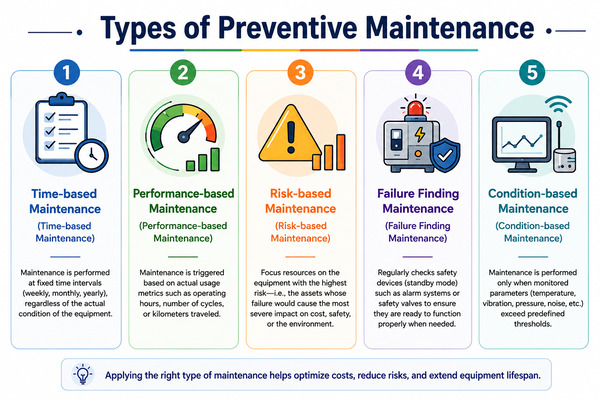
Preventive maintenance is not a single method – it is a group of flexible strategies, each suited to different equipment characteristics and operating environments. Understanding each type helps businesses choose the right approach and avoid wasting resources.
Time-based Maintenance
The most common form: maintenance is carried out at fixed time intervals – for example, weekly, monthly, or annually – regardless of whether the equipment is performing well or not. The advantage is ease of scheduling and management, but it can lead to unnecessary maintenance if the equipment is still in good condition.
Performance-based Maintenance
Rather than tracking time, this type triggers maintenance based on actual usage levels: operating hours, activity cycles, or kilometers traveled. A classic example is changing engine oil every 5,000 km, or servicing an air compressor after 500 hours of operation. This approach more accurately reflects real-world usage compared to a fixed schedule.
Risk-based Maintenance
This method prioritizes concentrating resources on the highest-risk equipment – that is, equipment whose failure would cause the most severe consequences in terms of cost, safety, or environmental impact. Businesses conduct a Risk Assessment to rank equipment and assign maintenance schedules accordingly.
Failure Finding Maintenance
This type of maintenance targets protective devices that are normally on standby – only activating when a failure occurs, such as safety valves or fire alarm systems. Because these devices don’t operate regularly, latent faults are very difficult to detect. Periodic inspections confirm that they remain ready to function correctly when needed.
Condition-based Maintenance
The most sophisticated type: maintenance is only carried out when actual measured parameters (temperature, vibration, pressure, noise, etc.) exceed acceptable thresholds. Equipment is monitored continuously or periodically; when a warning signal appears, the technical team intervenes. This approach optimizes costs by eliminating all unnecessary maintenance actions.
The Difference Between Preventive Maintenance and Predictive Maintenance
Many people confuse preventive maintenance with Predictive Maintenance (PdM). While both share a proactive nature, the two methods are fundamentally different.
| Criteria | Preventive Maintenance | Predictive Maintenance |
|---|---|---|
| Basis for action | Fixed schedule or usage thresholds | Real-time data from sensors |
| Technology required | Low to moderate | High (IoT, AI, data analytics) |
| Implementation cost | Moderate | Large upfront investment |
| Accuracy | Moderate | High |
| Suitable for | Most businesses | Large enterprises, complex equipment |
Simply put: preventive maintenance asks “Is it time yet?”, while predictive maintenance asks “Does the data indicate a problem is coming?” Many businesses choose to combine both approaches to maximize effectiveness.
How to Establish an Effective Preventive Maintenance Process
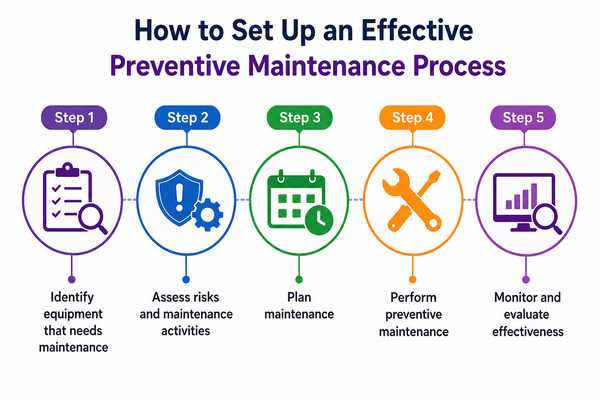
Building a successful preventive maintenance program requires careful preparation and systematic thinking. Below is a 5-step process widely applied in manufacturing and professional asset management organizations.
Step 1: Identify Equipment That Needs Maintenance
Not all equipment needs to be included in a preventive maintenance program. Start by listing all assets, then categorize them by criticality: which equipment directly affects production, which is related to safety, and which has a high replacement value. This is the foundation for allocating maintenance resources to the right places.
Step 2: Assess Risks and Maintenance Activities
For each piece of equipment on the list, analyze: what is the likelihood of failure, what would the consequences be if it breaks down, and what maintenance tasks could prevent that failure. Common tools at this stage include FMEA (Failure Mode and Effects Analysis) and risk matrices.
Step 3: Develop a Maintenance Plan
Based on the data from Step 2, build a detailed maintenance schedule: who will carry it out, when, what tools and materials are needed, and how long it will take. The maintenance schedule should be digitized and stored in a CMMS (Computerized Maintenance Management System) for easy tracking and coordination.
Step 4: Execute Preventive Maintenance
The technical team carries out work according to approved checklists. Each task must be fully documented: inspection results, parts replaced, anomalies detected, and time to completion. Discipline in record-keeping is the key factor that allows the maintenance program to continuously improve over time.
Step 5: Monitor and Evaluate Effectiveness
After implementation, measure effectiveness through indicators such as: on-time maintenance completion rate, number of unplanned incidents, MTBF (Mean Time Between Failures), and total maintenance cost. This data forms the basis for adjusting schedules, optimizing resources, and upgrading the program on a cyclical basis.
Common Mistakes in Preventive Maintenance
Even with a plan in place, many businesses still fail to achieve the results they expect from their preventive maintenance programs. The cause typically stems from a number of recurring mistakes:
- Applying a single maintenance schedule to all equipment. Each piece of equipment has different operating characteristics. Using a uniform cycle leads to over-maintenance for lightly used equipment, and under-maintenance for heavily used equipment.
- Failing to update maintenance schedules to reflect actual conditions. When operating conditions change – additional shifts, product changes, harsher environments – the old schedule is no longer appropriate. Businesses need to review and adjust schedules periodically.
- Neglecting documentation. Without complete maintenance records, businesses cannot analyze failure trends, optimize cycles, or avoid over-reliance on individual technicians’ personal experience.
- Insufficient training for the technical team. Preventive maintenance is only effective when those carrying it out understand the correct procedures and know how to identify signs of abnormality. Investment in training cannot be overlooked.
- Viewing preventive maintenance as a cost rather than an investment. This mindset leads businesses to continually cut maintenance budgets, resulting in a vicious cycle: poor maintenance → more failures → higher repair costs → further maintenance cuts.
Preventive maintenance is not a passing trend – it is the foundation of a sustainable asset management strategy. When implemented correctly, it helps businesses not only reduce costs but also build an operational system that is reliable, safe, and capable of competing effectively in the market over the long term.
