



The network is the backbone of every modern business. Even a minor incident can cause serious disruptions to operations and revenue. Network monitoring was developed to solve exactly this problem – helping IT teams track, detect, and resolve issues before they escalate.
What Is Network Monitoring?
In the age of digital transformation, network infrastructure is mission-critical for every organization. Any incident – even a few minutes of downtime – can lead to severe financial losses and reputational damage. Continuously monitoring the state of the network is therefore an indispensable requirement.

Network monitoring is the ongoing process of observing, analyzing, and evaluating the operational status of a computer network – including devices such as routers, switches, servers, and firewalls, as well as all data flows passing through them. The core objective is to detect failures, anomalies, or performance degradation early, so IT teams can intervene before problems escalate into disasters.
Network monitoring systems collect real-time data from multiple points across the infrastructure, analyze it against predefined thresholds, and send alerts the moment an anomaly is detected. This is far more than simply “checking whether the network is up” – it is an intelligent system that gives administrators a complete picture of the health of their organization’s IT infrastructure.
Why Network Monitoring Is Necessary
Even a well-designed network can experience unexpected failures. From hardware faults and cyberattacks to sudden traffic spikes – all of these demand fast, accurate responses from operations teams.
- There are several reasons why network monitoring has become a mandatory element in modern IT environments.
- First, most network incidents have early warning signs – such as gradually slowing response times or rising packet loss rates – before the system actually collapses. Without monitoring tools, these signals are typically missed until it is too late.
- Second, as cyberattacks grow increasingly sophisticated, network monitoring helps detect abnormal behavior in data flows – a telltale sign of unauthorized intrusion or data leakage.
- Third, many industries such as finance, healthcare, and public services have legal requirements to maintain and log network activity in order to ensure regulatory compliance.
Benefits of Network Monitoring
Investing in a network monitoring system does not just reduce risk – it also delivers significant long-term value to the organization.

- The first and most obvious benefit is reduced downtime. When incidents are detected and resolved in their early stages, the time a system spends offline is significantly shortened, directly protecting revenue and user experience.
- Beyond that, data collected over time allows IT teams to analyze trends and proactively plan infrastructure upgrades rather than reacting defensively.
- When an incident does occur, monitoring logs provide detailed information to identify root causes faster, shortening the time to resolution.
- Additionally, a clear understanding of data flows and bandwidth utilization helps organizations optimize resources and avoid wasting budget on unnecessary infrastructure.
Applications of Network Monitoring
Network monitoring is not confined to any one industry or organization size – it is widely deployed across many sectors and environments.
- In enterprises and large organizations, network monitoring is implemented to ensure business continuity and to track hundreds or even thousands of devices across distributed infrastructure.
- Internet Service Providers (ISPs) and data centers use it to manage bandwidth, control service quality, and meet SLA commitments to customers.
- In cloud computing environments, network monitoring tracks connectivity between on-premises and cloud environments to ensure stable data flow.
- Even healthcare facilities – where the network directly affects patient safety through connected medical devices – require continuous 24/7 network monitoring.
Types of Network Monitoring Tools
The market offers a wide variety of network monitoring tools with different features and use cases, suited to different organizational sizes and needs. Generally, they fall into three main categories.
- Network Performance Monitoring (NPM) tools focus on measuring bandwidth, latency, packet loss, and response times for devices and links.
- Traffic Analyzers inspect the content and origin of data flows, helping identify which applications are consuming the most bandwidth.
- Infrastructure Monitoring tools track the operational status of each physical and virtualized device in the system.
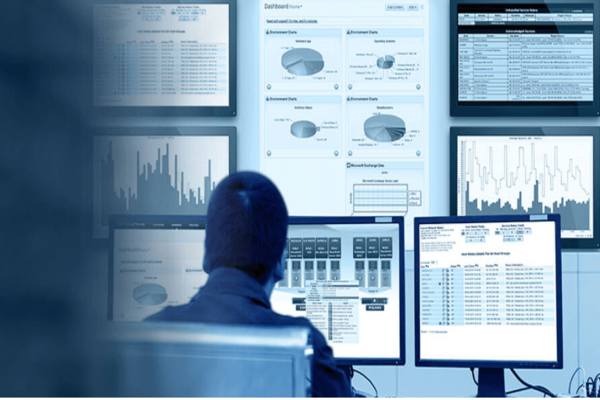
- In addition, Unified Monitoring Platforms integrate all of the above functions into a single dashboard – widely used in large enterprises that need a comprehensive view of their infrastructure.
How Network Monitoring Tools Work
Understanding the real value of network monitoring requires grasping how these tools operate internally – from data collection to alert generation.
At a high level, a network monitoring system operates in a closed loop of four steps:
- Data collection: The tool sends periodic queries to network devices (polling) or receives data proactively from devices (traps/agents), gathering metrics such as CPU load, RAM usage, bandwidth, and port status.
- Storage and processing: Data is stored and processed in a real-time time-series database for analysis and visualization.
- Threshold comparison: If any metric exceeds a predefined threshold – for example, CPU above 90% or packet loss above 5% – the system triggers an alert.
- Notification: Alerts are sent to administrators via email, SMS, or integrated with a ticketing system for timely incident response.
Common Protocols in Network Monitoring
To communicate with network devices and collect data, monitoring systems rely on standardized protocols. Each protocol has its own characteristics and applications, suited to different types of information being monitored.
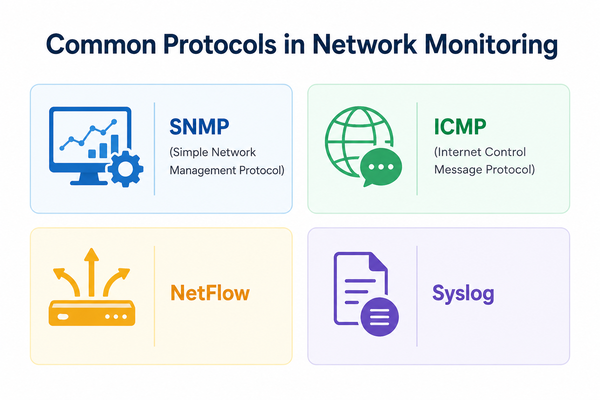
SNMP (Simple Network Management Protocol)
SNMP is the most foundational and widely used protocol in network monitoring. It allows management systems to collect information from devices such as routers, switches, and servers via polling or traps. SNMP uses a MIB (Management Information Base) to define collectable metrics. SNMPv3 is the currently recommended version, as it adds authentication and encryption mechanisms that address the security weaknesses of earlier versions.
ICMP (Internet Control Message Protocol)
ICMP is the basic protocol used to test connectivity between devices. The familiar ping command is a classic application of ICMP. In network monitoring, ICMP is used to determine whether a device is reachable, measure latency, and detect packet loss. Though simple, ICMP remains an indispensable tool in any monitoring system.
NetFlow
NetFlow is a protocol developed by Cisco to collect and analyze information about network traffic flows. Rather than simply knowing “whether the network is running,” NetFlow lets administrators understand “who is using bandwidth, how much, and for what purpose.” It is an extremely useful tool for identifying bandwidth-hungry applications, tracing the source of DDoS attacks, or analyzing anomalous behavior in internal network traffic. Other vendors offer similar variants, including sFlow (Foundry Networks) and IPFIX (the IETF standard).
Syslog
Syslog is a standardized protocol for recording and transmitting system logs from network devices to a centralized log server. Every event on a device – from configuration changes and hardware errors to login activity – is recorded as a syslog message with a corresponding severity level. In network monitoring, syslog plays an important role in incident forensics, security auditing, and meeting regulatory compliance requirements.
Network Monitoring vs. Network Security Monitoring: The Difference
These two concepts are often confused or used interchangeably, but they have distinct objectives and scopes, even though they overlap considerably.
| Criterion | Network Monitoring | Network Security Monitoring (NSM) |
|---|---|---|
| Primary goal | Track system performance and availability | Detect threats, intrusions, and malicious behavior |
| Core question | Is the system operating normally? | Is someone attempting to breach the system? |
| Monitoring focus | Bandwidth, latency, response time, uptime | Suspicious traffic, cyberattacks, data leakage |
| Data analysis | Based on technical metrics | Content and contextual analysis of traffic |
| Attack detection capability | Limited or indirect | Deep and proactive |
| Threat intelligence | Rarely used | Compared against known attack patterns |
| Operational goal | Ensure stable, efficient system operation | Protect systems and data from security threats |
| Primary role | Monitor infrastructure health | Strengthen network security defenses |
Challenges in Network Monitoring
Despite its many benefits, building and operating an effective network monitoring system is far from simple. Organizations frequently face significant challenges during deployment and ongoing management.
- Growing scale and complexity: Modern IT infrastructure is no longer confined to a single office building – it spans multiple locations, cloud environments, IoT devices, and VPN connections. Collecting and managing monitoring data in such an environment demands flexible architecture and high scalability.
- Alert fatigue: When alert thresholds are misconfigured, IT teams can be flooded with hundreds of notifications per day, causing them to overlook the alerts that actually matter.
- Cost and resources: Enterprise-grade network monitoring tools carry significant costs, and operating them effectively requires deeply skilled personnel.
- Security of monitoring data: Log data and network traffic contain a great deal of sensitive information and must be protected just as carefully as production systems.
Understanding these challenges is the essential first step toward building a truly effective and sustainable network monitoring strategy for any organization.
Network monitoring is no longer optional – it has become a mandatory requirement in modern IT systems. Investing appropriately in monitoring tools and processes allows businesses to proactively protect their infrastructure, reduce risk, and operate more reliably over the long term.
