


In the era of explosive digital transformation, simply “moving data to the cloud” (Cloud Migration) is no longer enough for businesses to maintain a competitive edge. Organizations today require a further, more specialized step to optimize performance and cost: Cloud Modernization. This article provides a detailed analysis of the concept, benefits, and key strategies to help businesses successfully modernize their cloud environments.
What is Cloud Modernization?
Cloud Modernization is the process of transforming existing applications, data, and infrastructure into a cloud-native model or optimizing them to fully leverage cloud computing characteristics such as scalability, flexibility, and managed services.

Instead of merely moving physical servers to virtual ones (the “Lift and Shift” method), cloud modernization focuses on re-architecting software, operational processes, and data management practices. The ultimate goal is to create a flexible technology ecosystem with high automation capabilities that can respond rapidly to market changes.
Benefits of Cloud Modernization
Investing in Cloud Modernization delivers superior value, extending beyond technical aspects to directly impact the business efficiency of digital enterprises:

- Cost Optimization: Instead of paying for redundant resources, modernization allows businesses to adopt the “Pay-as-you-go” model and automatically adjust resources based on actual demand.
- Accelerated Time-to-Market: With modern architectures like Microservices or Containers, development teams can deploy new feature updates daily rather than monthly.
- Infinite Scalability: Systems are designed for auto-scaling, handling traffic spikes seamlessly without service disruptions.
- Enhanced Security and Compliance: Modern cloud platforms integrate advanced built-in security tools, helping to detect and prevent threats in real-time.
- Improved Customer Experience: Stable system performance and fast response times significantly enhance end-user satisfaction.
Challenges in Cloud Modernization
Despite the numerous benefits, the modernization journey is not a “path covered in roses.” Businesses often face significant hurdles:
- Cumbersome Legacy Systems: Older applications typically have a Monolithic architecture, making them difficult to decouple or integrate with modern cloud services.
- Skill Gaps: Internal IT teams may lack familiarity with emerging technologies such as Kubernetes, Serverless, or DevOps practices.
- Complex Data Management: Migrating and restructuring massive databases while ensuring data integrity and security represents a major technical challenge.
- Initial Investment Costs: While offering long-term savings, the process of re-architecting applications requires substantial financial resources and time during the initial phase.
Key Pillars of a Cloud Modernization Strategy
To achieve optimal efficiency, businesses must approach modernization comprehensively across multiple dimensions. Below are the four main pillars of a complete Cloud Modernization strategy:
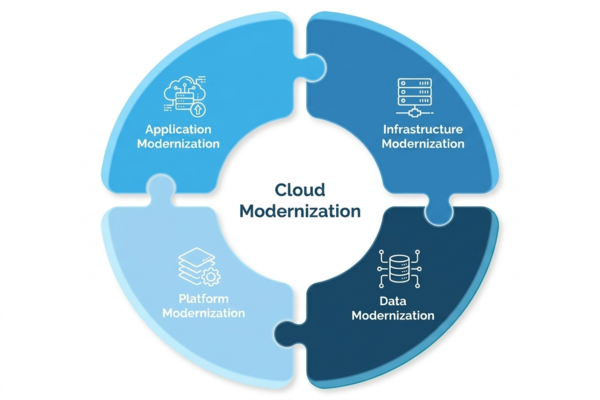
1. Application Modernization
This is the process of updating legacy applications to modern architectures. Instead of a single codebase, applications are broken down into Microservices. This allows development teams to work independently on specific features, making maintenance and upgrades significantly easier and faster.
2. Infrastructure Modernization
This involves replacing physical servers and traditional data centers with Infrastructure as Code (IaC). By utilizing technologies like Containerization (Docker, Kubernetes), businesses ensure that applications run consistently across all environments, from development to production.
3. Data Modernization
This entails transitioning from traditional relational databases to modern storage solutions such as NoSQL, Data Lakes, or Cloud Data Warehouses (e.g., BigQuery, Snowflake). This process empowers businesses to harness the power of Big Data and AI to make precise, data-driven business decisions.
4. Platform Modernization
Leveraging PaaS (Platform as a Service) and Serverless computing allows businesses to offload the burden of managing operating systems or patching infrastructure security. Instead, they can focus entirely on writing code and optimizing business logic.
Common Cloud Modernization Strategies
Depending on the current state of their systems and business goals, organizations can choose from several strategies (often referred to as the “Rs”):
- Replatform (Lift and Reshape): Moving applications to the cloud and making minor adjustments to take advantage of cloud features (e.g., migrating from a self-managed database to a Managed DB).
- Refactor (Rearchitect): Significantly changing the code structure to make the application cloud-native. This is the most resource-intensive strategy but yields the highest efficiency.
- Replace (Repurchase): Completely discarding the legacy application and replacing it with a modern SaaS (Software as a Service) solution.
- Retain/Retire: Keeping components that do not require changes or decommissioning outdated applications that no longer provide value.
Best Practices for Cloud Modernization
To ensure a smooth modernization process and minimize risk, businesses should adhere to these “golden rules”:

- Thorough Assessment: Analyze the entire application portfolio to determine priorities-identifying what should be modernized first and what delivers the most value.
- Iterative Approach: Avoid attempting to modernize everything at once. Start with small-scale projects, gather insights, and then scale up.
- Build a DevOps Culture: Technological modernization must go hand-in-hand with workflow modernization. Close collaboration between Development (Dev) and Operations (Ops) teams is the key to success.
- Focus on Security (Security by Design): Integrate security into every stage of the modernization process rather than treating it as a final step.
Cloud Modernization vs. Cloud Migration
Many people confuse these two concepts, but they differ significantly in objective and scope:
| Feature | Cloud Migration | Cloud Modernization |
| Definition | Moving data/apps from On-premise to the Cloud. | Optimizing and re-architecting to maximize Cloud benefits. |
| Method | Typically “Lift and Shift” (exact replication). | Re-architect, Microservices, Containerization. |
| Value | Initial hardware cost savings. | Increased flexibility, innovation, and superior performance. |
| Complexity | Low to medium. | High, requiring specialized skills. |
| Goal | Changing storage location. | Transforming operational and business models. |
Cloud Modernization is not merely a technical trend; it is a vital requirement for businesses looking to break through in the digital era. While the journey is challenging, the values of agility, speed, and cost optimization it provides will serve as a solid foundation for sustainable corporate growth.
