



In the era of digital transformation, the “Cloud” is no longer a foreign concept. However, for various cloud services to “talk” and work together seamlessly, we need a talented “switchboard operator.” That operator is the Cloud API. This article will help you gain a deep understanding of Cloud APIs and how they power the entire modern technology ecosystem.
What is a Cloud API?
To understand Cloud APIs, let’s first talk about APIs (Application Programming Interfaces). An API is a set of rules that allows different software programs to interact with one another. When we apply this concept to the cloud computing environment, we get the Cloud API.
Essentially, a Cloud API is a communication gateway that allows software applications to access and utilize resources, services, or data stored on a cloud platform. Instead of building everything from scratch, developers simply “call” an API to leverage the power of giants like AWS, Google Cloud, or Microsoft Azure. It is much like using an electrical outlet: you don’t need to know how the power plant works; you just plug in and use the energy.
Why are Cloud APIs Important?
Cloud APIs serve as the “bloodstream” of modern IT infrastructure. Without them, cloud services would exist as isolated islands, unable to coordinate with one another. The emergence of Cloud APIs has completely transformed how we build and operate software thanks to three key factors:
- Flexibility and Speed: Businesses can integrate complex features (such as payments, maps, or AI) into their applications in just a few hours instead of months.
- Scalability: When user demand surges, Cloud APIs help the system automatically connect to additional cloud resources to handle the load without requiring extensive manual intervention.
- Cost Optimization: You only pay for what you use through the API (Pay-as-you-go), reducing initial infrastructure investment costs.
How Cloud APIs Work
The operational process of a Cloud API follows the Request-Response model. When an application (the Client) wants to perform a task in the cloud, it sends a request via the API. The Cloud API receives the request, authenticates the identity, forwards the command to the cloud server, receives the result, and sends it back to the application.
This entire process happens in a split second. The magic lies in the fact that the client application does not need to know what operating system the cloud server is running or where it is located; it only needs to adhere to the format required by the API. This creates a brilliant level of abstraction, allowing developers to focus on the user experience rather than worrying about the underlying hardware.
Types of Cloud APIs
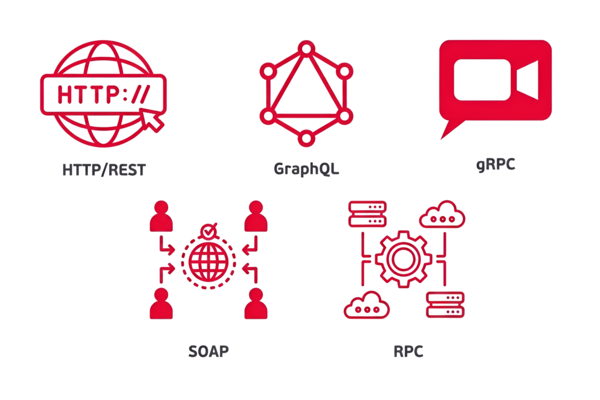
The world of Cloud APIs is highly diverse, with each type designed to solve specific challenges regarding performance, data structure, or compatibility. Depending on the system architecture, engineers will choose one of the following popular API types to optimize connectivity within the cloud ecosystem:
HTTP/REST APIs
REST (Representational State Transfer) is currently the most popular type of Cloud API. It utilizes standard HTTP protocols and lightweight data formats like JSON or XML. The strengths of REST lie in its simplicity, ease of learning, and high compatibility with web browsers, making it the top choice for standard web and mobile applications.
SOAP APIs
SOAP (Simple Object Access Protocol) is an older and more rigid protocol compared to REST. It relies entirely on XML and features robust, built-in standards for security and transactions. Despite its somewhat heavy and complex structure, SOAP is still preferred in banking systems or large enterprises where data integrity and security are the top priorities.
RPC APIs
RPC (Remote Procedure Call) allows a computer program to execute a subroutine in a different address space (usually on another computer within a network) without the need for detailed programming for that network interaction. This “remote function call” model makes distributed programming feel as natural as writing code on a local machine.
GraphQL APIs
GraphQL is a “query language” for APIs developed by Facebook. Unlike REST (where you receive a fixed data package), GraphQL allows the client to request exactly what they need. This minimizes the transfer of redundant data, which is extremely useful for mobile applications with limited bandwidth.
gRPC APIs
gRPC is a modern variant of RPC developed by Google. It uses HTTP/2 for transport and Protocol Buffers as the data format (instead of JSON). gRPC is incredibly fast and lightweight, typically used to connect microservices within complex cloud systems that require the lowest possible latency.
Securing Cloud APIs
Because Cloud APIs open the door to a business’s critical data and resources, they are also primary targets for cyberattacks. An API vulnerability can lead to large-scale data breaches. Therefore, Cloud API security is not just a feature-it is a mandatory requirement.
Common security strategies include:
- Authentication and Authorization: Using protocols like OAuth2 or API Keys to ensure only valid users or applications have access rights.
- Data Encryption: Always using HTTPS/TLS to encrypt data in transit between the Client and the Cloud to prevent information theft.
- Rate Limiting: Preventing Denial of Service (DDoS) attacks or API abuse by limiting the number of requests an account can send within a specific timeframe.
- Monitoring and Logging: Tracking all API activity to detect unusual behavior early and provide timely response plans.
Cloud API is the “glue” that binds disparate services into a powerful ecosystem. A clear understanding of Cloud APIs not only helps developers build better software but also enables businesses to fully leverage the power of cloud computing.
