



In the digital era, cloud computing is no longer just an option; it has become a vital foundation for the growth of every business. Among the tech giants, IBM Cloud stands out as a specialized solution focused on high performance, tight security, and flexible customization. This article will dive deep into every aspect of IBM Cloud to help you understand why it is the ideal “destination” for large-scale enterprises.
What is IBM Cloud?
IBM Cloud is a comprehensive cloud computing platform developed by the multinational technology corporation IBM. It combines Platform-as-a-Service (PaaS) with Infrastructure-as-a-Service (IaaS) to create a seamless experience for developers and IT operations teams.
Unlike competitors that focus on the mass consumer market, IBM Cloud was designed from the ground up with an “Enterprise-first” mindset. It focuses on solving complex problems involving massive data processing, Artificial Intelligence (AI), and stringent regulatory compliance requirements.
The platform grants businesses access to over 170 advanced technology services, ranging from virtual servers and data storage to cutting-edge technologies like Blockchain, the Internet of Things (IoT), and notably, the world-renowned Watson AI system. With a presence in over 19 countries and dozens of data centers globally, IBM Cloud ensures low latency and high redundancy for all mission-critical applications.
Why Do Businesses Choose IBM Cloud?
Choosing a cloud provider is based not only on price but also on the ability to support a long-term strategic vision. Enterprises choose IBM Cloud based on three main pillars: Trust, Intelligence, and Openness.
- Highest Level of Security: With decades of experience working with central banks and government organizations, IBM’s cloud infrastructure adheres to the strictest security standards, such as FIPS 140-2 Level 4—a level that very few other providers have achieved.
- Watson AI Integration: IBM Cloud is the “home” of Watson, allowing businesses to easily embed AI into their business processes for deep data analysis and operational automation.
- Support for Legacy Infrastructure: Many large enterprises still rely on legacy physical server systems. IBM Cloud provides seamless connectivity between these legacy systems and the modern cloud, ensuring that the digital transformation process occurs without disruption.
IBM Cloud Products and Services
The IBM Cloud ecosystem is incredibly rich, categorized into key service groups to meet the needs of everyone from individual developers to multinational corporations. Below are the standout service areas:

- Compute: Includes Bare Metal Servers (dedicated physical servers), Virtual Servers, and Serverless computing to help optimize operational costs.
- Storage: Provides Object Storage, Block Storage, and File Storage solutions with extremely high data durability.
- Networking: Features Virtual Private Cloud (VPC), Load Balancers, and Content Delivery Networks (CDN) to accelerate global application access.
- Database: Supports a wide range of options from SQL (Db2, PostgreSQL) to NoSQL (Cloudant, MongoDB), ensuring data is always available and secure.
- AI & Machine Learning: Most notably Watson Studio and Watson Assistant, which help build and train complex machine learning models.
Key Features of IBM Cloud
What sets IBM Cloud apart from AWS, Azure, or Google Cloud? It lies in specific features optimized for performance and governance:
- Bare Metal Servers: IBM is a leader in providing dedicated physical servers in the cloud. This is critical for applications that require maximum raw performance and do not want to share resources with anyone else (avoiding the “noisy neighbor” effect).
- Centralized Management with IBM Cloud Satellite: This feature allows you to deploy and run IBM Cloud services anywhere: in local data centers, at the edge, or even on other cloud platforms.
- “Keep Your Own Key” (KYOK) Encryption: IBM ensures that even they cannot access customer data. You hold the sole encryption key, providing absolute peace of mind regarding privacy.
- Containers and Kubernetes: With Red Hat OpenShift on IBM Cloud, deploying applications as microservices becomes easy and highly portable across different environments.
IBM Cloud Deployment Models for Enterprises
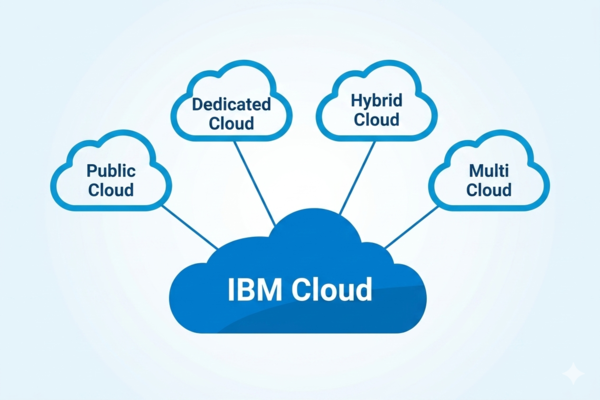
Every business has its own unique infrastructure structure and security regulations. Understanding this, IBM Cloud offers four flexible deployment models to optimize everything from costs to data control.
Public Cloud
This is the most common model, where resources such as servers and storage are shared among different customers while still ensuring logical isolation. IBM’s Public Cloud is suitable for businesses looking for rapid deployment and low costs following a “pay-as-you-go” model without worrying about hardware maintenance.
Dedicated Cloud
Designed for enterprises with extreme security and compliance requirements. In this model, IBM provides a completely isolated hardware infrastructure dedicated solely to a single customer. You gain maximum control over network configuration and data residency, entirely eliminating risks associated with shared resources.
Hybrid Cloud
This has become IBM’s greatest strength following the acquisition of Red Hat. Hybrid Cloud allows for the integration of a company’s on-premise infrastructure with Public Cloud services. Data and applications can move flexibly between these two environments, helping businesses keep sensitive data internally while still leveraging the massive computing power of the cloud for other tasks.
Multi-Cloud
In practice, many businesses do not rely on just one provider. IBM’s Multi-Cloud approach helps uniformly manage applications running across various cloud platforms (such as AWS, Azure, and IBM Cloud). Through advanced management tools, enterprises can avoid vendor lock-in and take advantage of the specific strengths of each platform.
IBM Cloud is not merely a data storage repository; it is an intelligent ecosystem that helps businesses break through in the era of AI. With its focus on security, the openness of Hybrid Cloud, and the power of Watson, it stands as a premier choice for organizations seeking a sustainable and professional cloud platform.
