



In the era of digitalization, cloud computing has become the “backbone” of operations for millions of businesses. However, alongside this convenience come inherent cybersecurity risks. Cloud security is no longer an optional add-on; it is a vital element for protecting an organization’s digital assets.
What is Cloud Computing Security?
Cloud Computing Security is a set of policies, technologies, applications, and controls designed to protect data, applications, and virtualized infrastructure within the cloud. Its goal is to prevent unauthorized access, data breaches, and ensure service availability.
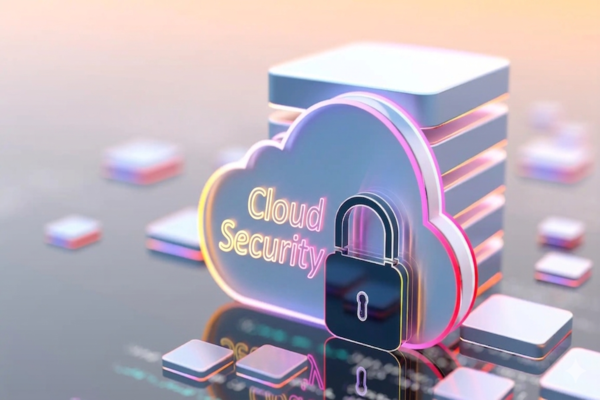
Unlike traditional security (On-premise), where businesses have full control over physical hardware, cloud security focuses on protecting layers of abstraction. This includes controlling user access, encrypting data flows between environments, and establishing technical barriers to prevent hackers from attacking centralized storage systems.
Why is Cloud Computing Security Important?
Migrating to the cloud provides flexibility but also expands the attack surface for cybercriminals. Understanding its importance helps businesses gain the right perspective on the level of investment required for system security.
Here are the key reasons why security has become imperative:
- Protecting sensitive data: The cloud houses customer information, intellectual property, and financial data. A single breach can lead to severe legal consequences.
- Ensuring business continuity: DDoS attacks or ransomware can paralyze systems, causing significant revenue loss.
- Regulatory compliance: Many industries have strict data security requirements (such as GDPR or PCI-DSS). A lack of security equates to a legal violation.
- Building customer trust: Customers only entrust their information to businesses that can prove their systems are secure.
How Cloud Computing Security Works
Cloud security operates based on the principle of “Defense in Depth.” Instead of relying on a single layer of protection, it combines multiple rigorous control measures, ranging from physical to logical security.

This process typically begins with user identity authentication before they can access any data. Subsequently, monitoring systems continuously scan network traffic to detect anomalous behavior. Data, whether at rest or in transit, is converted into complex codes through encryption to ensure that even if it is stolen, hackers cannot read the content. Finally, automated backup processes ensure that data can always be recovered following an incident.
Shared Responsibility Model in Cloud Security
A common misconception is the assumption that service providers (such as AWS, Google Cloud, or Azure) are 100% responsible for security. In reality, the Shared Responsibility Model clearly defines the boundaries between the user and the provider:
- The Provider (Cloud Provider): Responsible for security “of” the cloud. This includes the physical infrastructure, servers, internet connectivity, and foundational software.
- The Business (Customer): Responsible for security “in” the cloud. You must manage your own data, access permissions, firewall configurations, and protect the applications you install on the platform.
Cloud Computing Security Solutions
To build a robust system, businesses must combine various modern technological solutions. Each solution plays a specialized role in thwarting different attack scenarios.
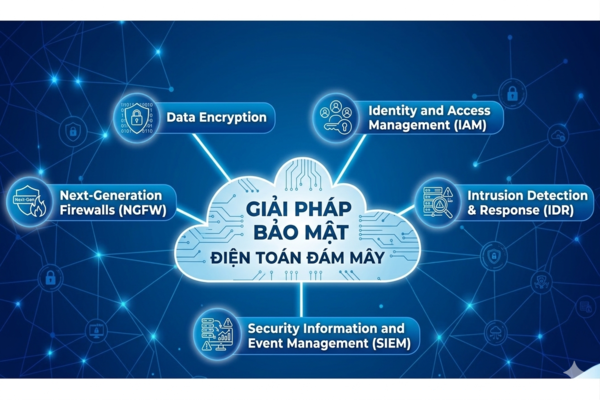
Data Encryption
Encryption serves as the final “armor” for data. By utilizing complex mathematical algorithms, data is converted into an unreadable format without a decryption key. This ensures that even if an attacker penetrates the database, they only obtain meaningless characters.
Identity and Access Management (IAM)
IAM allows administrators to define who has access to specific resources. Following the “Principle of Least Privilege,” employees are only granted sufficient permissions to perform their specific tasks. Features such as Multi-Factor Authentication (MFA) provide security enhancements that go far beyond standard passwords.
Next-Generation Firewalls (NGFW)
Unlike traditional firewalls, cloud-based next-generation firewalls are capable of Deep Packet Inspection (DPI), application recognition, and blocking sophisticated malware. They act as an intelligent “gatekeeper,” filtering all inbound and outbound traffic within the system.
Intrusion Detection & Response (IDR)
An IDR system functions like a 24/7 surveillance camera. It continuously analyzes system behavior to detect early signs of intrusion. When an incident occurs, the system automatically triggers responses, such as disconnecting or isolating the affected area to minimize damage.
Security Information and Event Management (SIEM)
SIEM collects and analyzes logs from all sources across the cloud infrastructure. It provides a comprehensive overview of the security landscape, helping technical teams identify hidden threats that might be overlooked if each component were inspected individually.
Challenges in Cloud Computing Security
Despite the availability of numerous supporting tools, implementing cloud security still faces several hurdles due to the complex nature of virtualized environments. Some major challenges include:
- Loss of Visibility: It is difficult for businesses to maintain full control and oversight of what is happening on a third-party infrastructure.
- Misconfiguration: This is the leading cause of data breaches. A single incorrect setting in a Security Group can expose an entire database to the internet.
- Shortage of Specialized Personnel: Engineers with cloud security expertise are currently in high demand and short supply, leaving many businesses struggling to respond to emerging attacks.
Why Should Businesses Implement Cloud Security?
Investing in security is not a lost expense; it is an investment in long-term sustainability. In an era where cyberattacks are becoming increasingly sophisticated, deploying protective measures is mandatory.

When security is implemented correctly, businesses not only avoid the financial risks of ransomware or legal fines but also optimize operational performance. A secure system allows the technical team to focus on product development instead of spending time “firefighting” cybersecurity incidents.
Risks When Cloud Providers Encounter Issues
No system is absolutely perfect. Even tech giants experience technical glitches or targeted attacks. This is why businesses must have a contingency strategy.
The greatest risk is Vendor Lock-in—total dependence on a single provider. If the provider suffers an outage or a critical security vulnerability, the business’s entire operations could grind to a halt. Consequently, building a Multi-cloud strategy (using multiple clouds) or a Hybrid Cloud approach (combining cloud and physical servers) is becoming a trend to ensure maximum data safety.
Cloud computing security is a continuous journey, not a destination. To protect your business effectively, you need a seamless combination of modern technology, rigorous processes, and a deep understanding of the Shared Responsibility Model.
