



In the era of digital transformation, Time-to-Market (TTM) is a vital factor for the survival of any technology business. Instead of spending weeks setting up servers, configuring networks, or installing runtime environments, today’s developers are turning toward a more optimized solution: PaaS (Platform as a Service). So, what exactly is PaaS, and why is it such a powerful “weapon” for developers? Let’s dive into the details in this article.
What is PaaS (Platform as a Service)?
PaaS, or Platform as a Service, is a cloud computing model that provides a complete cloud-based environment for developers to build, manage, and run applications without worrying about the complexity of the underlying infrastructure.

To put it simply, if building software is like cooking a meal, PaaS provides you with a fully equipped kitchen-complete with a stove, oven, utensils, and pre-stocked spices. Your only job is to bring the ingredients (source code) and start cooking. You don’t need to build the kitchen from scratch or buy every pot and pan (the equivalent of not needing to buy physical servers or install operating systems).
PaaS sits between IaaS (Infrastructure as a Service) and SaaS (Software as a Service) in the cloud computing pyramid. It liberates programmers from tedious administrative tasks, allowing them to focus 100% on writing code and creating innovative features.
Classification of PaaS
To meet diverse market demands, PaaS is not limited to a single definition but is divided into several types based on deployment methods and levels of control. Here are the three most common types of PaaS you should know:
- Public PaaS: This is the most common model, where service providers (such as Heroku or Google App Engine) manage all resources on a public cloud. It is ideal for small businesses or projects that require rapid deployment at a low cost.
- Private PaaS: Deployed on a company’s private infrastructure or within an internal data center. This model provides maximum security and higher levels of control, making it the preferred choice for banks and large organizations.
- Hybrid PaaS: A combination of Public and Private PaaS, allowing businesses to leverage the flexibility of the public cloud while keeping sensitive data on a private cloud.
How Does PaaS Work?
The operational mechanism of PaaS (Platform as a Service) is based on the abstraction of complex infrastructure layers. Instead of interacting directly with hardware, developers interact through Application Programming Interfaces (APIs) or a management Dashboard provided by the vendor.
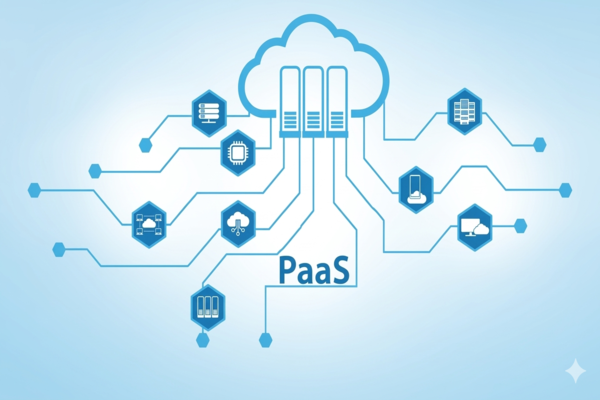
In essence, a PaaS service consists of these core components:
- Cloud Infrastructure: Includes Virtual Machines (VMs), storage, networking, and physical servers.
- Middleware Layer: Provides the necessary tools for applications to run, such as Operating Systems (OS), language runtimes (Java, Python, Node.js), and system libraries.
- Database Management Systems (DBMS): Integrated databases like MySQL, PostgreSQL, or MongoDB for easy data storage.
- Development Tools: Software Development Kits (SDKs), online IDEs, and version control managers to optimize workflows.
When you push your code to a PaaS, the system automatically allocates resources, sets up containers, and configures the corresponding environment so the application can go live immediately.
The Benefits of PaaS
Why have developers and businesses “fallen in love” with PaaS? The answer lies in resource optimization and enhanced creativity. Here are the key benefits that PaaS brings to the table:
- Minimized Setup Time: You can have a standardized environment in just a few clicks. This shortens the application development cycle from months to weeks or even days.
- Cost Efficiency: Following the “Pay-as-you-go” model, you only pay for what you use. There is no need for large capital investments in hardware or system maintenance personnel.
- Flexible Scalability: When your application suddenly hits millions of users, PaaS automatically scales up resources (Auto-scaling) to ensure performance, and scales back down when demand drops.
- Remote Work Support: Since the environment is hosted on the Cloud, development teams can collaborate from anywhere in the world with just an internet connection.
- Focus on Core Value: Developers no longer have to worry about server errors or network configurations, allowing them to devote their full attention to optimizing the user experience.
Limitations of PaaS
Despite its many advantages, PaaS is not a “silver bullet” that solves every problem. There are several hurdles you should consider before making a choice:
- Vendor Lock-in: Once you have built an application using the specific tools and APIs of a single provider (such as AWS or Azure), migrating to another platform can be extremely difficult and costly.
- Security and Compliance Risks: Since your data resides on a third-party infrastructure, you must place absolute trust in their security measures. Certain specialized industries (such as healthcare or defense) may face challenges in meeting strict regulatory requirements.
- Limited Customization: PaaS provides ready-made “frameworks.” If your application requires highly specific operating system configurations or deep kernel-level access, PaaS may not be able to accommodate those needs.
Common Applications of PaaS
Thanks to its high flexibility, PaaS is applied across almost every field of modern technology. Below are the most typical examples that developers frequently deploy on this platform:
Web and Mobile Application Development
PaaS offers powerful frameworks and optimized runtimes for both Web (such as Ruby on Rails, Django) and mobile backends. The platform supports the entire product lifecycle: from design and testing to deployment and Continuous Updates without disrupting the user experience.
Big Data Analytics
Analyzing terabytes of data is no longer a difficult problem in terms of hardware costs. PaaS provides real-time analytical tools and massive computational processing power, helping businesses extract value from data without investing in complex supercomputer systems.
Building and Deploying IoT Applications
With the specific requirement of connecting millions of devices and processing massive data streams, PaaS acts as an intelligent “coordination center.” The platform helps manage endpoints and collect/process information from sensors seamlessly and securely.
Business Process Automation (BPA)
Instead of manual operations, businesses can leverage PaaS to set up automated workflows, such as invoice approvals, HR management, or customer service. This not only minimizes errors but also creates a leap in labor productivity.
Software Development and Testing
PaaS is “fertile ground” for DevOps and CI/CD models. Engineers can quickly spin up sandboxes to test new features and release resources immediately upon completion, maximizing savings in both costs and operational time.
Types of PaaS by Purpose
To serve specialized technological niches, the concept of PaaS (Platform as a Service) has evolved into specific variants. Choosing the right specialized PaaS allows developers to fully leverage pre-built libraries and functionalities:
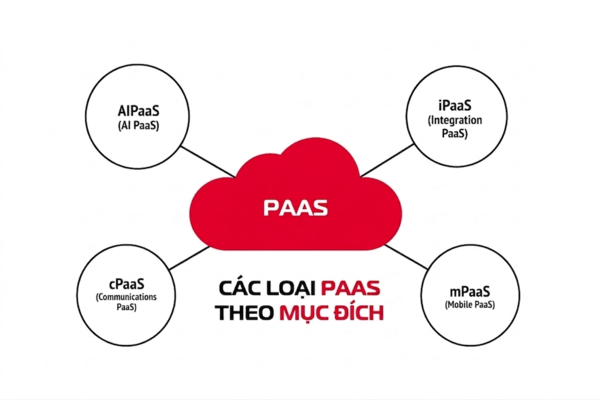
AIPaaS – PaaS for Artificial Intelligence
AIPaaS provides pre-trained Machine Learning models along with powerful APIs for voice recognition, image analysis, and Natural Language Processing (NLP). This allows even developers who aren’t AI experts to quickly and effectively integrate AI features into their applications.
iPaaS – Integration PaaS
This service focuses on integrating and connecting different applications (usually SaaS platforms), allowing them to exchange and synchronize data seamlessly. iPaaS helps eliminate “data silos” within an enterprise by establishing automated workflows and smooth data flow between software systems.
cPaaS – Communications PaaS
If you want to integrate features like video calling, SMS, or live chat into your app without building a complex telecommunications infrastructure, cPaaS (e.g., Twilio) is the optimal solution. It provides robust, easy-to-integrate communication APIs with high stability.
mPaaS – Mobile PaaS
mPaaS focuses on supporting the rapid and efficient development of cross-platform mobile applications. It offers essential features such as push notifications, offline storage/capabilities, and performance optimization tools to ensure apps run smoothly across various smartphones and operating systems.
PaaS (Platform as a Service) is not just a technological trend; it is a turning point that has changed the mindset of software development. By removing the burden of infrastructure, PaaS empowers developers to focus on what matters most: creating value for users through source code.
While limitations regarding control and vendor dependency remain, the benefits of PaaS in terms of speed, cost, and scalability are undeniable. In the future, as AI and IoT continue to advance, PaaS will remain a solid foundation for all creative innovation.
