



In the era of digital transformation, the demand for data storage and processing is no longer limited to individuals or isolated enterprises. The emergence of Community Cloud has paved a new path, combining the privacy of Private Cloud with the flexibility of Public Cloud. This is an optimal solution for organizations sharing common goals, security standards, or regulatory compliance requirements.
What is Community Cloud?
Community Cloud is a cloud computing service model designed specifically for a group of organizations or users with shared interests, missions, or security requirements. Instead of sharing resources with the general public like a Public Cloud, this model limits access to a specific community. This helps optimize infrastructure investment costs while still ensuring stringent data management standards.
The infrastructure of a community cloud can be owned, managed, and operated by one or more organizations within that community, or by a third party (service provider). The key is that it creates a secure collaborative environment where members can share common applications, software, and data without the risk of intrusion from outsiders.
Types of Community Cloud
Depending on the purpose of use and the specific characteristics of the participating members, Community Cloud is divided into several types to best meet practical needs:
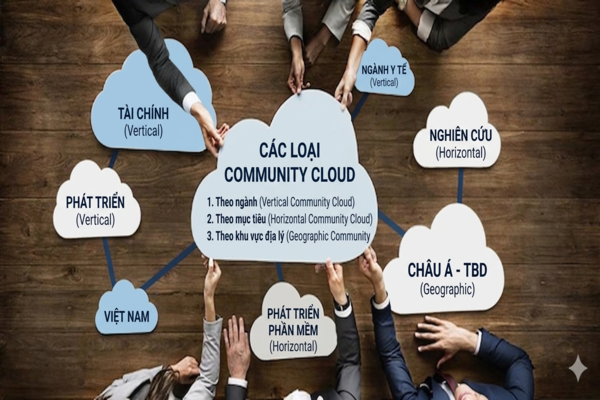
Vertical Community Cloud (Industry-specific)
This is the most common type, focusing on organizations operating within the same specialized field, such as healthcare, finance, or government. For example, hospitals within the same system can share a community cloud to securely exchange patient records while complying with medical information security regulations.
Horizontal Community Cloud (Goal-oriented)
This model is not limited to a specific industry but focuses on organizations with shared operational goals or those using the same type of technology. For instance, businesses participating in a multinational scientific research project can use a Community Cloud to run complex simulation models and share research results in real-time.
Geographic Community Cloud
This type serves organizations located within the same geographic area to address issues regarding network latency or compliance with local data sovereignty laws. City government agencies or businesses within an industrial park often adopt this model to optimize connectivity and support one another.
Structure of Community Cloud
To operate effectively, the structure of a Community Cloud typically involves a close integration of hardware infrastructure, management software, and multi-layered security. Fundamentally, it functions like a network connecting nodes from various members.
The administration system within a community cloud can be either decentralized or centralized, depending on the mutual agreement. Members contribute a portion of their resources (bandwidth, storage capacity, CPU) into a shared “resource pool.” A middleware layer is responsible for distributing these resources as fairly and efficiently as possible, ensuring that all members have access to necessary services without compromising the performance of the entire system.
Applications of Community Cloud
Thanks to its flexibility and specialization, Community Cloud is becoming the top choice for sectors requiring high collaboration while maintaining strict privacy standards.

- Finance: Banks can utilize a community cloud to share data regarding fraud prevention and anti-money laundering.
- Education: Affiliated universities can build shared digital libraries and massive Learning Management Systems (LMS).
- Government: This model helps ministries and agencies synchronize population, tax, and insurance data, accelerating public administrative processes while maintaining absolute national security.
Advantages of Community Cloud
Implementing a Community Cloud provides a perfect balance between economic efficiency and technical functionality for participating organizations.
- Cost Savings: Instead of each entity building its own expensive Private Cloud infrastructure, members share the costs of maintenance, operation, and upgrades.
- High Scalability: Users can easily adjust the amount of resources used based on the actual needs of a project.
- Effective Collaboration: Data sharing occurs seamlessly within a trusted environment, increasing the speed of workflow and decision-making.
- Standard Compliance: Because it is designed for specific groups, the system easily meets international standards (such as HIPAA for healthcare or PCI-DSS for finance).
Disadvantages of Community Cloud
Despite its many advantages, Community Cloud still presents certain barriers that organizations need to consider carefully before adoption.
- Management Responsibility: The biggest challenge lies in the division of management responsibility. When an incident occurs, determining which party is primarily liable can become complex if the terms of the agreement are not clearly defined.
- Resource Contention: Additionally, shared bandwidth among members can be limited if one party overuses it, affecting the experience of the remaining users.
- Initial Investment: Finally, the initial deployment cost of a community cloud is still significantly higher than renting mass-market Public Cloud services.
Security in Community Cloud
Security is the “vital” factor and the primary reason organizations seek out Community Cloud. These systems are equipped with specialized firewall layers and extremely stringent multi-factor authentication mechanisms.
In a community cloud, data is typically encrypted both at rest and in transit. Unlike a Public Cloud—where your “neighbors” are unknown—all participating parties in a Community Cloud are clearly identified and verified. This minimizes the risk of insider attacks and prevents cross-data leakage vulnerabilities. Furthermore, continuous monitoring by industry security experts ensures the system is always ready to respond to the latest threats.
Community Cloud is truly a strategic solution that helps organizations not only optimize resources but also enhance competitiveness through secure collaboration. With the advancement of technology, this model promises to go even further in reshaping how we work and share information.
