



In the era of digital transformation, data has become the most valuable asset of every organization. Selecting a storage infrastructure that ensures both stringent security and flexible scalability remains a challenging puzzle for IT administrators. This is precisely why Hybrid Cloud has emerged as a leading trend, breaking down the barriers between traditional infrastructure and modern cloud technology.
What is Hybrid Cloud?
Hybrid Cloud is a cloud computing model that combines at least one Private Cloud (or on-premises infrastructure) with at least one Public Cloud, such as AWS, Google Cloud, or Microsoft Azure. Rather than operating in silos, these environments are interconnected via Wide Area Networks (WAN) or Virtual Private Networks (VPN), allowing data and applications to move seamlessly between them.
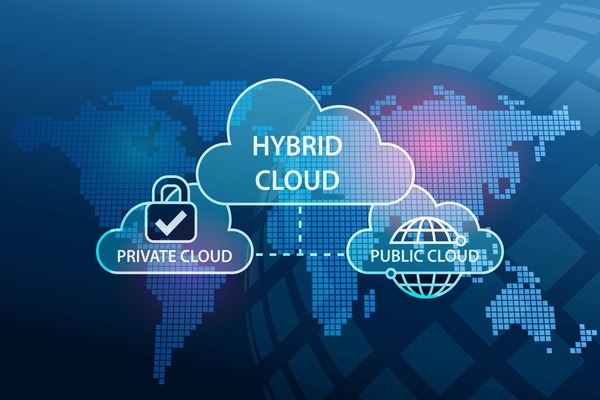
The defining characteristic of Hybrid Cloud is its “hybridization” capability. It enables businesses to leverage the massive computing power of the Public Cloud for routine tasks while keeping sensitive data protected behind a Private Cloud firewall. This is not merely a physical combination but a management synchronization that optimizes both performance and investment costs.
Hybrid Cloud Architecture
To understand how a hybrid system operates, we must examine its evolution over time. Hybrid Cloud architecture is not static; it evolves alongside advancements in virtualization and containerization, categorized into the two main stages below:
Traditional Hybrid Cloud
The traditional architecture focuses on connecting a company’s on-premises data center infrastructure with Public Cloud services. In this model, connectivity typically relies on dedicated lines or complex VPNs.
Businesses often use the Private Cloud as their primary storage and only “cloud burst” into the Public Cloud when computing demands spike. However, the greatest barrier to this architecture is the discrepancy between hardware and software platforms, which makes application migration difficult.
Modern Hybrid Cloud
Today, modern architecture prioritizes application portability over simple infrastructure connectivity. Thanks to Kubernetes and Container technology, the boundaries between clouds are gradually disappearing.
Public Cloud providers are now extending their services directly into customers’ data centers (e.g., AWS Outposts or Azure Stack). This allows developers to “write once, run anywhere”—whether on the Cloud or local servers—providing a unified management experience across the entire system.
Pros and Cons of Hybrid Cloud
Every technological solution is a double-edged sword. Understanding the strengths and limitations of Hybrid Cloud will help businesses develop the right deployment strategy and avoid wasting resources.
Advantages:
- High Flexibility: Businesses can choose the optimal environment for each specific type of workload.
- Cost Optimization: Instead of over-investing in physical servers just to handle peak periods, businesses only pay for the additional Public Cloud resources they actually use.
- Scalability: Instantly meet growth demands without waiting for the procurement and installation of new hardware.
- Security and Compliance: Keep sensitive data on-premises to comply with legal regulations while still leveraging Cloud-based AI and Big Data technologies.
Disadvantages:
- Management Complexity: Requires an IT team with extensive knowledge across multiple different platforms.
- Initial Operational Costs: Establishing connectivity and synchronization between two environments involves significant upfront setup costs.
- Network Latency: Without dedicated transmission lines, data transfer between Public and Private Clouds may experience latency issues.
How Hybrid Cloud Works
The core principle of Hybrid Cloud is based on resource abstraction. Instead of managing individual physical servers, the system uses middleware layers or orchestration tools to create a unified resource pool. Data moves back and forth thanks to Application Programming Interfaces (APIs) and secure network protocols.
When an application runs in a Hybrid environment, it can retrieve data from a secure database in the Private Cloud, then utilize the processing power of the Public Cloud to analyze and display results to the user. This entire process is automated and coordinated to ensure that resources are always used at the highest efficiency and the lowest cost.
Which Businesses Should Use Hybrid Cloud?
Not every business needs a hybrid cloud, but for certain specific entities, it is an essential choice. Hybrid Cloud is particularly suited for:
- Businesses with seasonal fluctuations: For example, e-commerce platforms that require massive resources during sales events but need stability for daily operations.
- Financial institutions and banks: Entities that require absolute security for on-premises customer information while wanting to use the Cloud to develop mobile applications.
- Businesses undergoing gradual digital transformation: Organizations that cannot immediately abandon legacy systems but want to access new technologies.
Applications of Hybrid Cloud
The versatility of Hybrid Cloud has led to its presence in almost every critical sector of life. Depending on the specific characteristics of the industry, this model is customized to maximize its value.

In the Corporate Sector
Multinational corporations use Hybrid Cloud to synchronize data globally. They utilize a Private Cloud at headquarters to control strategic data and a Public Cloud at local branches to reduce latency for end-users. Additionally, it is used effectively and economically for Backup and Disaster Recovery purposes.
In Government and Public Agencies
For e-government, security is the top priority. Citizen identification and national security information are stored in an internal Private Cloud. However, public service portals serving millions of citizens are hosted on the Public Cloud to ensure they do not crash during high traffic periods, while also leveraging AI chatbot tools to support citizens 24/7.
In the Education Sector
Universities today use Hybrid Cloud to operate Learning Management Systems (LMS). Grades and student records are kept secure on the university’s servers. Meanwhile, large-capacity video lectures and high-traffic online exams are pushed to the Public Cloud to ensure smooth transmission speeds and prevent network congestion.
Challenges of Implementing Hybrid Cloud
While offering numerous benefits, the road to implementing Hybrid Cloud is not always paved with roses. The biggest challenge is Interoperability between platforms. Occasionally, an application functions perfectly in one environment but encounters errors in another due to differences in operating system versions or network configurations.
A second challenge is cost management. Without rigorous monitoring tools, businesses can easily fall victim to “bill shock” from Public Cloud providers due to uncontrolled data transfer volumes or virtual resources that are left running when not in use. Finally, securing high-quality personnel remains a difficult puzzle as the market faces a shortage of experts experienced in multi-cloud administration.
Is Hybrid Cloud Secure?
The answer is: Yes, if implemented correctly. In fact, Hybrid Cloud provides a “defense-in-depth” security layer that single-model infrastructures struggle to achieve. By utilizing Data Classification, businesses can place their most critical data behind multiple physical and logical firewalls.

However, information security in a hybrid model is a Shared Responsibility. The Cloud provider is responsible for securing the underlying infrastructure, while the business is responsible for application security configuration, data encryption, and access management. Utilizing Unified Identity and Access Management (IAM) and continuous monitoring will help minimize data breach risks.
Frequently Asked Questions (FAQ)
To conclude, let’s review some common questions managers often ask when exploring this model:
- How does Hybrid Cloud differ from Multi-cloud? Multi-cloud refers to using multiple different Public Clouds. Hybrid Cloud is the combination of Private and Public Clouds. It is possible to have a system that is both Hybrid and Multi-cloud.
- Does switching to Hybrid Cloud take a long time? It depends on the scale of the system. A typical roadmap can span from several months to years to ensure a safe data migration process.
- How are Public Cloud costs calculated in a Hybrid model? Costs are usually based on the “Pay-as-you-go” principle for computing resources, storage, and data egress (outgoing data transfer).
We hope this article has provided you with a comprehensive and insightful look at Hybrid Cloud. It is not just a technological solution, but a smart business strategy that helps enterprises adapt quickly to any market fluctuations.
