



The Fourth Industrial Revolution has opened new doors for advanced manufacturing methods, in which 3D Printing in Industry has emerged as a true game-changer. No longer confined to rapid prototyping or personal hobbies, this additive manufacturing technology is penetrating deep into mass production lines, helping businesses optimize processes and realize designs once thought impossible.
What is 3D Printing in Industry?
To understand why this technology is creating such a buzz, we need a close-up look at its technical nature and the differences between professional-grade 3D printing and consumer-level machines. Industrial 3D printing is not just about creating objects; it is an ecosystem combining design software, advanced materials, and high-precision mechanical systems.
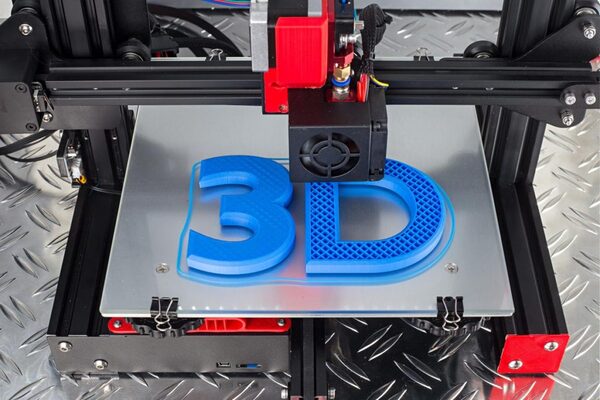
Definition of Additive Manufacturing
3D Printing in Industry, also known as Additive Manufacturing, is the process of fabricating objects by depositing material layer by layer based on a digital 3D model (CAD). Unlike cutting away from a solid block of raw material, this method “builds” the object from scratch, maximizing material savings.
Differences Between Desktop and Industrial 3D Printers
| Criteria | Desktop 3D Printers | Industrial 3D Printers |
|---|---|---|
| Materials | Low-cost plastics (Standard PLA, ABS) | Metals (Titanium, Steel), high-temp engineering plastics, composites |
| Accuracy | Low to Medium | Very high, perfect repeatability |
| Build Volume | Small, limited | Large, accommodating various dimensions |
| Durability | Low, mainly for visual models | Very high, suitable for end-use parts |
| Applications | Hobbies, education, basic prototyping | Aerospace, Healthcare, mass production |
Traditional Manufacturing vs. 3D Printing
Comparing these two methods provides production managers with an objective view of when to switch or integrate them. While each method has its strengths, 3D Printing in Industry is gradually filling the gaps left by traditional manufacturing.
Subtractive vs. Additive Methods
Traditional manufacturing (such as CNC milling or turning) is a “subtractive” method, meaning it removes excess material to achieve the desired shape. In contrast, 3D printing is an “additive” method. This leads to a significant difference in material efficiency and geometric freedom.
Production Flexibility
With traditional manufacturing, every design change requires businesses to alter molds and reset machinery, which is time-consuming and costly. 3D printing allows for design changes with just a click of a button in the software, enabling industrial-scale product personalization without increasing fixed costs.
Benefits of 3D Printing in Manufacturing
Why are global giants like Boeing, BMW, and Siemens investing billions of dollars in this technology? The answer lies in the economic and technical value it provides, helping businesses sharpen their competitive edge in the global market.
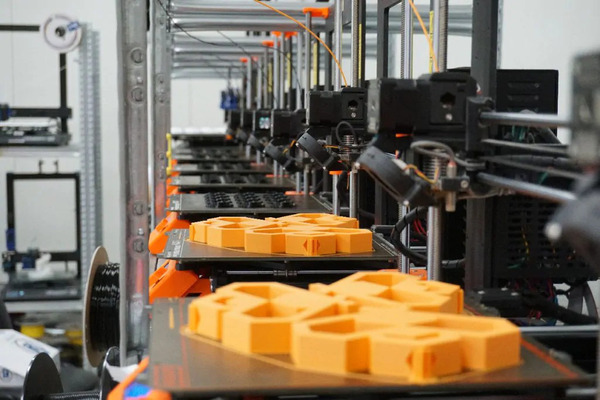
- Weight and Structural Optimization: 3D Printing in Industry enables the creation of hollow or lattice structures that are ultra-lightweight yet maintain exceptional rigidity. In the aerospace sector, reducing just 1kg of an aircraft’s weight can save tens of thousands of dollars in fuel costs annually.
- Accelerated Time-to-Market: The journey from a conceptual idea to a physical product is shortened from months to mere days. Rapid prototyping allows engineers to detect design flaws early, avoiding costly mistakes during mass production.
- Supply Chain and Warehouse Optimization: Instead of storing thousands of spare parts in physical warehouses, companies can maintain a “digital inventory.” When needed, they simply send a file to the nearest printer for on-site production, significantly reducing shipping costs and inventory management overhead.
Challenges of Adopting 3D Printing
Despite its numerous advantages, the path to implementing 3D Printing in Industry is not always paved with roses. Businesses must face both economic and technical hurdles before achieving a true breakthrough.
- High Initial Investment Costs: An industrial-grade metal 3D printing system can cost anywhere from hundreds of thousands to millions of dollars. Additionally, the expense of specialized materials and system maintenance remains a challenging financial puzzle for small and medium-sized enterprises.
- Limitations in High-Volume Mass Production: For producing millions of simple components, 3D printing cannot yet compete with the speed and cost-efficiency of traditional injection molding. This technology is currently most optimal for small to medium batches or extremely complex geometries that traditional methods cannot replicate.
How 3D Printing Technology Works
To operate efficiently, it is essential to understand the underlying technical process. 3D Printing in Industry is not as simple as just pressing a “Print” button; it is a series of closely coordinated steps that bridge the gap from virtual design to physical reality.
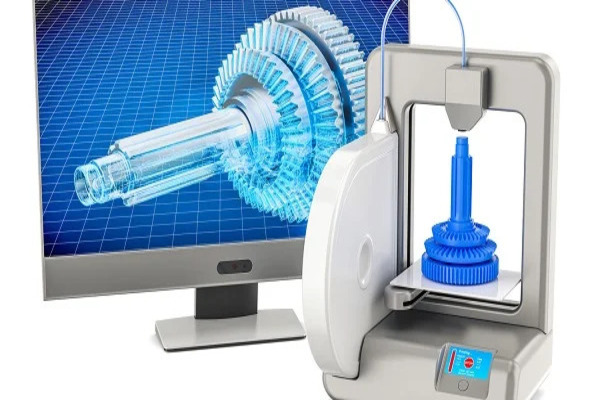
- Design and File Preparation (Pre-processing): Everything begins with a 3D model on a computer. Specialized software then “slices” this model into thousands of thin horizontal cross-sections, generating the toolpath for the print head to follow.
- Common Printing Technologies: FDM, SLA, and SLS:
- FDM (Fused Deposition Modeling): The most common method, which utilizes molten thermoplastic filaments.
- SLA (Stereolithography): Uses UV light to cure liquid resin, providing exceptionally high surface smoothness.
- SLS (Selective Laser Sintering): Employs a laser to sinter powdered materials (plastic or metal) together, eliminating the need for support structures.
- Post-processing: Once printed, products often require additional treatment, such as removing support structures, polishing, heat treatment to enhance durability, or coating to achieve the desired aesthetic finish.
Practical Applications of 3D Printing in Industry
Reality has proven that 3D Printing in Industry is no longer just a theoretical concept. It is now present in almost every critical sector, creating high-performance products that traditional methods simply cannot achieve.
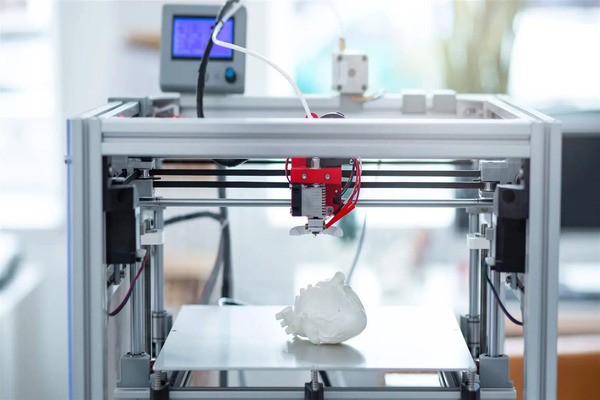
- Aerospace and Defense: Manufacturing rocket fuel nozzles or jet engine components with integrated structures. This helps reduce the part count from dozens of individual pieces to a single unified component, significantly decreasing the risk of leaks and mechanical failure.
- Medical and Dental: Creating personalized bone implants tailored specifically to the unique anatomy of each patient. In dentistry, 3D printing enables the production of clear aligners and ceramic crowns with absolute precision.
- Automotive Industry: Utilizing 3D printing to fabricate custom jigs and fixtures that help assembly workers move faster, or producing high-performance components for Formula 1 racing cars to optimize aerodynamics.
Challenges in Implementing 3D Printing
To move further, the sector must address several lingering obstacles. These are the bottlenecks that, if resolved, will allow 3D printing to truly become a universal manufacturing standard.
- Shortage of Highly Skilled Workforce: Operating industrial 3D printers requires engineers to be well-versed in materials science, Design for Additive Manufacturing (DfAM), and digital workflows. Currently, the talent pool meeting these high standards remains very scarce.
- Standardization and Quality Certification: In sectors like aerospace or healthcare, every part requires rigorous certification for durability and safety. The establishment of international standard sets for 3D printed products is still a work in progress, which hinders mass adoption.
- Intellectual Property and Data Security: When a product exists as a digital file, the risk of design theft or “pirated” printing becomes real. Businesses must invest heavily in data security to protect their intellectual property.
3D Printing in Industry is not merely a new tool; it represents a fundamental shift in manufacturing mindset. While challenges regarding cost and standardization remain, the benefits of flexibility, design optimization, and supply chain efficiency are undeniable. This technology is the key for businesses to ride the wave of innovation and break through in the era of digital production.
