



In the digital era, the boundaries between websites and mobile applications are becoming increasingly blurred. Users are demanding faster access speeds, greater convenience, and high interactivity. This is exactly why Progressive Web Apps (PWA) were born, becoming one of the most breakthrough technologies in modern web design. This article will provide you with a comprehensive look at everything from the concept and inner workings to the economic benefits that PWAs provide.
What are Progressive Web Apps (PWA)?
Fundamentally, Progressive Web Apps (PWA) are a type of application software built using common web technologies such as HTML, CSS, and JavaScript, but optimized to deliver an experience identical to a mobile app (Native App).
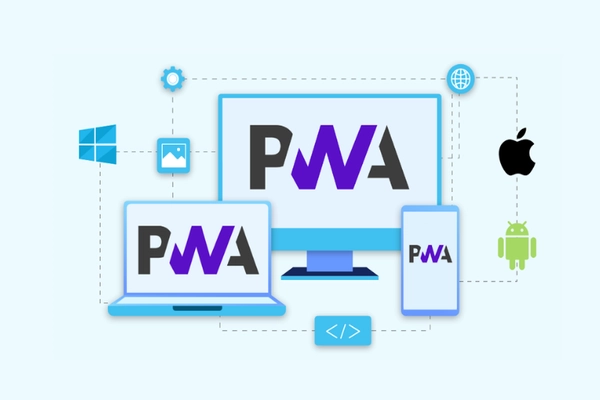
A PWA is not merely a mobile-responsive website. It is the perfect combination of web flexibility and the power of an installed application. You can add a PWA to your phone’s home screen without going through app stores like the App Store or Google Play. This helps eliminate download barriers—a primary reason why many users abandon traditional apps.
How PWAs Work
To understand why PWAs offer such superior performance, we need to examine their internal operating mechanisms. A PWA does not function like a traditional website that depends entirely on a continuous network connection.
The core of a PWA lies in a component called a Service Worker. This is a JavaScript file that runs in the background, acting as a proxy between the browser and the network. It allows the application to cache resources, enabling the website to load instantly even when the network is weak or unavailable. Additionally, the Web App Manifest (a JSON file) contains information such as the app name, icons, and brand colors, allowing the browser to understand that this is an “installable” application.
PWA Programming Languages
Because they are essentially products of web technology, PWAs use familiar programming languages accessible to any web developer. This makes application building more flexible and resource-efficient.

Most PWAs today are developed based on the trio of HTML5, CSS3, and JavaScript. To increase efficiency and development speed, engineers often use modern frameworks such as:
- React.js: Powerful for building dynamic user interfaces.
- Vue.js: Flexible and easy to integrate.
- Angular: Suitable for large-scale applications with high security requirements. In addition, tools like Google’s Workbox are widely used to manage Service Workers more effectively.
Purpose of Using PWA
Why are businesses shifting towards PWAs instead of focusing solely on websites or Native Apps? The answer lies in the goal of optimizing the customer journey.
PWAs are designed to solve performance and accessibility issues. The primary purpose is to provide a seamless user experience, reduce dependence on intermediary app stores, and increase customer retention through features like push notifications. For e-commerce or news businesses, a PWA is an ideal tool to maintain a continuous presence on a user’s device without consuming too much storage space.
Pros and Cons of PWA
Like any technology, Progressive Web Apps (PWA) have outstanding strengths but also certain limitations that need to be considered.

Advantages:
- Flexibility: Runs smoothly on both desktops and mobile devices.
- No Store Installation Required: Users can simply “Add to Home Screen” directly from the browser.
- Extremely Lightweight: Typically occupies only a few hundred KB compared to the tens of MB required by traditional apps.
- Offline Functionality: Thanks to Service Workers, users can still view content even when the connection is lost.
Disadvantages:
- Hardware Limitations: PWAs cannot yet deeply access certain hardware features such as FaceID or Bluetooth (especially on iOS).
- Higher Battery Consumption: Because they run through a browser, power consumption can be higher than that of a native app.
- Browser Support: Some older browsers may not fully support all PWA features.
Do PWAs Run on All Browsers?
The short answer is: Yes, but the level of support varies. PWAs are built on the principle of “progressive enhancement,” meaning they will function at a basic level on older browsers and offer full features on modern ones.
Chromium-based browsers like Google Chrome, Microsoft Edge, and Opera support PWAs exceptionally well. Regarding the Apple ecosystem, Safari has begun supporting PWAs, though it remains somewhat limited in features like push notifications on iPhone (though recent updates have improved this significantly). Overall, most internet users today can experience PWAs smoothly.
Why were PWAs born?
The emergence of PWAs was not a coincidence, but rather the result of addressing the “pain points” of both users and businesses in the mobile era.
In the past, users were often reluctant to download new applications due to the friction of logging into app stores, forgotten passwords, or lack of storage space on their phones. For businesses, maintaining two separate development teams for iOS and Android was prohibitively expensive. PWAs were born as a compromise solution: delivering a smooth, app-like experience but with the cost-efficiency and convenience of the web. The term was first proposed by Frances Berriman and Alex Russell in 2015 to redefine the standards of the modern web.
PWA Development Costs
Budget is always a vital factor when deciding on a technology investment. The cost of developing Progressive Web Apps (PWA) is generally considered much more economical than building a Native App.
Instead of paying to develop three separate products (Website, Android App, and iOS App), you only need to invest in a single codebase for a PWA. Maintenance costs are also cut in half because you do not need to update multiple versions across various app stores. Typically, a PWA project can save a business anywhere from 30% to 75% of the budget compared to traditional mobile app development.
Benefits of Progressive Web Apps (PWA)
When discussing benefits, a PWA is not just a technical tool but also a powerful business strategy. Below are the specific values that PWAs bring to both businesses and end-users.
Faster Development Time
Since they utilize standard web technologies, building a PWA happens much faster than a Native App. Developers do not need to wait for the rigorous approval processes from the App Store or Play Store, allowing businesses to achieve a faster time-to-market.
All-in-One Platform
PWAs operate across every device and operating system. This means a business only needs to manage a single platform for all customer segments, thereby unifying the brand experience and user data.
Cost Savings
As mentioned, cutting down the development teams for each specific operating system helps businesses save a massive amount of capital. Additionally, maintenance and update costs are lower because all changes are updated instantly on the web without requiring users to redownload the app.
Reduced Customer Acquisition Cost (CAC)
Downloading an app from a store requires multiple steps (entering the store, searching, entering a password, and waiting for the download). Every step causes a drop-off in potential customers. PWAs allow users to experience the application instantly, thereby reducing abandonment rates and lowering the cost of acquiring new customers.
Leveraging Headless Commerce
PWAs are the perfect partner for the Headless Commerce trend (decoupling the front-end interface from the back-end data management). This allows businesses to change the interface flexibly without affecting the underlying sales system, resulting in lightning-fast page load speeds.
More Effective SEO
Unlike Native Apps that are “hidden” within app stores, a PWA is a website, meaning it can be fully indexed by Google. This helps businesses leverage the power of SEO to attract organic traffic—something traditional apps simply cannot do.
Lower Bounce Rate
Record-breaking page load speeds (often under 3 seconds) combined with offline functionality ensure that users do not feel frustrated by poor connections. This significantly reduces the bounce rate, keeping customers on the website longer.
Increased Engagement and Revenue
Features such as push notifications and home screen icons remind customers to return to the application more frequently. Studies have shown that brands adopting PWAs (such as Starbucks or Twitter) have witnessed a marked increase in conversion rates and overall revenue.
Comparing Progressive Web Apps and Native Mobile Apps
To make the most informed choice, we need to place PWAs and Native Apps on the scale for comparison based on several key criteria.
| Criteria | Progressive Web Apps (PWA) | Native Mobile Apps |
|---|---|---|
| Installation | No Store required; add directly from the web | Must download via App Store / Play Store |
| Cost | Low (Shared web codebase) | High (Must develop separately for iOS / Android) |
| Performance | Very fast, but browser-dependent | Absolutely optimized for hardware |
| Offline | Good support via Service Workers | Extremely powerful support |
| SEO | Excellent (Searchable by Google) | Cannot be SEO-optimized directly on Google |
| Features | Supports most (except some deep features) | Access to all sensors, FaceID, etc. |
The Future of Progressive Web Apps (PWA)
Looking ahead, PWAs are not just a passing trend but are becoming the new standard for website construction. With increasingly strong support from tech giants like Google, Microsoft, and gradually Apple, the functional gap between PWAs and Native Apps is steadily narrowing.
In the future, as 5G networks become ubiquitous and browser APIs evolve further, PWAs will have the potential to replace the majority of common mobile applications—particularly in e-commerce, journalism, and productivity tools. Investing in Progressive Web Apps (PWA) right now is the way for businesses to stay ahead of the curve and optimize the customer experience for the future.
A PWA is the perfect combination of web technology and mobile applications. It provides businesses with a comprehensive solution for costs, SEO, and business efficiency, while offering users a smooth, fast, and convenient experience.
