


In the context of rapid digital transformation, the concepts of Blockchain and Big Data are frequently mentioned as the pillars of the Fourth Industrial Revolution. The intersection between a ‘new resource’ (Big Data) and a ‘trust-storage technology’ (Blockchain) is unlocking unprecedented opportunities for businesses.
What are Blockchain and Big Data?
To understand why this combination is revolutionary, we first need to break down each concept independently. Despite their different natures—one focusing on volume and processing speed, the other on integrity and security—they complement each other perfectly within modern intelligent systems.
What is Blockchain?
Blockchain is a data storage technology that organizes information into blocks linked together by cryptography. Its standout features are decentralization and immutability. Every time a transaction occurs, it must be validated by a network of nodes before being recorded into a new block.
Once recorded, the data is virtually impossible to modify or delete without the consensus of the majority of the network. This creates a transparent ‘digital ledger,’ eliminating the need for third-party intermediaries.
What is Big Data?
Big Data refers to extremely large, complex, and diverse datasets that traditional data processing software cannot handle. Big Data is typically defined by the 5V model: Volume (massive amounts), Velocity (high processing speed), Variety (diverse data types), Veracity (accuracy), and Value (economic worth).
The ultimate goal of Big Data is not merely storage, but rather utilizing algorithms to uncover hidden patterns, trends, and correlations, thereby helping humans make more accurate business decisions.
Benefits of Big Data
Big Data has become the ‘oil’ of the 21st century. The benefits it brings to society and businesses are undeniable:
- Personalizing customer experience: By analyzing user behavior on social networks, websites, and applications, businesses can provide product recommendations best suited to each individual’s preferences.
- Optimizing operations: In manufacturing and logistics, Big Data helps forecast market demand, manage inventory efficiently, and minimize waste in the supply chain.
- Supporting data-driven decision-making: Instead of relying on intuition, today’s leaders use analytical reports from Big Data to determine investment strategies and new product development.
- Risk prevention: The banking and finance industry uses Big Data to detect unusual transactions, thereby promptly preventing fraud and money laundering.
Major Challenges of Big Data
Despite providing immense value, the management and exploitation of Big Data still face several serious hurdles:
- Security and Privacy Issues: Concentrating a large amount of sensitive user data on a central server turns them into primary targets for cyberattacks.
- Data Quality (Dirty Data): Junk data, inaccurate, or incomplete data can lead to erroneous analyses, causing significant damage to businesses.
- Transparency and Provenance: It is very difficult to trace where a piece of data originates or whether it has been altered during transmission.
- Storage and Processing Costs: Maintaining the infrastructure to process petabytes of data requires enormous financial and technical resources.
Comparing Big Data and Blockchain
Although both are related to data, their purposes and operating methods are distinctly different:
| Feature | Big Data | Blockchain |
|---|---|---|
| Primary Goal | Analysis and forecasting from massive data. | Secure storage of immutable data. |
| Structure | Usually centralized or distributed. | Decentralized. |
| Modifiability | Data can be edited, updated, or deleted. | Data is immutable; can only be added, not edited/deleted. |
| Reliability | Based on the reputation of the data manager. | Based on cryptographic algorithms and network consensus. |
| Data Types | Diverse (text, video, sensors, images). | Primarily transaction records and smart contracts. |
Applications of Blockchain and Big Data in Business
The combination of Blockchain and Big Data does not happen in isolation. To truly create a disruptive power, they need to be integrated into a diverse technological ecosystem. Here is how this synergy is changing the landscape of industries:
Combining with AI and Machine Learning
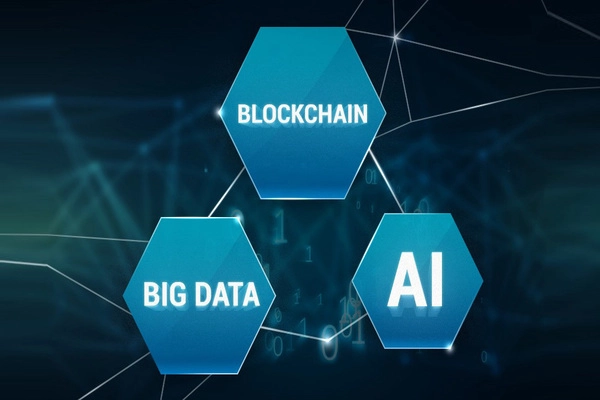
AI needs clean and high-quality data to “learn.” Blockchain provides a reliable, transparent, and unforgeable data source. When AI analyzes data stored on a Blockchain, the outputs become more accurate. Conversely, AI can help optimize the management of nodes within a Blockchain network.
Combining with IoT
IoT (Internet of Things) devices generate a massive amount of data every second. However, IoT security remains a major vulnerability. Blockchain helps authenticate every device within the network, ensuring that data sent from sensors is accurate and protected from hacker interference during transmission.
Combining with Cloud Computing
Cloud computing provides the storage space for Big Data, while Blockchain ensures the integrity of that data. This combination provides businesses with an infrastructure that is both flexible and absolutely secure against the risks of server attacks.
Integrating Blockchain within Data Processes
Applying Blockchain itself to Big Data processing workflows helps solve the “trust” problem. Instead of relying on a single organization, partners in a supply chain can place their trust in cryptographic algorithms when sharing data with one another.
Combining with Automation and RPA
Robotic Process Automation (RPA) can automatically retrieve data from Blockchain ledgers to perform repetitive tasks. This helps eliminate human error and accelerates the processing speed of complex workflows.

Combining with Real-time Data Analytics
In industries such as stock markets or healthcare, data must be analyzed instantaneously. Blockchain ensures that the transmitted data stream remains “original,” enabling Big Data analytical algorithms to provide real-time feedback without concerns regarding tampering or falsification.
Combining with 5G
The speed of 5G allows for the faster transmission of massive Big Data volumes, while Blockchain manages these data transactions securely. This serves as the foundation for smart cities and autonomous vehicles.
Combining with Location-Based Data Analytics
In logistics, knowing the precise location of goods (Location Big Data) and confirming delivery via Smart Contracts (Blockchain) helps to make the entire transportation process completely transparent.
Combining with AR/VR
Augmented Reality (AR) and Virtual Reality (VR) create digital interactions. Blockchain can be used for user identification and digital asset ownership within these spaces, while Big Data analyzes user behavior to optimize virtual environments.
The Future of Blockchain and Big Data
In the future, the boundaries between Blockchain and Big Data will become increasingly blurred. We are moving toward an era of “Data Democracy,” where individuals have the right to control their own data through Blockchain and only share it with Big Data systems when permission is granted.
This not only helps protect privacy but also creates a market for clean, high-quality data, driving breakthrough advancements in medicine, space science, and social management. This combination is the key to building a digital society that is more trusted, transparent, and efficient than ever before.
The convergence of Blockchain and Big Data is a pivotal turning point in the digital era. While Big Data provides a vast resource of knowledge for analysis, Blockchain plays the role of securing and authenticating absolute trust. This synergy helps businesses optimize operations, ensuring transparency and data safety. It is undoubtedly the core foundation driving innovation and sustainable development for all industries in the future.
