



In the midst of the powerful Fourth Industrial Revolution, two standout technologies – Blockchain and AI (Artificial Intelligence) – are gradually moving beyond isolated applications to create unprecedented synergistic power. If AI is considered the “brain” capable of processing and decision-making, then Blockchain serves as the reliable “nervous system” that stores and protects data. This article will provide a detailed analysis of how these two technologies operate and why their combination is the key to the future.
What are Blockchain and AI?
To understand why this combination is groundbreaking, we first need to deconstruct the definitions and core characteristics of each technology. Blockchain brings transparency and immutability, while AI brings the capacity for learning and intelligent automation.
What is Blockchain?
Blockchain is a data storage technology where information is kept in blocks that are tightly linked and encrypted using complex algorithms. The most critical features of Blockchain are decentralization and immutability. Once data has been recorded onto the chain, it is nearly impossible to modify or delete without the consensus of the majority of nodes in the network. This creates a transparent “digital ledger” where every transaction can be verified without the need for a third-party intermediary.
What is AI?
Artificial Intelligence (AI) is a field of computer science that simulates human thought and learning processes. Through Machine Learning and Deep Learning algorithms, AI has the capability to analyze massive datasets to identify patterns, make predictions, and execute complex tasks such as image recognition, natural language processing, and automated decision-making. The ultimate goal of AI is to optimize performance and perform tasks that require intelligence far beyond the capacity of manual human processing.
The Value of Combining Blockchain and AI
The intersection of Blockchain and AI is not merely a technological addition but a qualitative transformation. While AI requires vast amounts of clean data to learn, Blockchain provides a reliable and unmanipulatable data source. Conversely, AI helps Blockchain become smarter by optimizing smart contracts and managing network resources more efficiently. This combination addresses the challenges of data trust and processing performance.
- Algorithmic Transparency: AI is often viewed as a “black box” because users do not understand why it makes certain decisions. Blockchain can record every logical step of the AI on a ledger, enabling human auditability.
- Data Security: Data used for AI training is often a valuable asset or sensitive information. Blockchain utilizes encryption to protect this data, ensuring AI learns from standard sources without exposing personal information.
- Increased Economic Efficiency: AI can automate transaction validation on the Blockchain, helping to reduce operational costs and increase the processing speed of the network.
Applications of Blockchain and AI
Reality has proven that the parallel implementation of Blockchain and AI is creating revolutions across various industries. From securing medical records to optimizing cash flow in banking, this combination is resolving long-standing bottlenecks in traditional systems.
Healthcare
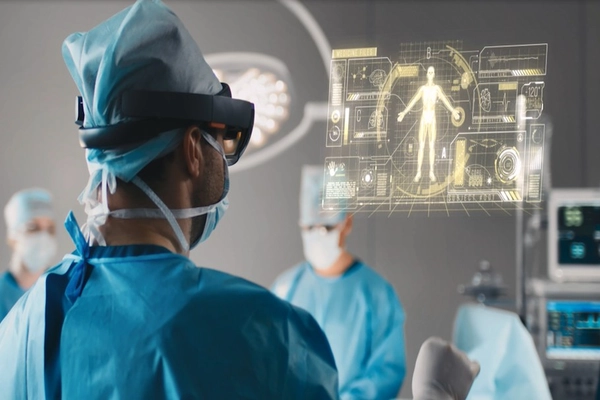
In the medical field, this combination enables high-precision diagnostics based on strictly secured medical records. Blockchain stores a patient’s treatment history safely and privately, while AI analyzes that data to detect early signs of cancer or genetic diseases. Patients have control over who accesses their data, and doctors can trust the accuracy of that data 100%.
Life Sciences
In pharmaceutical research, Blockchain and AI help accelerate the clinical trial process. Trial data is stored on the Blockchain to prevent the falsification of results, while AI processes complex protein structures to discover new drug formulas. This helps reduce research costs and shortens the time required to bring drugs to market.
Financial Services
This is the field where Blockchain and AI demonstrate their power most clearly. AI is used to detect financial fraud in real-time based on abnormal transaction patterns. Meanwhile, Blockchain executes instant cross-border payment transactions at low costs without the need for intermediary banks. This combination creates a safer and more efficient decentralized finance (DeFi) system.
Supply Chain
The combination helps create a “smart” supply chain. Blockchain enables the tracking of goods’ origins from the factory to the consumer’s hands. AI forecasts market demand, optimizes shipping routes, and manages warehouses automatically. The result is a reduction in waste, the elimination of counterfeit goods, and increased sustainability for businesses.
Case Studies
Many major corporations have begun implementation. For instance, IBM has developed solutions using AI to analyze data from the Food Trust Blockchain network, helping to identify the source of contaminated food in just seconds instead of weeks. Similarly, in the energy sector, smart grids use AI to balance supply and demand while utilizing Blockchain to allow citizens to trade surplus electricity with one another.
How Blockchain Supports AI
Many experts believe that Blockchain is the missing piece for AI to reach a higher level. By providing a secure infrastructure platform, Blockchain helps resolve issues regarding ethics, security, and data ownership-which are currently the biggest barriers to AI.
Advanced Data Security
AI models require massive amounts of data. However, centralizing data on a single server makes them vulnerable to attacks. Blockchain enables distributed data storage. Data is encrypted and sharded; only AI with authorized access can process it, helping to prevent large-scale information leaks.
Increasing Trust in AI System Decisions
One of the major issues with AI is “hallucination” or bias. When input data is verified through Blockchain, AI learns from reliable sources that have been validated by the community. Furthermore, every decision made by an AI can be recorded as a digital trail, helping humans clearly understand “why” the AI acted in a certain way.
Collective Decision-Making
Through Blockchain’s consensus mechanisms, we can build decentralized AI systems. Instead of a single entity controlling the AI, critical model decisions (such as algorithm updates) can be made through community voting via DAOs (Decentralized Autonomous Organizations), ensuring democracy and fairness.
Decentralized Intelligence
Blockchain allows for the creation of peer-to-peer computing networks. Instead of relying on expensive supercomputers from Google or Microsoft, AI can leverage surplus computing power from millions of personal computers globally through Blockchain. This helps reduce model training costs and prevents technological monopolies.
Enhancing Operational Efficiency
Smart contracts on the Blockchain can automate processes based on AI outputs. For example, if an AI identifies a damaged package via camera, a smart contract can automatically trigger a refund or request a replacement without human intervention, making the operational process smooth and absolutely accurate.
The Future of Blockchain and AI
Looking ahead, the convergence of Blockchain and AI will lead to the birth of an entirely new data economy. In this economy, data is an individual asset, exchanged transparently and securely. We can expect the emergence of “Autonomous Agents”—AI entities with their own crypto wallets on the Blockchain, capable of signing contracts, purchasing services, and generating economic value without direct human management.

Furthermore, as Web3 evolves, Blockchain and AI will serve as the core foundations. AI will personalize user experiences, while Blockchain ensures digital ownership. Although challenges regarding legal regulations and technical scalability remain, the potential brought by this combination is undeniable. It is not merely a trend, but a new standard for a digital world that is more secure, transparent, and intelligent.
