



In the context of powerful digital transformation, the combination of Blockchain and IoT (Internet of Things) is no longer a foreign concept but has become the foundation for trust and automation. As billions of internet-connected devices generate a massive volume of data, the challenges of security and centralized management have become more urgent than ever. Blockchain has emerged as the ‘perfect piece of the puzzle’ to address these vulnerabilities.
1. What is Blockchain?
Before diving deep into this combination, we need to understand the nature of Blockchain. This is not merely the technology behind cryptocurrencies, but a revolutionary method of storing and transmitting information, based on complex mathematical and cryptographic principles.
Concepts and Structure of Blockchain
Blockchain is a decentralized digital ledger that records transactions across many computers in such a way that the records cannot be altered retroactively without the alteration of all subsequent blocks. Each block contains a timestamp and transaction data, and is securely linked to the previous block using a cryptographic hash.
Technical Characteristics that Empower Blockchain
- Decentralization: Data is not stored on a single server but is distributed across the entire network, eliminating the risk of being attacked at a single point of failure.
- Transparency: Every change on the ledger can be verified by all authorized participating parties.
- Immutability: Once data has been validated and added to a block, modifying it is nearly impossible for any individual or organization.
2. What is IoT (Internet of Things)?
IoT represents a world where every object—from light bulbs and washing machines to extremely complex industrial sensors—has the capability to collect and share data over the Internet. The explosion of IoT is blurring the boundaries between the physical and digital worlds.
The Internet of Things Ecosystem
IoT is a network of physical entities integrated with sensors, software, and connectivity technologies. The primary goal is to enable devices to “communicate” with each other and with humans to optimize work performance or improve the quality of life.
The Importance of Data in IoT
Data is the “lifeblood” of the IoT system. By collecting data on temperature, humidity, location, or the operational status of machinery, businesses can make decisions based on actual figures rather than predictions. However, this massive volume of data also poses challenges regarding authenticity and information security.
3. How do Blockchain and IoT work together?
The combination of Blockchain and IoT creates a new network architecture where the security of Blockchain protects the data collected by IoT devices. This relationship operates on mutual trust without the need for a third party.
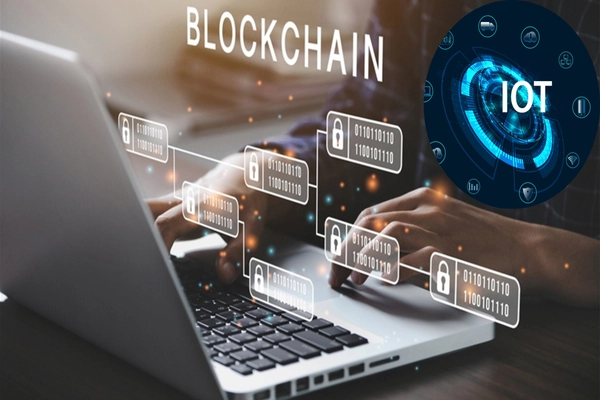
Decentralized Device Identity Mechanism
In traditional models, IoT devices typically authenticate through a central server (cloud). With Blockchain, each device is assigned a unique ID stored on the blockchain. When a device intends to send data, it signs the transmission with its own private key. The network verifies the validity of that signature before accepting the data, ensuring that no fraudulent devices can penetrate the system.
Automation via Smart Contracts
Smart Contracts are self-executing lines of code stored on the Blockchain. When combined with IoT, they act as the “enforcers” of regulations. For example: if an IoT sensor detects that the humidity in a warehouse has exceeded the allowed threshold, the Smart Contract will automatically trigger the air conditioning system and record this incident on the ledger to serve as evidence for future insurance claims.
4. Applications of Blockchain and IoT
When theory is put into practice, Blockchain and IoT have created spectacular changes in many key sectors of the economy, helping to increase productivity and minimize risks.
Supply Chain Management and Logistics
This is the most common application. IoT sensors track the location and condition of goods (e.g., vaccine temperatures) throughout the transportation process. This data is recorded on the Blockchain, enabling all stakeholders (manufacturers, carriers, and customers) to perform transparent traceability and prevent counterfeit goods.
Smart Grid
In smart power grids, households with solar panels can sell excess electricity directly to their neighbors. Smart meters (IoT) measure the volume of electricity traded, and Blockchain executes automated payments between parties without the need for an intermediary power company.
Smart Agriculture
IoT sensors measure soil pH, humidity, and crop growth. Blockchain stores this cultivation log. When purchasing fruit, customers simply scan a QR code to know the exact date of fertilization, harvest, and the transportation process, creating absolute trust for consumers.
5. Benefits of Blockchain in IoT
Integrating Blockchain is not merely a technological trend; it brings tangible economic and operational value to organizations operating IoT systems.
Maximum Security and Anti-Tampering
IoT devices are notoriously known as “weak points” vulnerable to attacks. Blockchain addresses this by encrypting data and eliminating centralized control. Even if a device is compromised, hackers cannot alter historical data on the blockchain or attack other nodes within the network.
Cost Savings and Increased Transaction Speed
By removing intermediary authenticators, operational processes become more streamlined. Machine-to-Machine (M2M) transactions occur almost instantaneously and at an extremely low cost—something traditional banking or management systems cannot achieve.
Limitless Interoperability
Blockchain creates a common standard that allows devices from different manufacturers to “talk” and exchange value with one another securely, breaking down the barriers of closed ecosystems maintained by individual tech brands.
6. Challenges and Considerations when Combining Blockchain and IoT
Despite the outstanding advantages, the implementation of Blockchain and IoT is still in its early stages and faces technical hurdles that need to be resolved in the near future.
Performance and Scalability Issues
Current Blockchain networks often have a certain latency when confirming blocks. With billions of IoT devices sending continuous data, recording every bit of information on the chain is technically and financially unfeasible. Solutions such as “Sidechains” or “Off-chain storage” are being researched to address this issue.
Hardware Constraints of IoT Devices
Many IoT devices have very weak configurations, lacking the capacity to process heavy Blockchain encryption algorithms. This requires system architects to design “Lightweight Blockchain” models or utilize Gateways to perform computational tasks on behalf of the end devices.
7. The Future of Blockchain and IoT
Looking toward the next decade, we will witness the explosion of an entirely new economy, where machines do not just serve humans but also become independent economic entities.
Machine Economy
Imagine a self-driving car that can navigate to a charging station, pay for its own electricity using its unique digital wallet, and subsequently collect fares from passengers. All these transactions are managed by Blockchain and IoT, creating a fully automated loop that requires no human intervention.
Convergence with AI and 5G
5G connectivity will provide the necessary speed for IoT, while AI will analyze the massive amounts of collected data to make intelligent decisions. Blockchain will serve as the “security layer” and “activity log” to ensure that AI decisions are transparent and tamper-proof.
8. Frequently Asked Questions about Blockchain and IoT
To provide you with a clearer perspective, here is a summary of the most common questions regarding this combination.
Does Blockchain drain the battery of IoT devices?
If a full node is run directly on an IoT device, the answer is yes. However, in practice, “lightweight” versions are typically used, or encryption tasks are offloaded to Gateways, keeping energy consumption at a low and manageable level.
Can data on the Blockchain be exposed?
Blockchain ensures that data is immutable (cannot be changed), but it does not inherently guarantee privacy on a Public Blockchain. Therefore, in enterprise IoT applications, organizations often use Private Blockchains or additional security technologies like Zero-Knowledge Proofs (ZKP) to protect sensitive information.
Is the cost of deploying Blockchain and IoT expensive?
Initially, the setup and research costs will be higher than traditional solutions. However, in the long run, the reduction of errors, prevention of fraud, and automation of processes will yield a much higher Return on Investment (ROI) for businesses.
Blockchain and IoT are redefining how we interact with the physical world. This is no longer a story of the future, but a reality unfolding in modern factories, cities, and supply chains.
